image
  • About Me
  • Portfolio
    • Comics
    • Illustration
    • Concept and Design
  • Commissions
  • Store
  • Contact
© 2026 Maki Naro All rights reserved. Violators will be cursed.
image

Fall Guy Fan Adventure
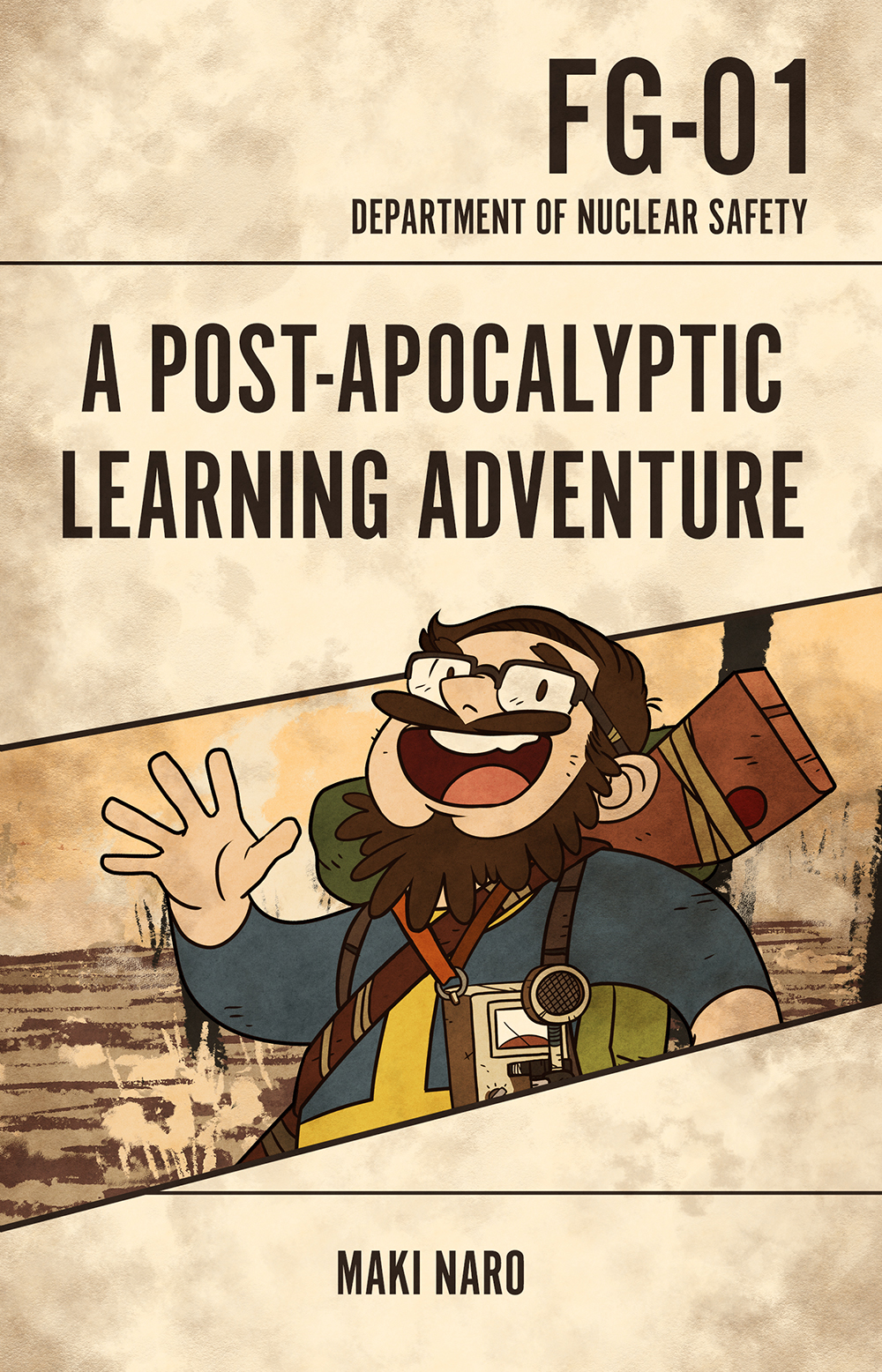
The cover of "A Post-Apocalyptic Learning Adventure" by Maki Naro. Made to look like a distressed, dirty military field manual, it features a bearded bespectacled man in a blue jumpsuit. He carries a geiger counter slung from a strap across his chest and waves at the viewer.
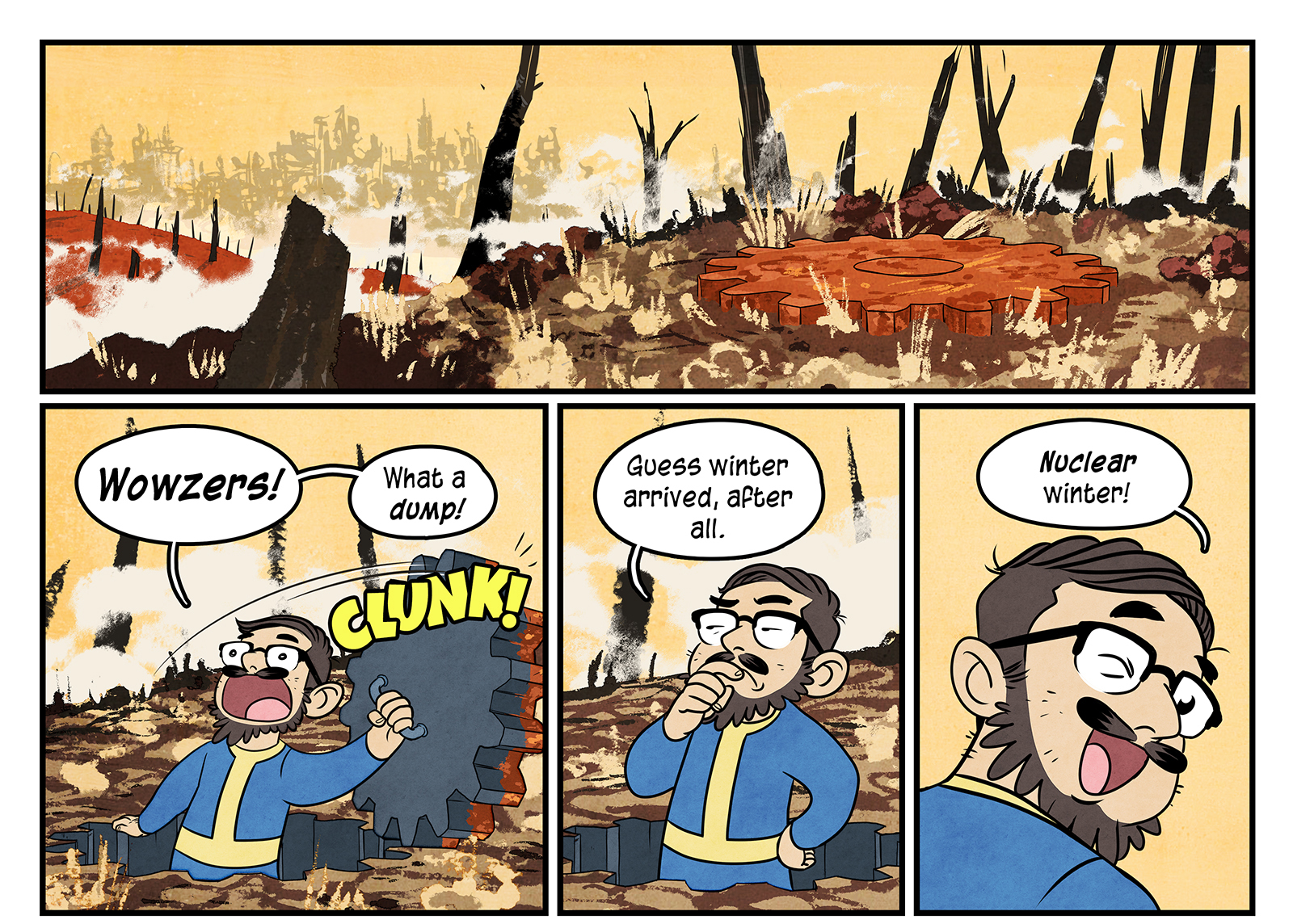
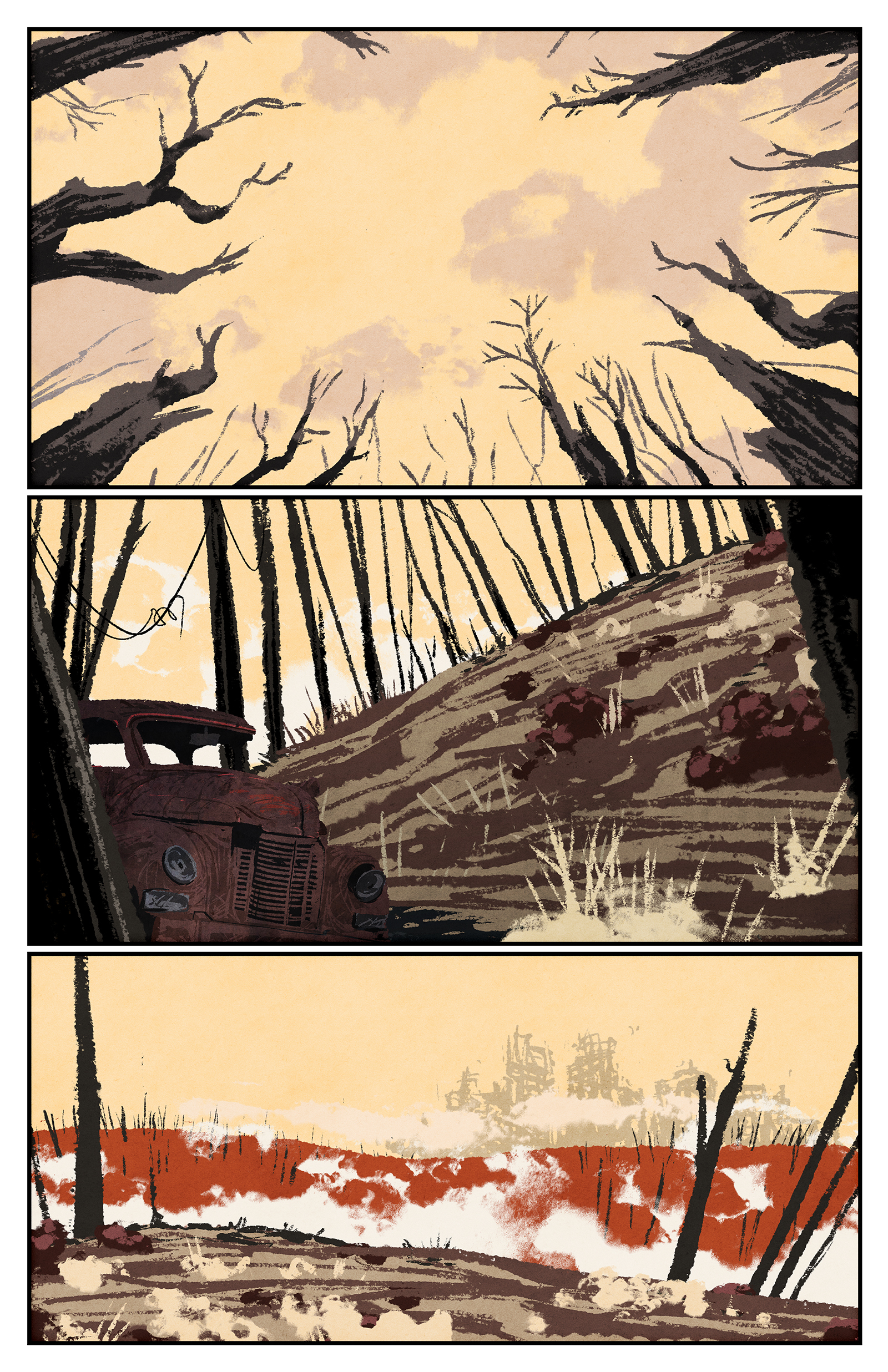
Three panels showing a scene from a dim, barren wasteland. The sky is a pale orange in color, and the bare earth is red like rust. Among the stripped trees are the wrecks of burnt out cars. Across an empty field behind wisps of smoke is the faded, ruined skeleton of a modern city.
The camera focus on a large rusty gear embedded in the ground. It springs open, and the author, Maki, pops out. Maki: WOWZERS! What a dump! Maki rubs his chin: Guess winter arrived after all. He turns and winks at the viewer: Nuclear Winter!
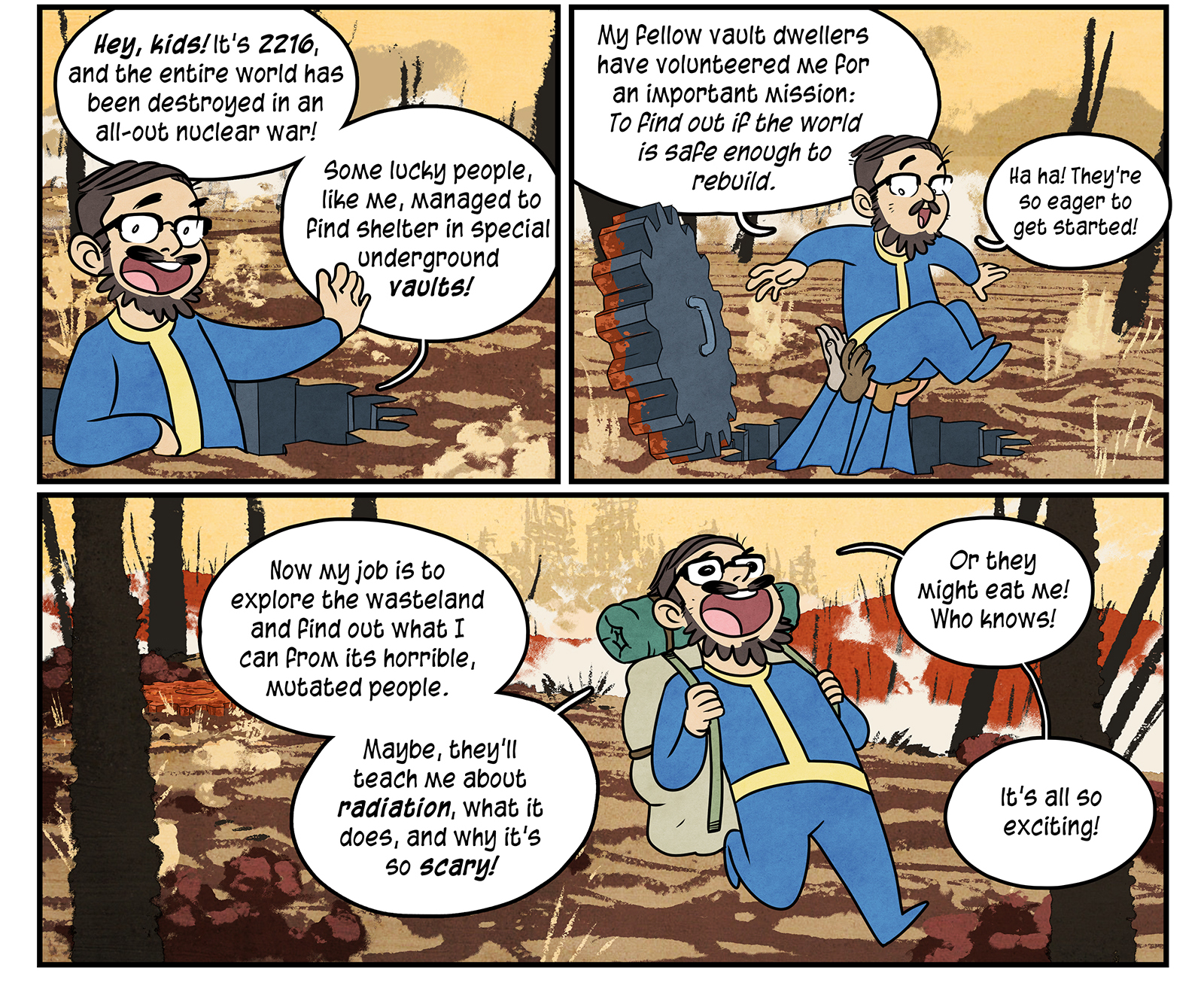
Maki: Hey, kids! lt’s 2216, and the entire world has been destroyed in an all-out nuclear war! Some lucky people, like me, managed to find shelter in special underground vaults! From underneath him, the hands of several people lift Maki from the bunker entrance: My fellow vault dwellers have volunteered me for an important mission: To find out if the world is safe enough to rebuild. Ha ha! They’re so eager to get started! Packed up and good to go, Maki walks forward: Now my job is to explore the wasteland and find out what I can from its horrible, mutated people. Maybe, they’ll teach me about radiation, what it does, and why it’s so scary! Or they might eat me! Who knows! lt’s all so exciting!
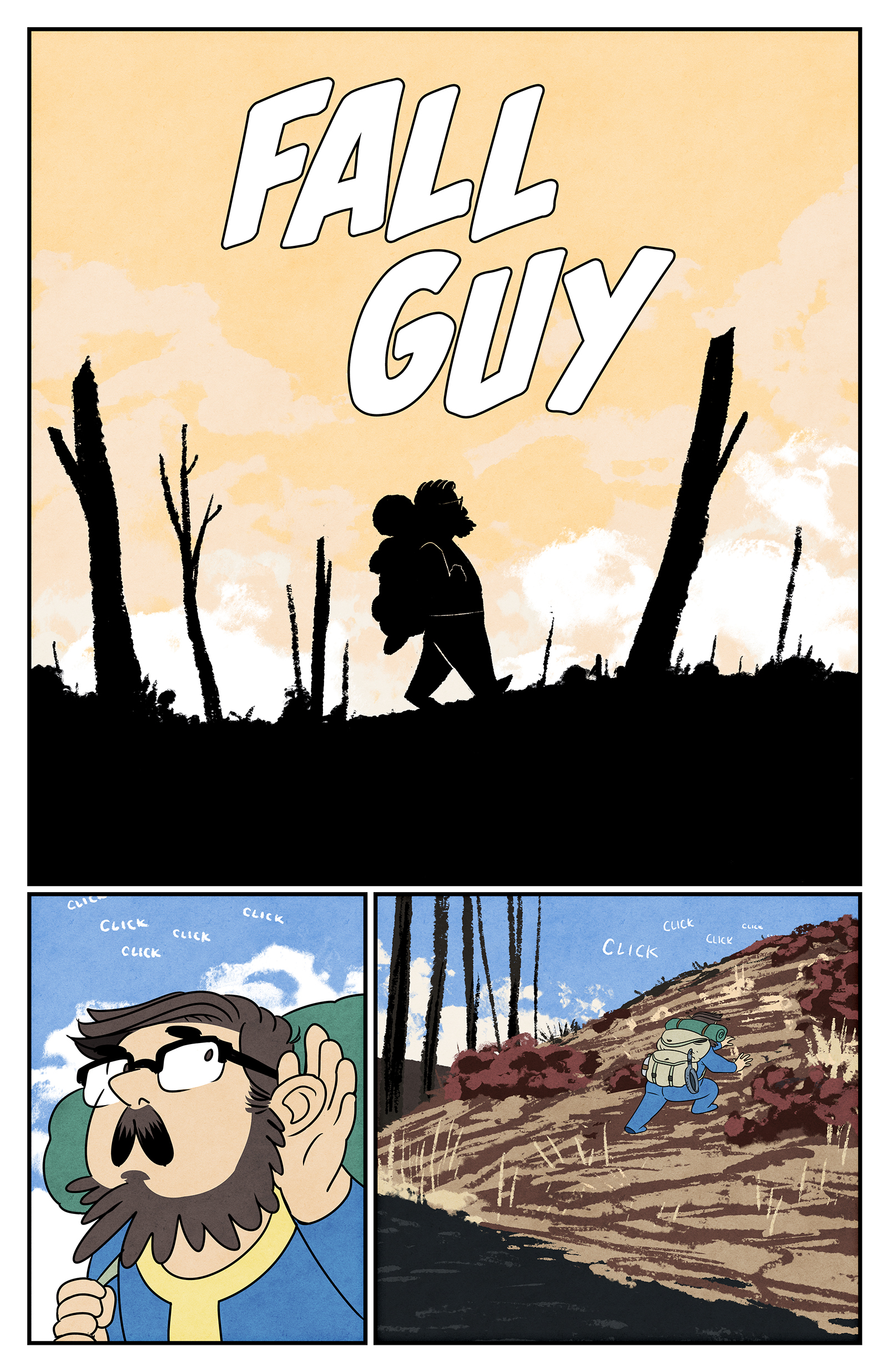
Maki seen in silhouette walking among the blasted trees against the vanilla sky. The title in large text hangs above him: Fall Guy. He puts a hand to his ear, hearing some faint clicking sound. He climbs up the side of a hill to follow it.
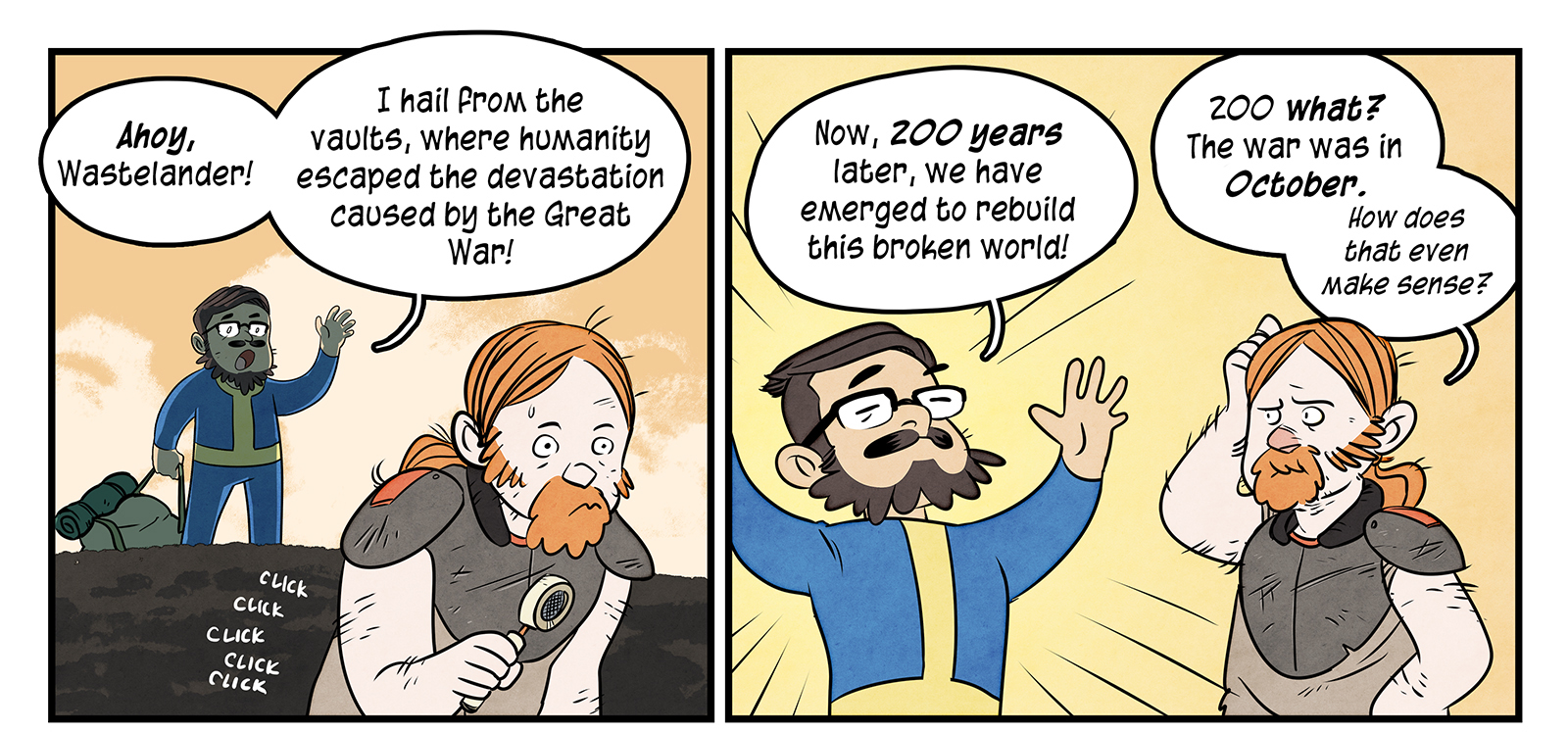
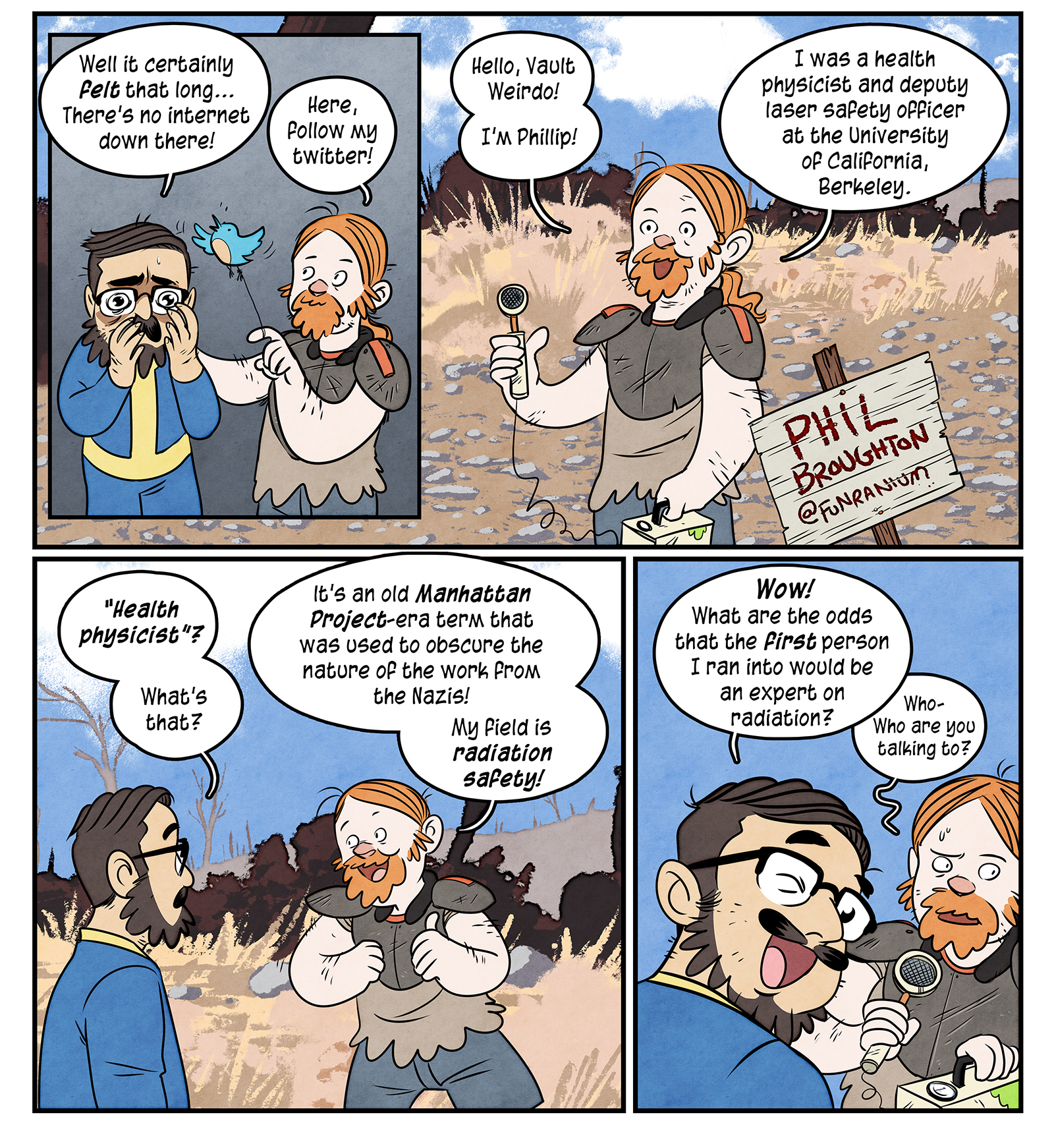
He finds Phil, a white man with long red hair tied in a ponytail and a bushy goatee and sideburns. Phil is holding the source of the clicking: A Geiger counter. Maki: Ahoy wastelander! I hail from the vaults, where humanity escaped the devastation caused by the Great War! Beaming, he says: Now, 200 years later, we have emerged to rebuild this broken world! Phil, confused: 200 what? The war was in October. How does that even make sense?
Maki, a harrowed look on his face: Well it certainly felt that long...There’s no internet down there! Reassuring him and offering a bluebird on a string, Phil says: Here, follow my twitter! Phil: Hello Vault Weirdo. I'm Phillip! I was a health physicist and deputy laser safety officer at the University of California, Berkeley. Maki, a harrowed look on his face: Well it certainly felt that long...There’s no internet down there! Reassuring him and offering a bluebird on a string, Phil says: Here, follow my twitter! Phil: Hello Vault Weirdo. I'm Phillip! I was a health physicist and deputy laser safety officer at the University of California, Berkeley. Maki: Health physicist? What's that? Phil, ribbing him with an elbow: It’s an old Manhattan Project-era term that was used to obscure the nature of the work from the Nazis! My field is radiation safety! Maki, turning to the viewer and winking: Wow! What are the odds the first person I ran into would be an expert on radiation? Phil, looking around nervously: Who- who are you talking to?
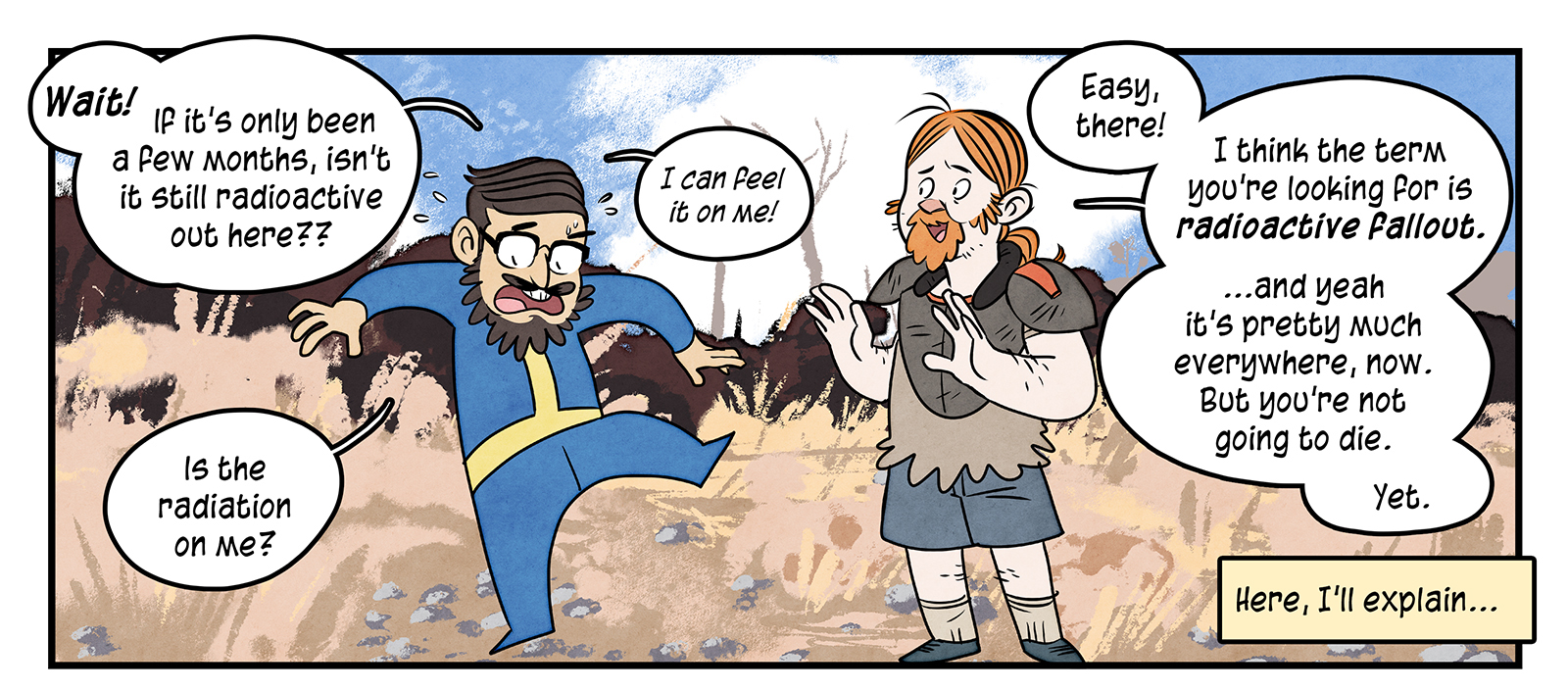
Maki, looking at himself in fear: Wait! If it’s only been a few months, isn’t it still radioactive out here?? Is the radiation on me? I can feel it on me! Phil, reassuring: Easy there! I think the term you’re looking for is radioactive fallout. And yeah it’s pretty much everywhere, now. But you’re not going to die. Yet. Let me explain.
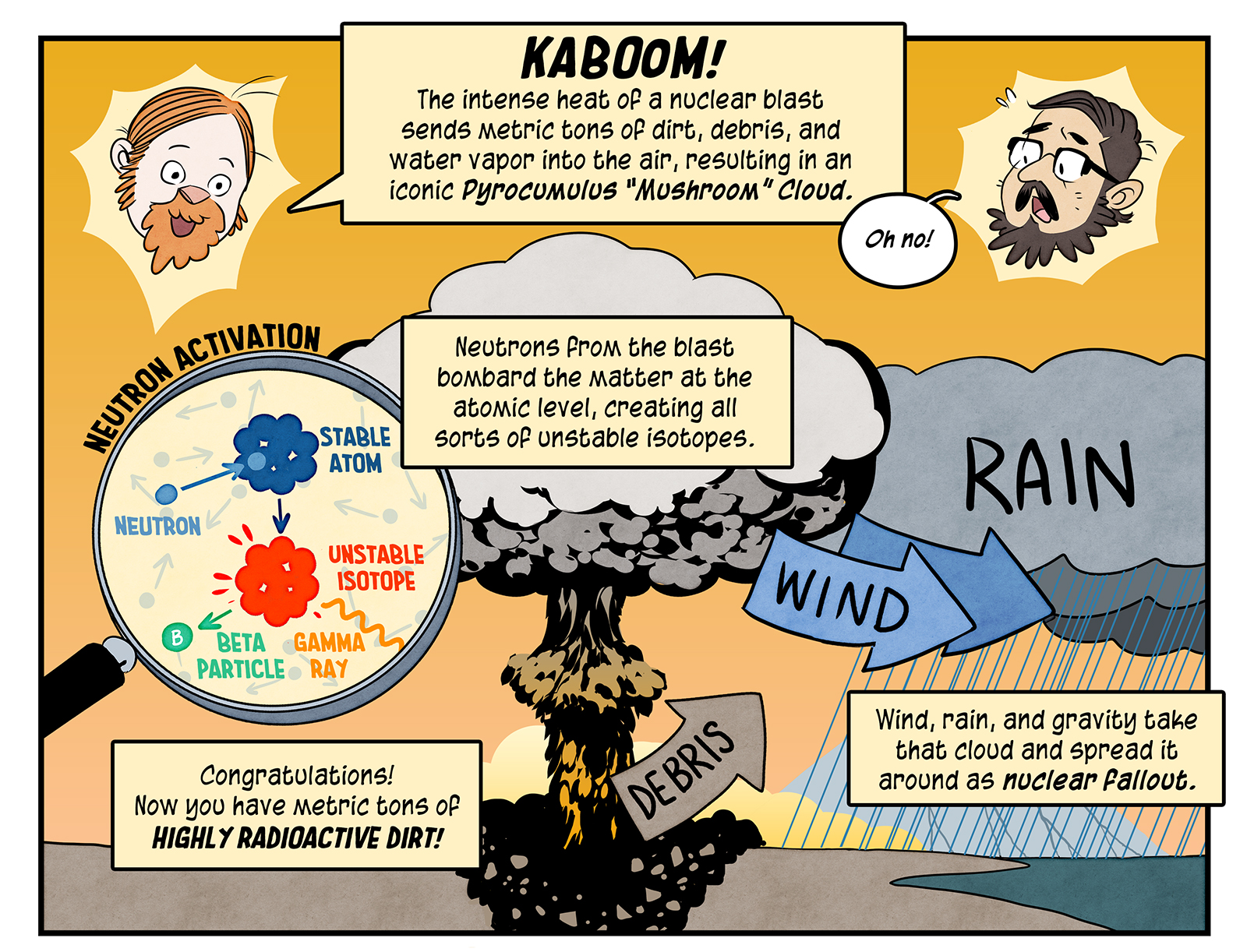
Phil: KABOOM! The intense heat of a nuclear blast sends metric tons of dirt, debris, and water vapor into the air, resulting in an iconic Pyrocumulus “Mushroom” Cloud. Neutrons from the blast bombard the matter at the atomic level, creating all sorts of unstable isotopes. Congratulations! Now you have metric tons of HIGHLY RADIOACTIVE DIRT! Wind, rain, and gravity take that cloud and spread it around as nuclear fallout.
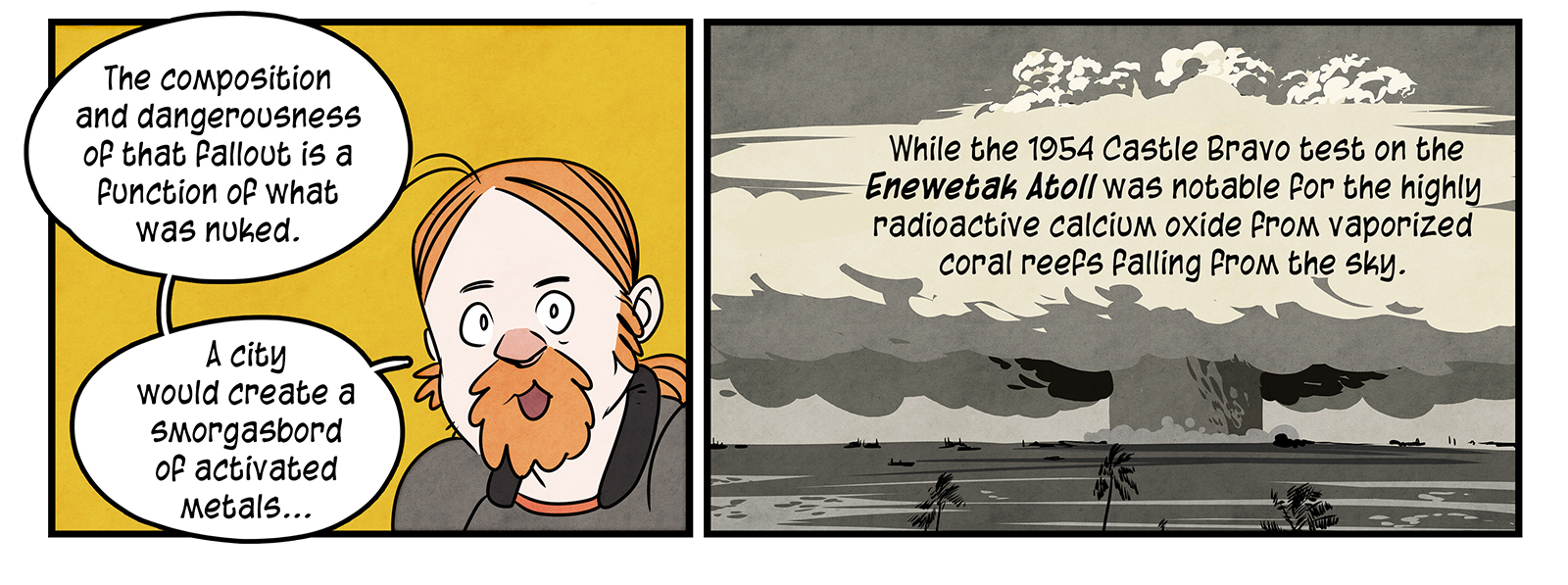
Phil: The composition and dangerousness of that fallout is a function of what was nuked. A city would create a smorgasbord of activated metals. A black and white image of a large flat mushroom cloud dwarfing some palm trees in the foreground. Caption: While the 1954 Castle Bravo test on the Enewetak Atoll was notable for the highly radioactive calcium oxide from vaporized coral reefs falling from the sky.
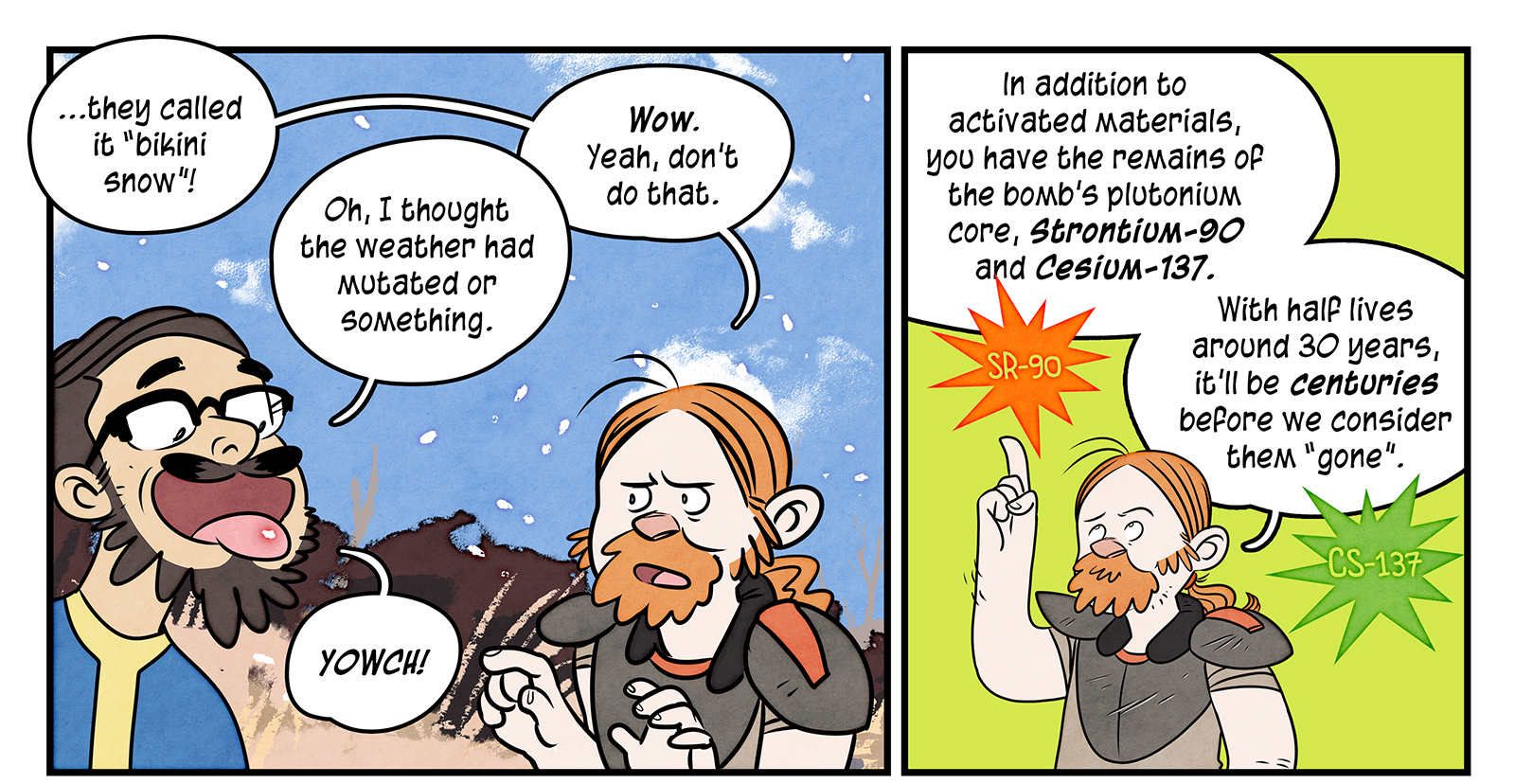
Maki is sticking his tongue out, a white flake lands on it with a painful looking red halo. Phil: They called it "bikini snow!" Maki: Oh, I thought the weather had mutated or something. YOWCH! Phil cannot believe what he is seeing: Wow. Yeah, don't do that. Phil: ln addition to activated materials, you have the remains of the bomb’s plutonium core, Strontium-90 and Cesium-137. With half lives around 30 years, it’ll be centuries before we consider them “gone”.
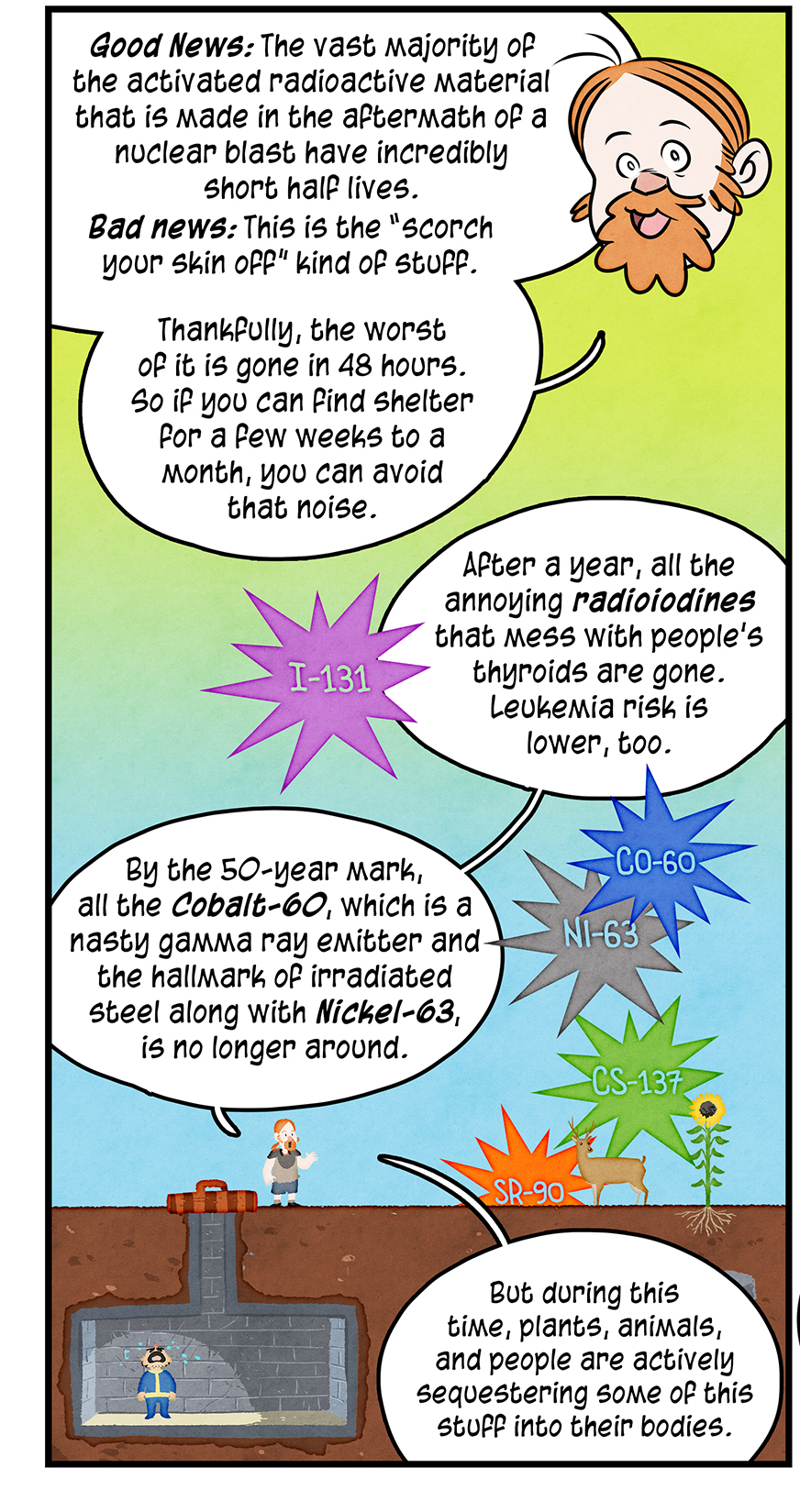
A tiny Phil stands next to a sunflower and a deer as he narrates the scene of variously labeled isotopes falling from the sky. Underneath him is Maki crying in a bunker. Phil: Good News: The vast majority of the activated radioactive material that is made in the aftermath of a nuclear blast have incredibly short half lives. Bad news: This is the “scorch your skin off” kind of stuff. Thankfully, the worst of it is gone in 48 hours. So if you can find shelter for a few weeks to a month, you can avoid that noise. Phil continues: After a year, all the annoying radioiodines that mess with people's thyroids are gone. Leukemia risk is lower, too. By the 50-year mark, all the Cobalt-60, which is a nasty gamma ray emitter and the hallmark of irradiated steel along with Nickel-63, is no longer around. But during this time, plants, animals, and people are actively sequestering some of this stuff into their bodies.
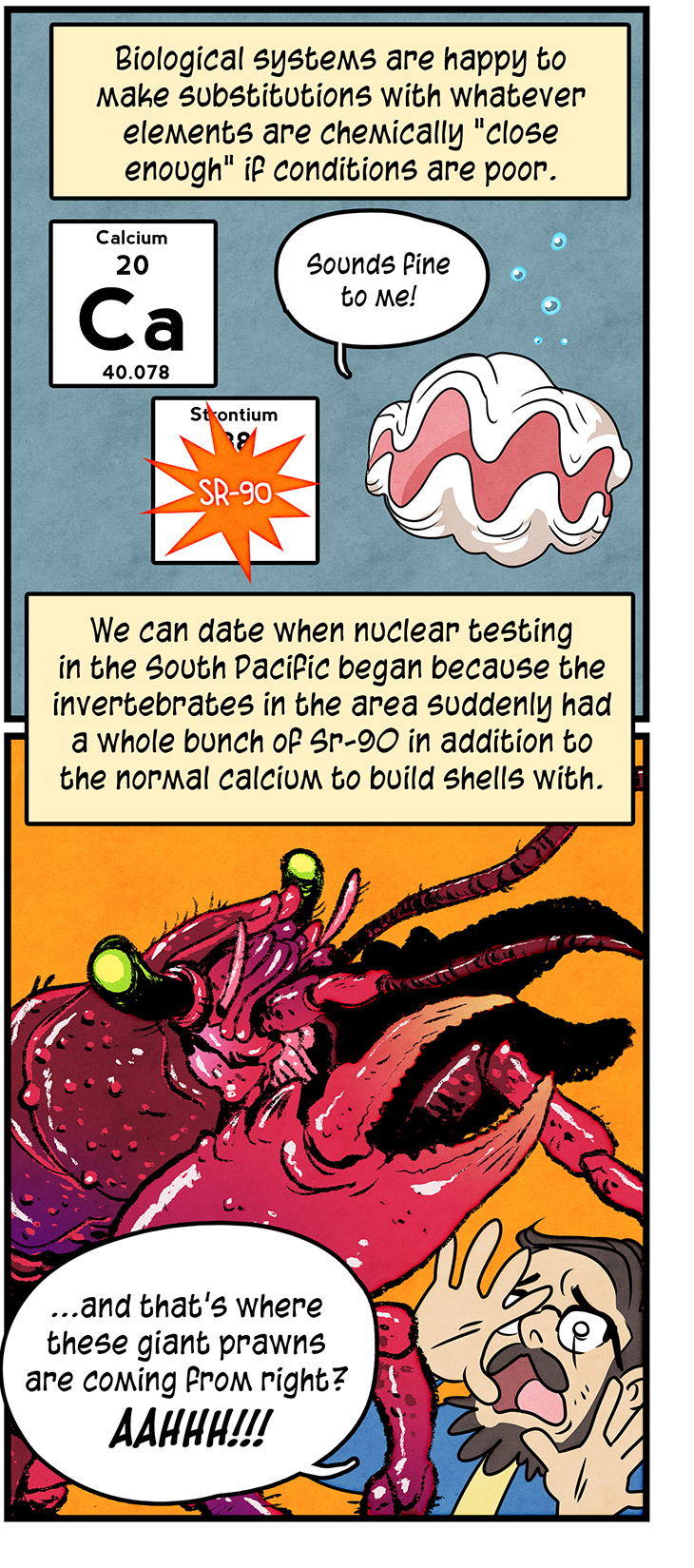
A large clam substitutes calcium for Strontium-90. Phil: Biological systems are happy to make substitutions with whatever elements are chemically "close enough" if conditions are poor. Clam: Seems fine to me! Phil: We can date when nuclear testing in the South Pacific began because the invertebrates in the area suddenly had a whole bunch of Sr-90 in addition to the normal calcium to build shells with. A giant red crayfish bursts into the scene, seemingly attacking Maki: And that’s where these giant prawns are coming from right? AAHHH!!!
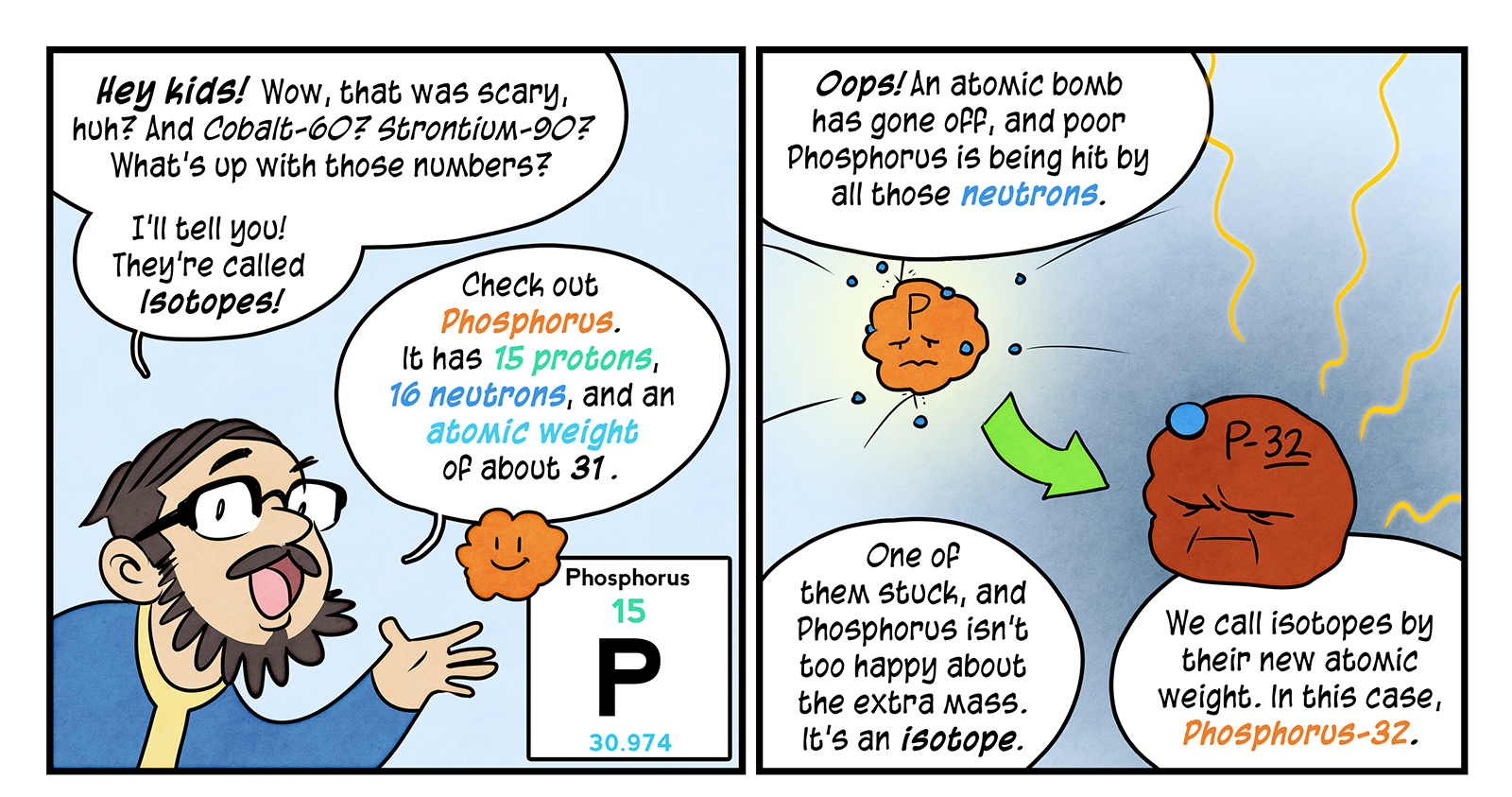
In an interlude, Maki explains the concept of isotopes. Maki: Hey kids! Wow, that was scary, huh? And Cobalt-60? Strontium-90? What’s up with those numbers? I’ll tell you! They’re called Isotopes! Gesturing towards a cute smiling blob in front of a color coded periodic table icon: Check out Phosphorus. It has 15 protons, 16 neutrons, and an atomic weight of about 31. Tiny blue marbles hit the blob: Oops! An atomic bomb has gone off, and poor Phosphorus is being hit by all those neutrons. One of them stuck, and Phosphorus isn’t too happy about the extra mass. It’s an isotope. The blob looks big and angry now: We call isotopes by their new atomic weight. ln this case, hosphorus-32.
A loose neutron flies towards an angry green Pu-239: Not all isotopes are formed by activation, though. Many are fission products. It splits into smaller blobs of Sr-90, Ba-140, I-131, and CS-137: When the Plutonium in that bomb underwent nuclear fission, it split into a whole slew of unstable isotopes. Maki: Isotopes try to return to a stable state by shedding extra energy. This is called radioactive decay, and the resulting emissions are what make up harmful radiation. Thorium emits alpha particles, which are helium atoms. Thorium, seen farting helium gas: No joke, this is where helium comes from. Maki: When lodine-131 decays, it doesn’t just go back to being regular Iodine. It sheds an electron (beta particle) and becomes Xenon, instead! Xenon: I'm ok with this.
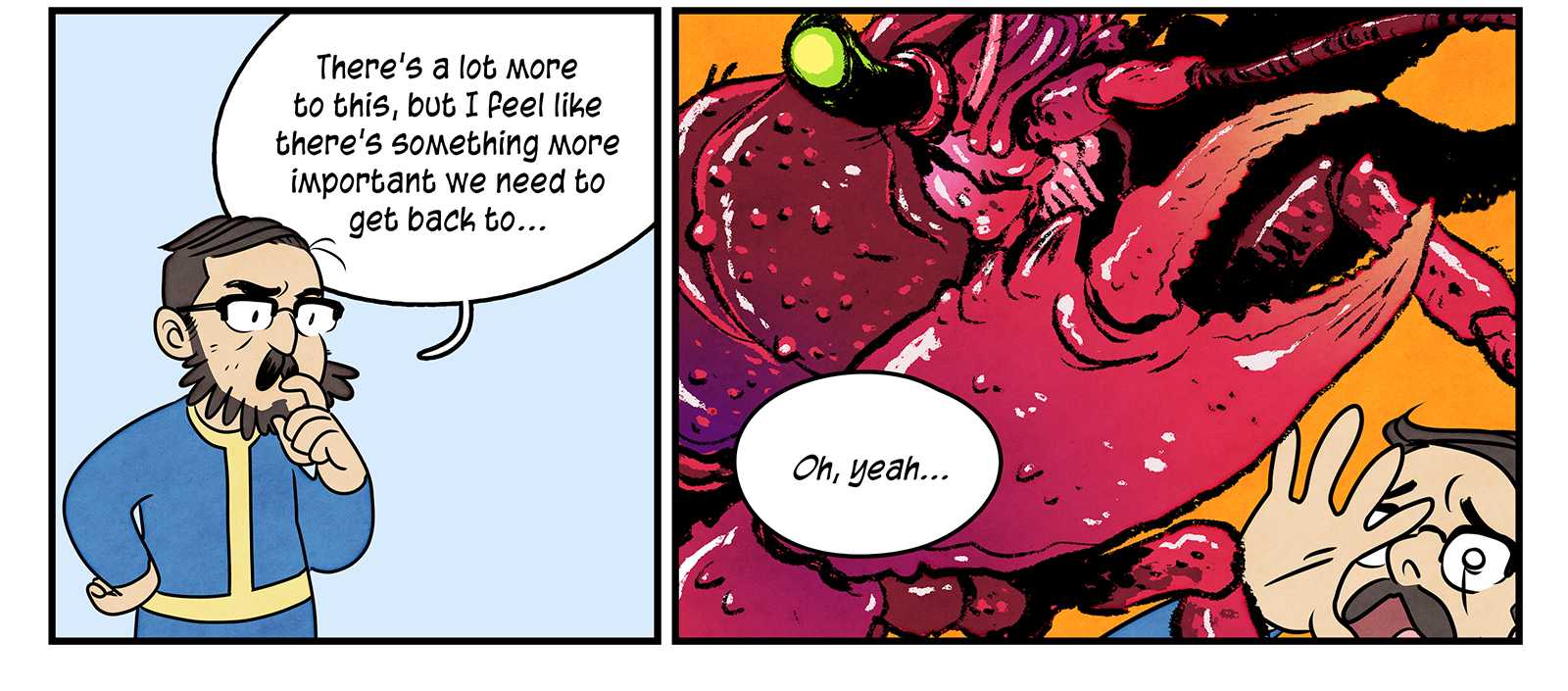
Maki, a finger to his mouth in thought: There’s a lot more to this, but I feel like there’s something more important we need to get back to something. The giant prawn bursts onto the scene: Oh yeah!
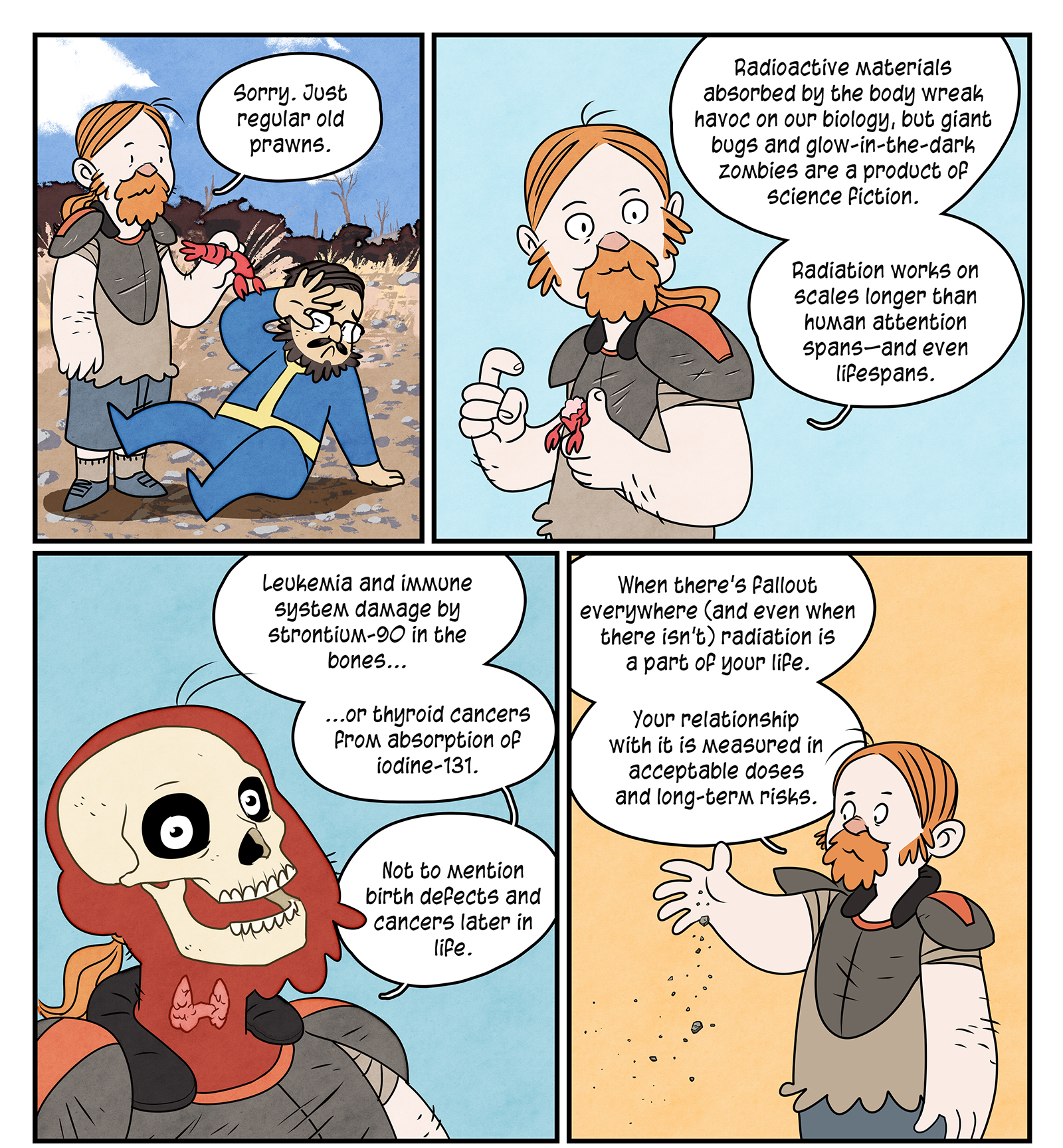
Maki cowers from Phil, who holding a small prawn: Sorry, just regular old prawns. Phil bites the prawn's head off: Radioactive materials absorbed by the body wreak havoc on our biology, but giant bugs and glow-in-the-dark zombies are a product of science fiction. Radiation works on scales longer than human attention spans—and even lifespans. Phil, seen in X-ray: Leukemia and immune system damage by strontium-90 in the bones or thyroid cancers from absorption of iodine-131. Not to mention birth defects and cancers later in life. Phil empties a handful of sand into the wind: When there’s fallout everywhere (and even when there isn’t) radiation is a part of your life. Your relationship with it is measured in acceptable doses and long-term risks.
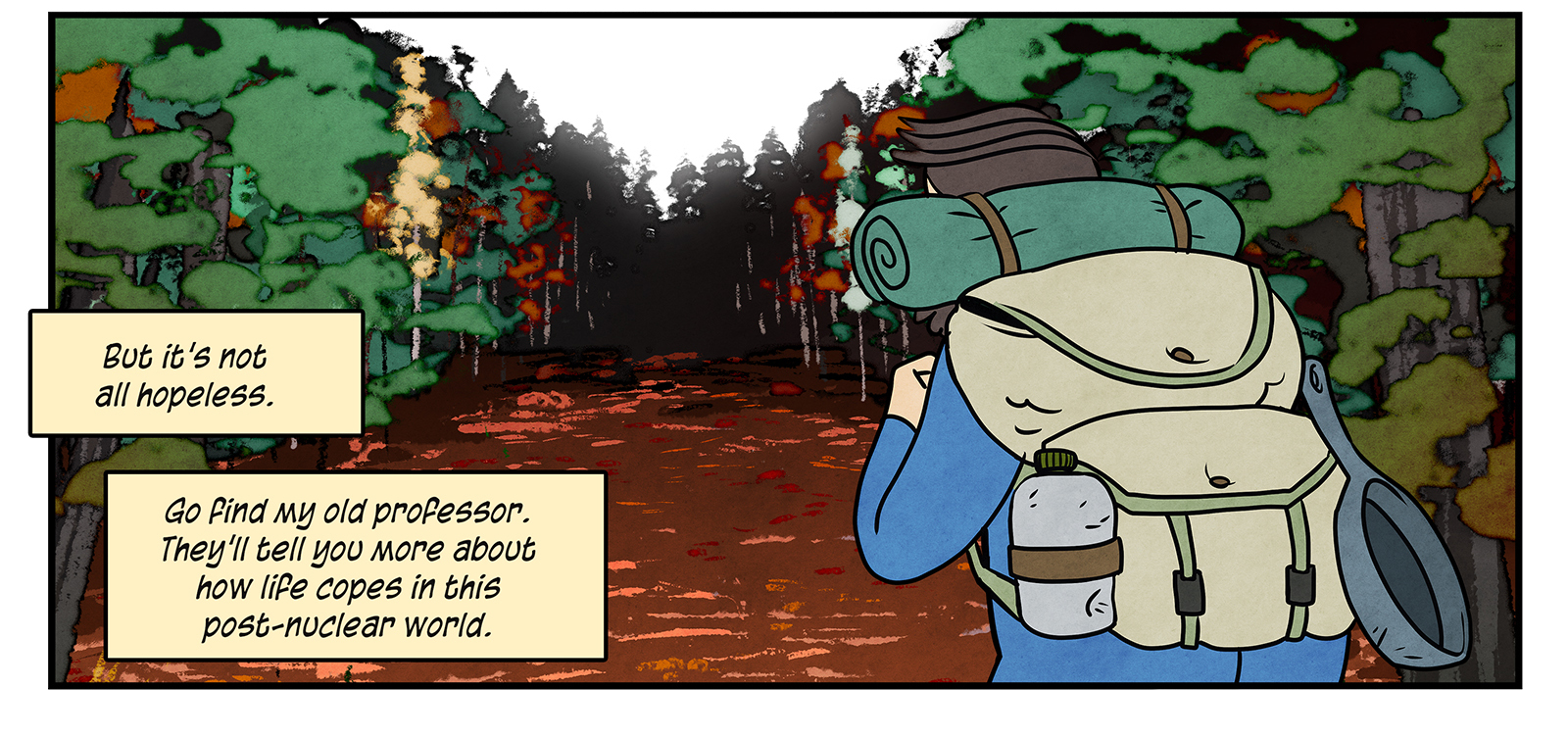
Maki, seen from behind walks down a heavily wooded path. The forest grows dark before him. Phil narrates: But it’s not all hopeless. Go find my old professor. They’ll tell you more about how life copes in this post-nuclear world.
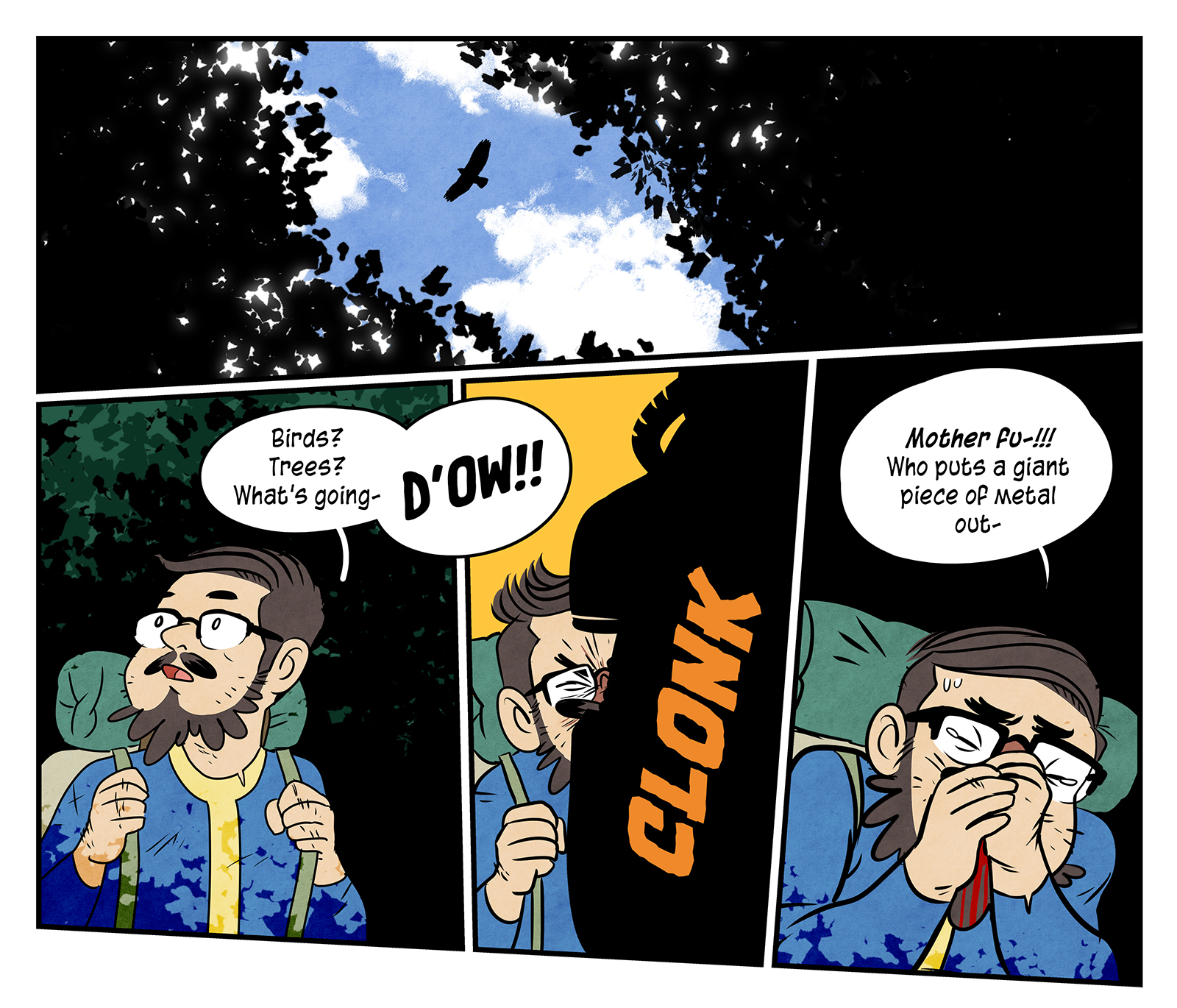
A worm's eye view of the forest canopy in silhouette against a bright blue partly cloudy sky. A bird flies overhead. Maki looks up: Birds? Trees? What's going- He walks into some large object with a CLONK sound. Grabbing his now bleeding nose: Mother fu-!!! Who puts a giant piece of metal out-
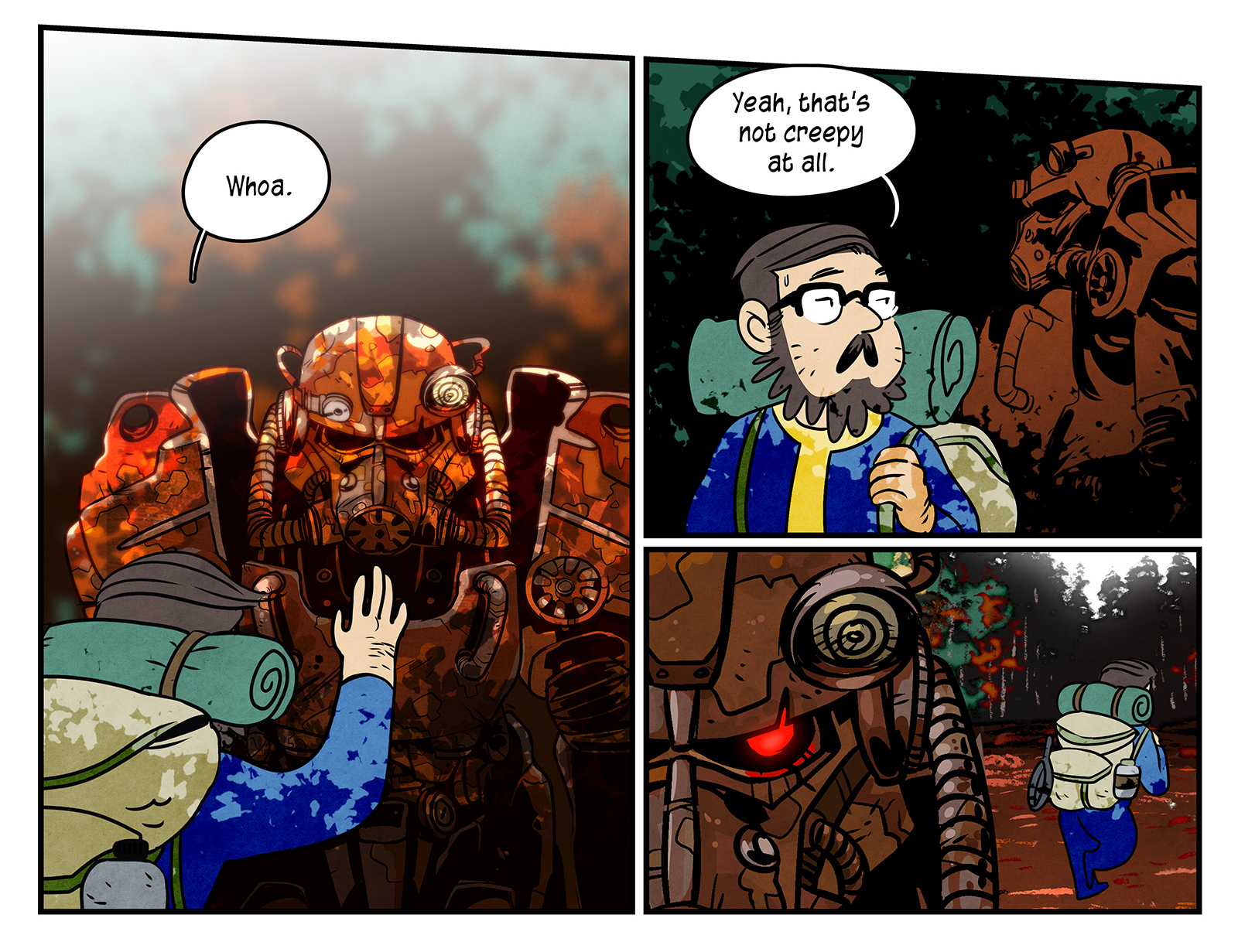
The mystery object is a large suit of powered armor, rusty and ancient. Maki: Whoa. He gives it a sidelong glance as he walks away: Yeah, that's not creepy at all. As Maki walks down the path, one eye on the armor lights up a menacing red color.
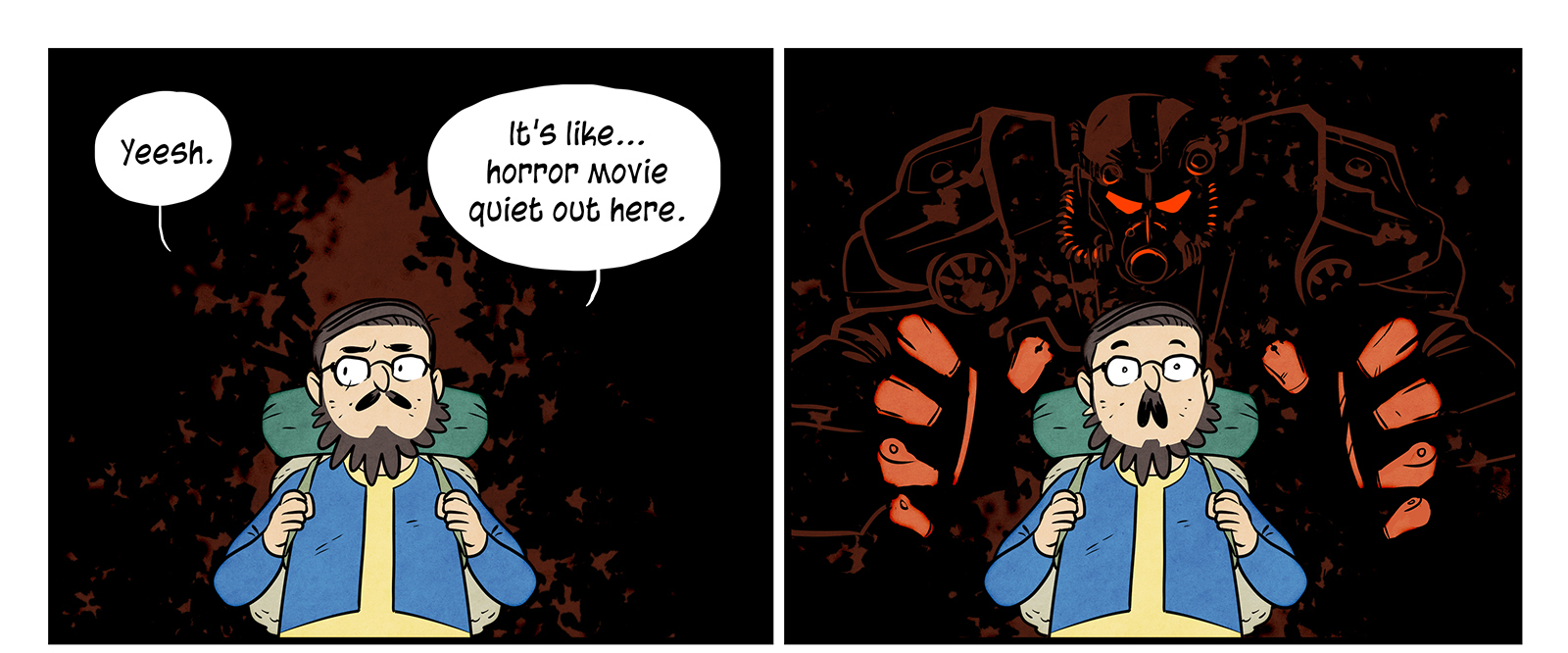
The scene is dark as Maki eyes his surroundings nervously. Maki: Yeesh. It's like horror movie quiet out here. He stops in slow realization as a rust colored shape behind him coalesces into the form of the power armor, its hands reaching out to grab him.
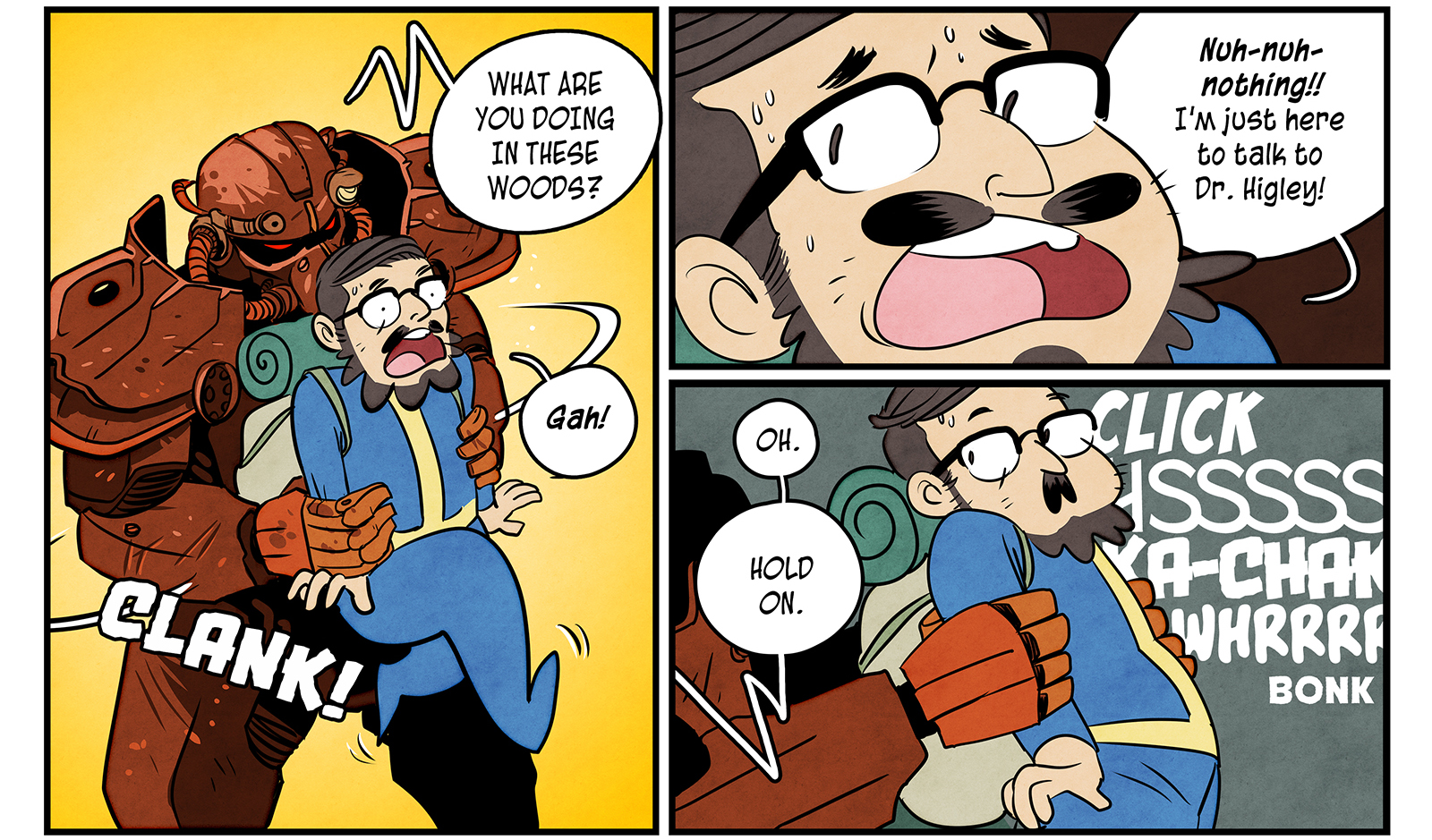
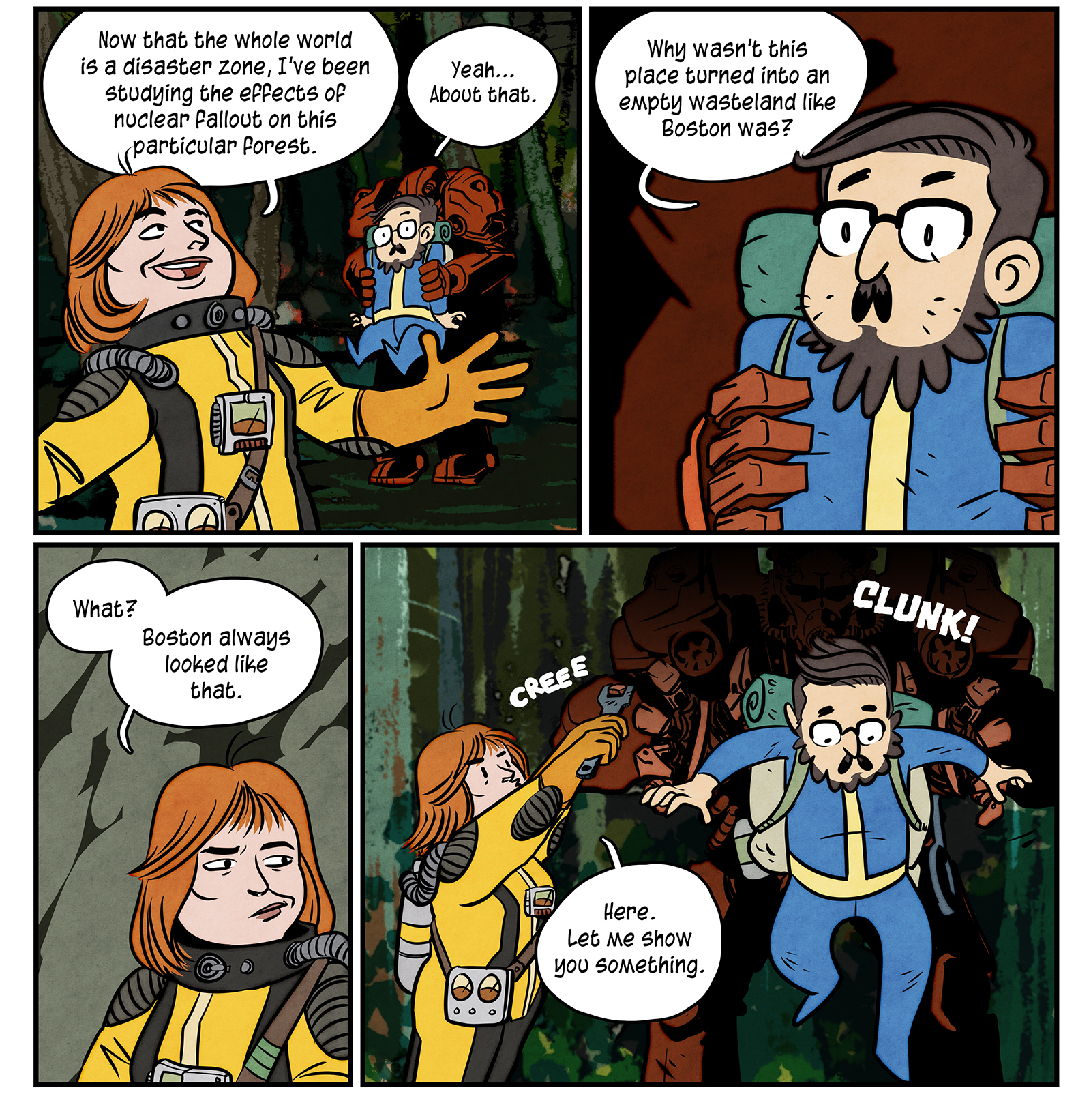
The armor takes hold, with a loud clank. It picks Maki up and barks: What are you doing in these woods? A close up of Maki: Nuh-nuh- nothing!! I’m just here to talk to Dr. Higley! Armor: Oh. Hold on. A series of clicks, hydraulic hisses, and whirring sounds emits from the armor.
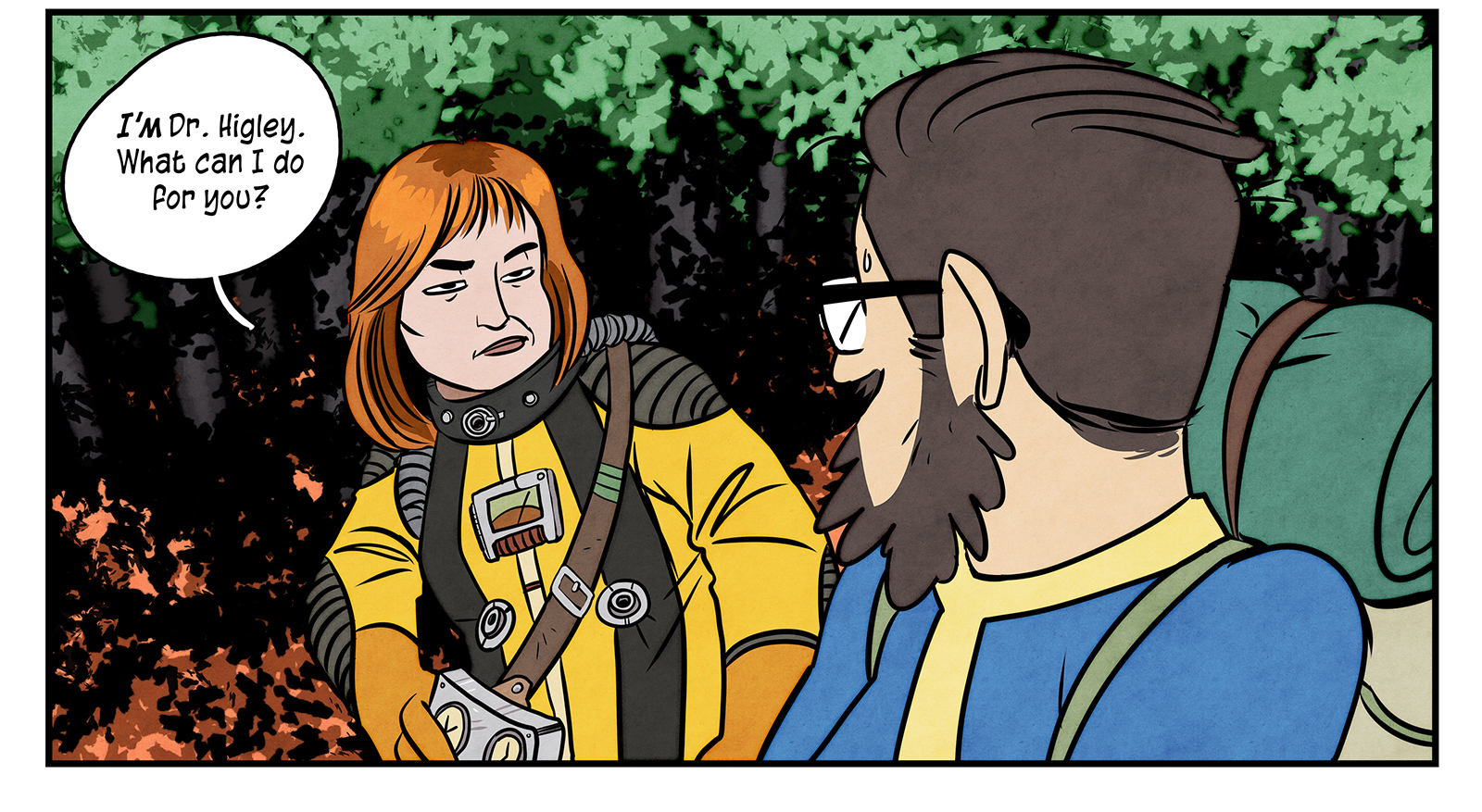
From the rear of the armor the pilot, a middle aged white woman with shoulder length red hair and bangs wearing a yellow radiation suit, appears. Kathryn: I'm Dr. Higley. What can I do for you?
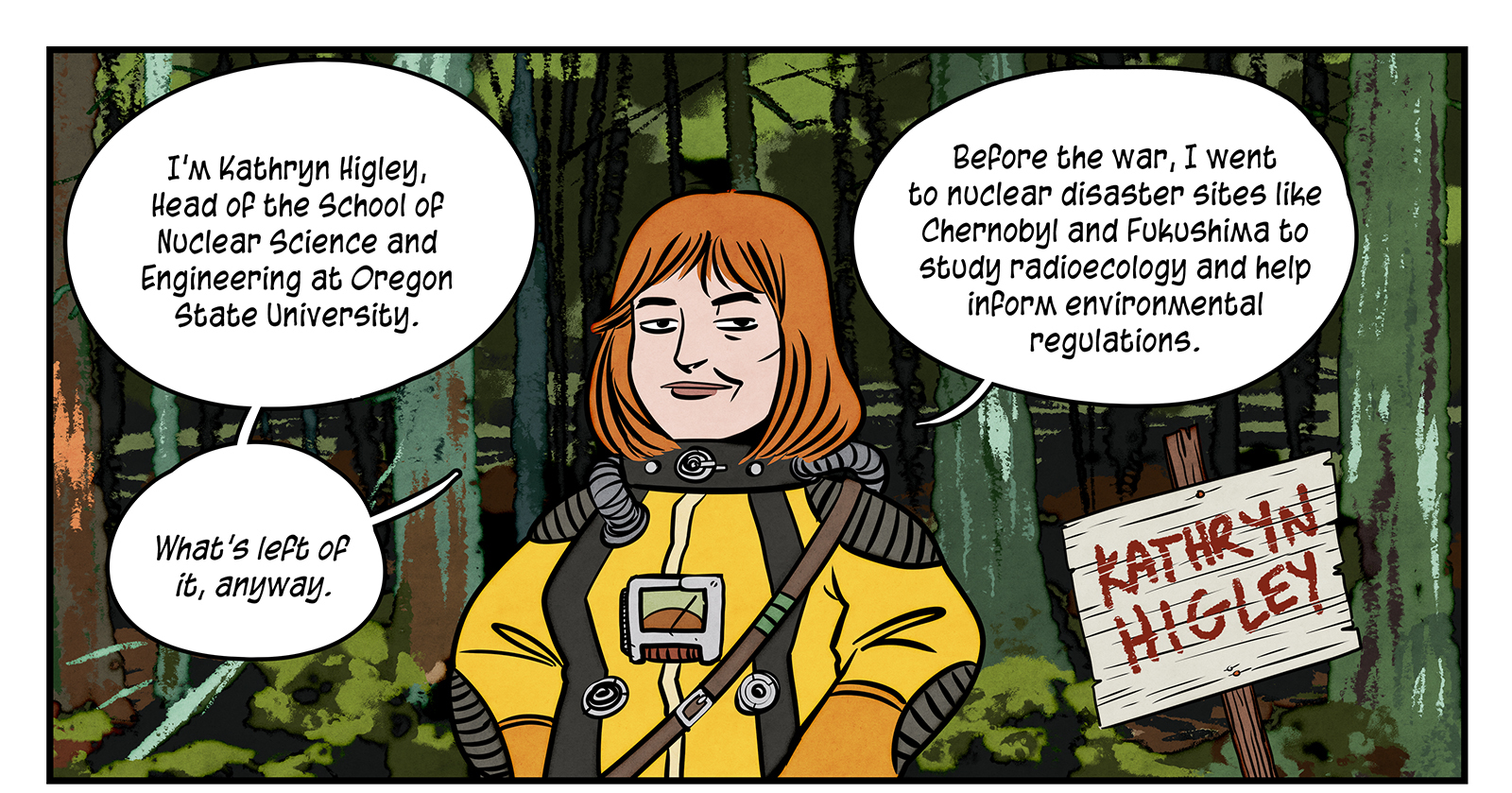
Dr Higley stands in the forest introducing herself: I’m Kathryn Higley, Head of the School of Nuclear Science and Engineering at Oregon State University. What's left of it anyway. Before the war, I went to nuclear disaster sites like Chernobyl and Fukushima to study radioecology and help inform environmental regulations.
Kathryn, looking around at the forest: Now that the whole world is a disaster zone, I’ve been studying the effects of nuclear fallout on this particular forest. Maki, still lifted off the ground by the armor: Yeah about that. Why wasn’t this place turned into an empty wasteland like Boston was? Kathryn: What? Boston always looked like that. She uses a wrench to open the armor's hands, allowing Maki to fall free: Here, let me show you something.
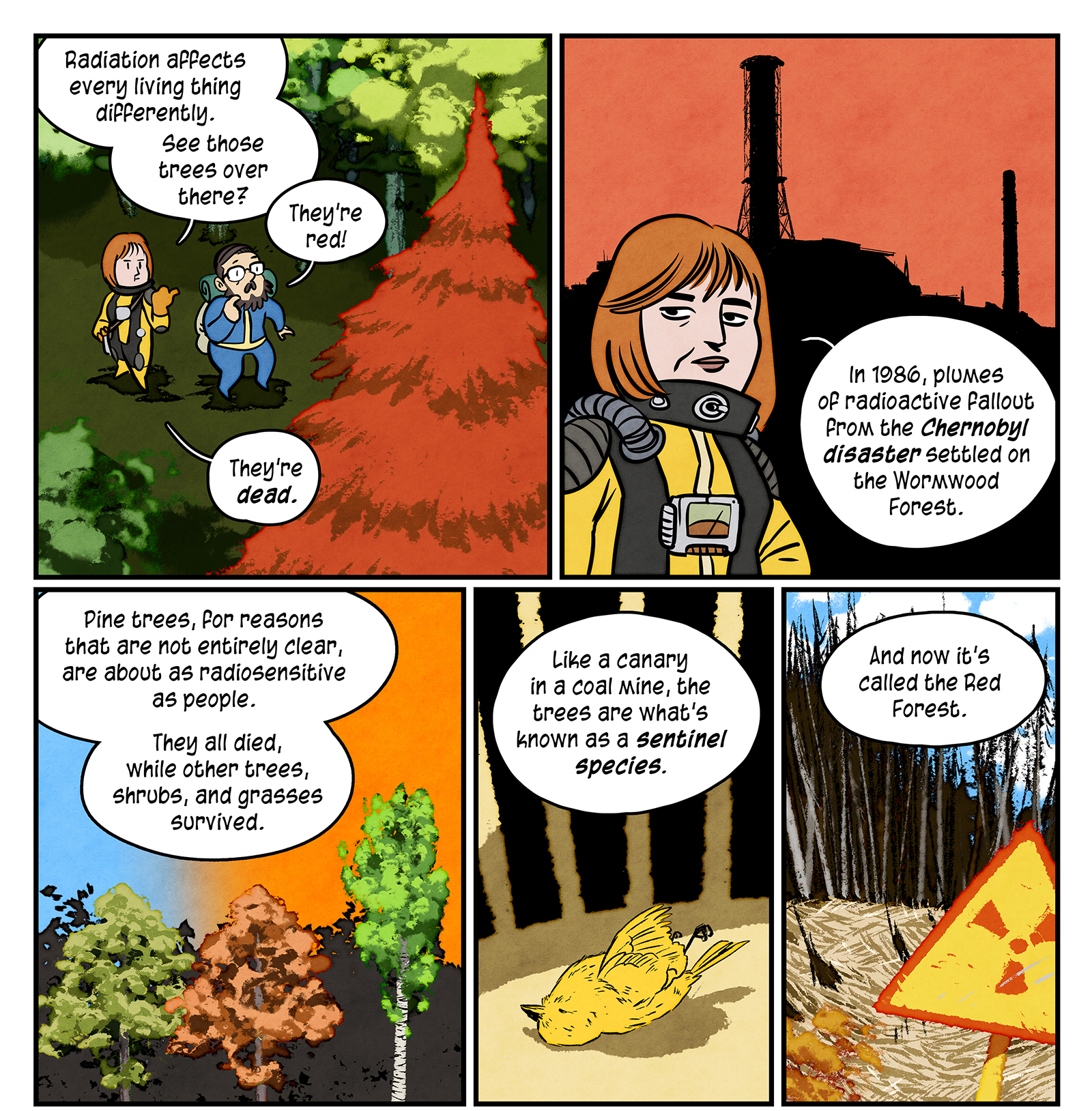
She points out a rust orange fir tree: Radiation affects every living thing differently. See those trees over there? Maki, in surprise: They're red! Kathryn: They're dead. Kathryn shown standing in front of the silhouette of the Chernobyl Nuclear Plant: ln 1986, plumes of radioactive fallout from the Chernobyl disaster settled on the Wormwood Forest. Pine trees, for reasons that are not entirely clear, are about as radiosensitive as people. They all died, while other trees, shrubs, and grasses survived. A dead canary in a cage: Like a canary in a coal mine, the trees are what’s known as a sentinel species. The dead Wormwood Forest is seen with an old radiation warning sign in the foreground: And now it’s called the Red Forest.
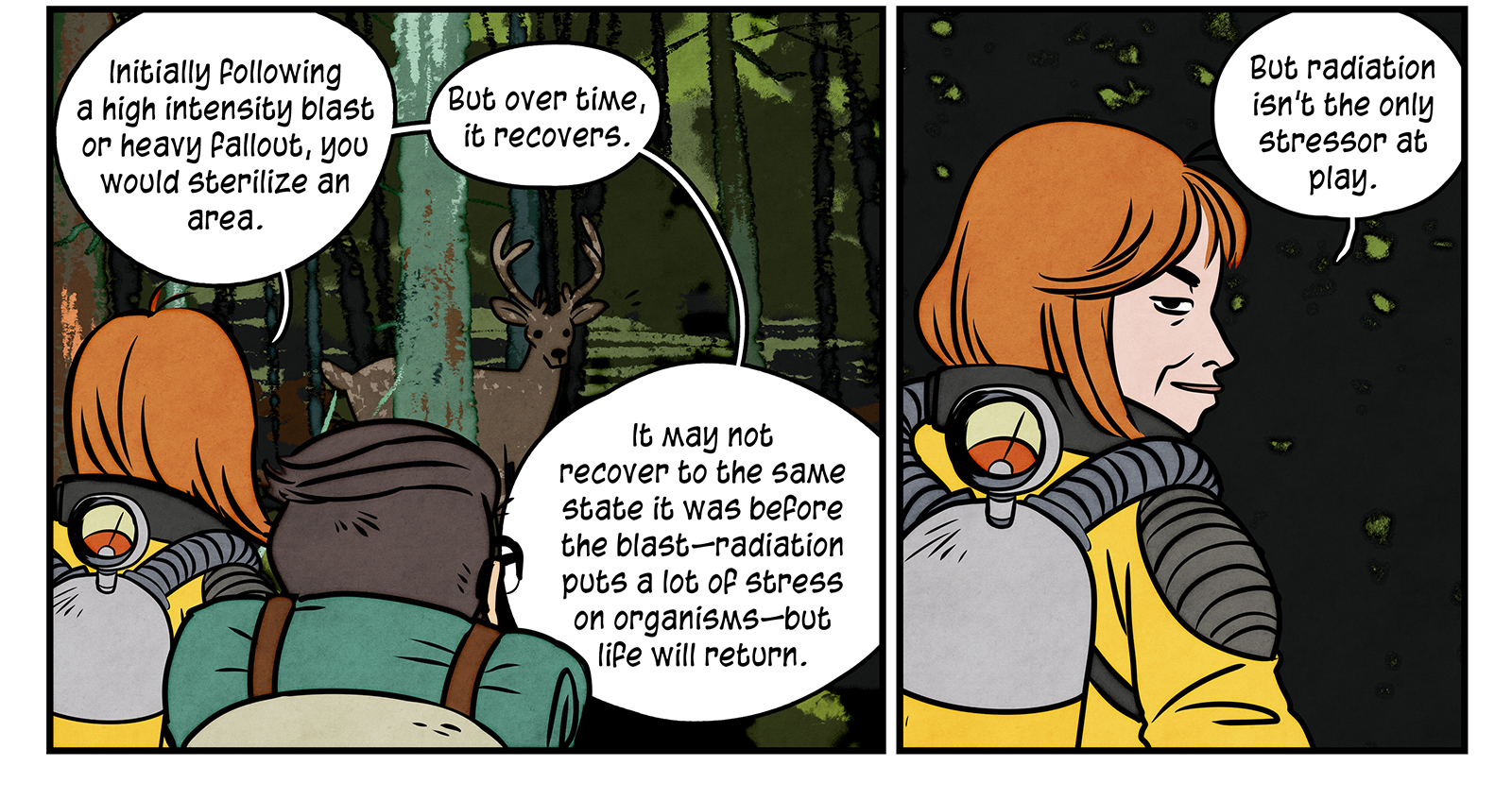
The two watch a deer walk through the woods nonchalantly. Kathryn: Initially following a high intensity blast or heavy fallout, you would sterilize an area. But over time, it recovers. It may not recover to the same state it was before the blast—radiation puts a lot of stress on organisms—but life will return. She turns to look at Maki: But radiation isn’t the only stressor at play.
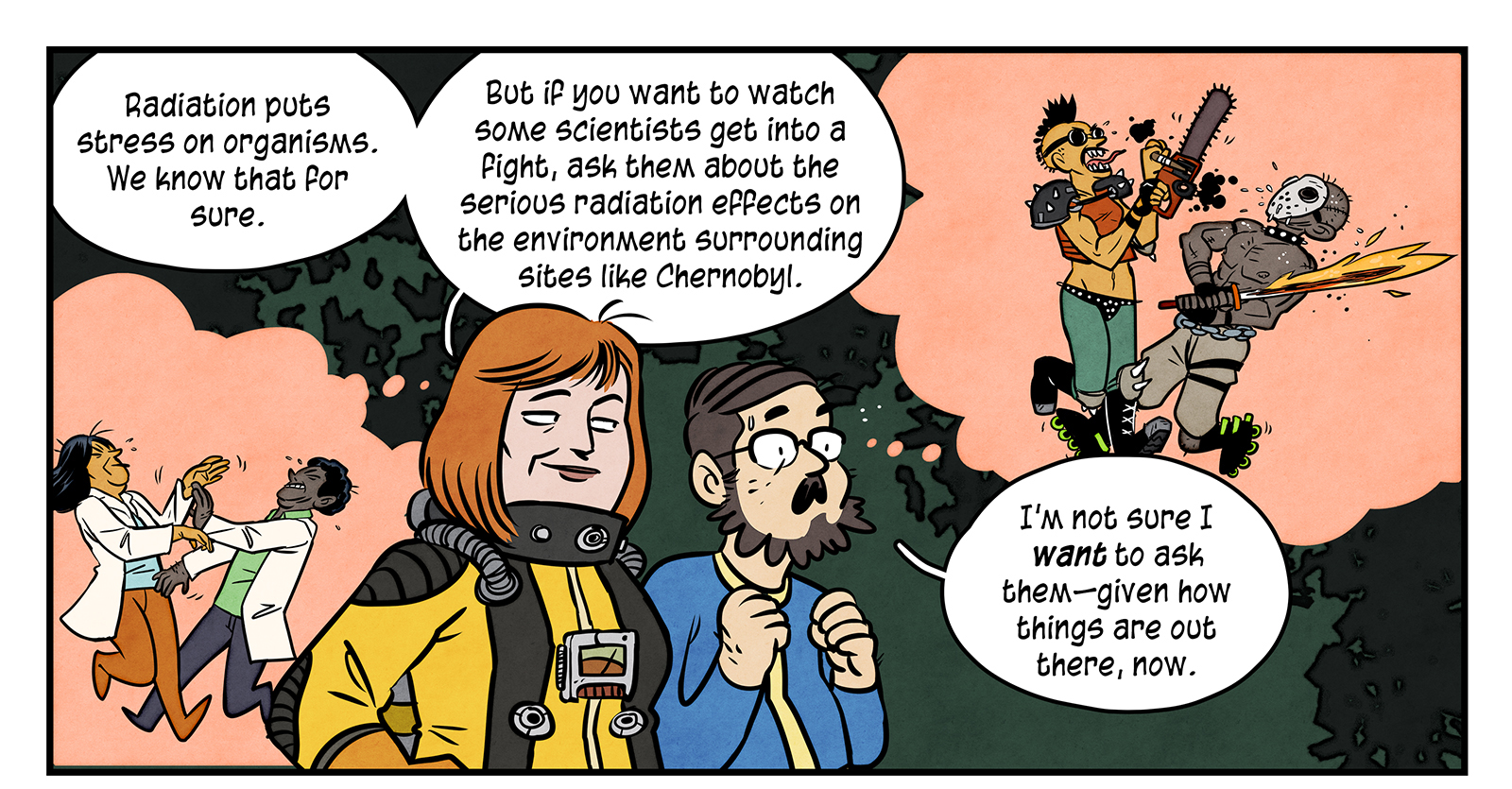
Kathryn and Maki continue through the forest. Behind her in a bubble, two scientists slap fight over some squabble. Kathryn: Radiation puts stress on organisms. We know that for sure. But if you want to watch some scientists get into a fight, ask them about the serious radiation effects on the environment surrounding sites like Chernobyl. Maki, nervously thinking about the same fighting scientists, only now they are wasteland warriors with spiky armor, chainsaws, and flaming swords: I’m not sure I want to ask them—given how things are out there, now.
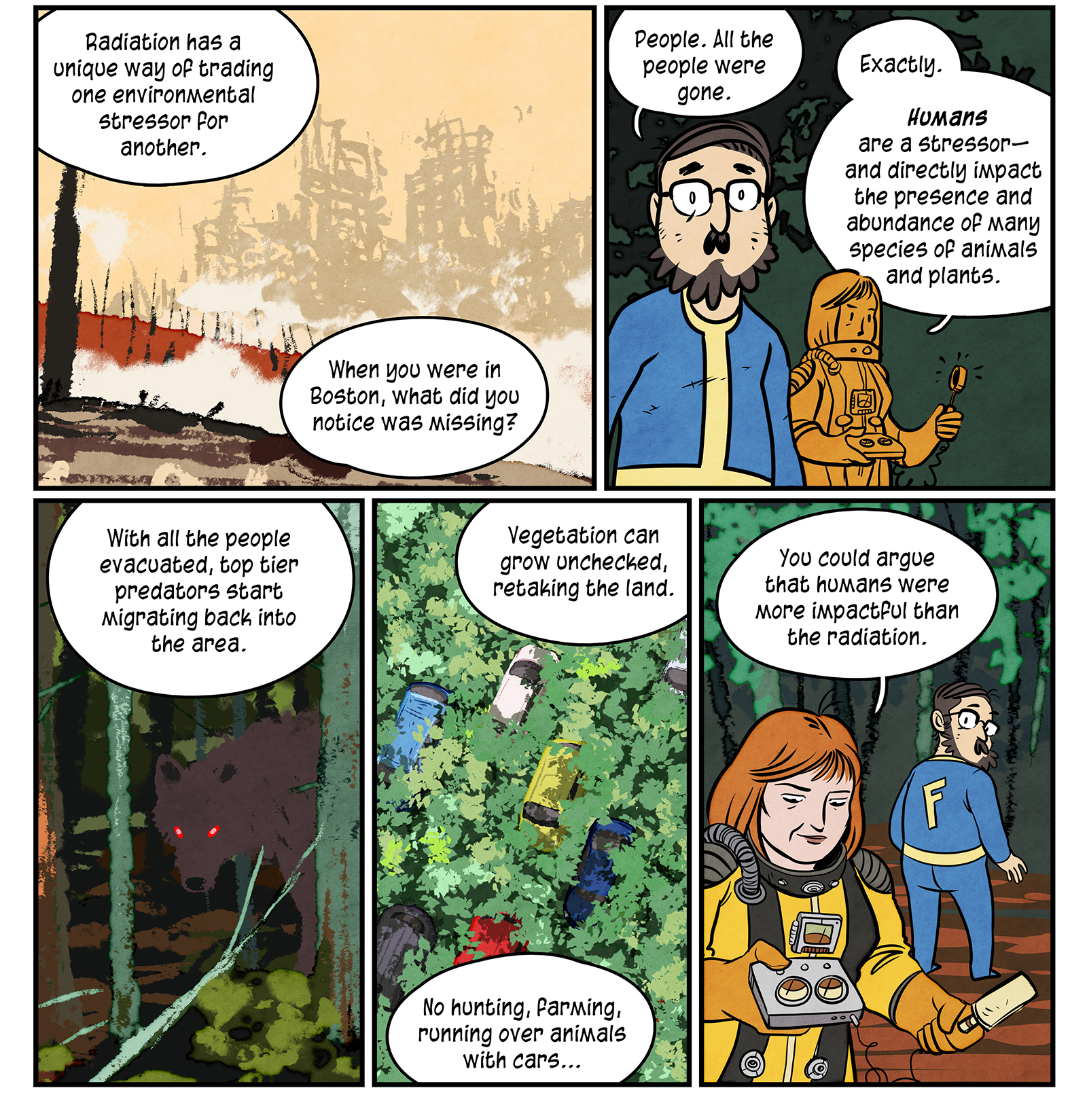
A scene from burnt out Boston with Kathryn's narration: Radiation has a unique way of trading one environmental stressor for another. When you were in Boston, what did you notice was missing? Maki thinks and realizes: People. All the people were gone. Kathryn: Exactly. Humans are a stressor— and directly impact the presence and abundance of many species of animals and plants. A wolf prowls in the forest as she continues: With all the people evacuated, top tier predators start migrating back into the area. A scene of a highway full of abandoned cars, now overgrown with lush greenery: Vegetation can grow unchecked, retaking the land. No hunting, farming, running over animals with cars. You could argue that humans were more impactful than the radiation.
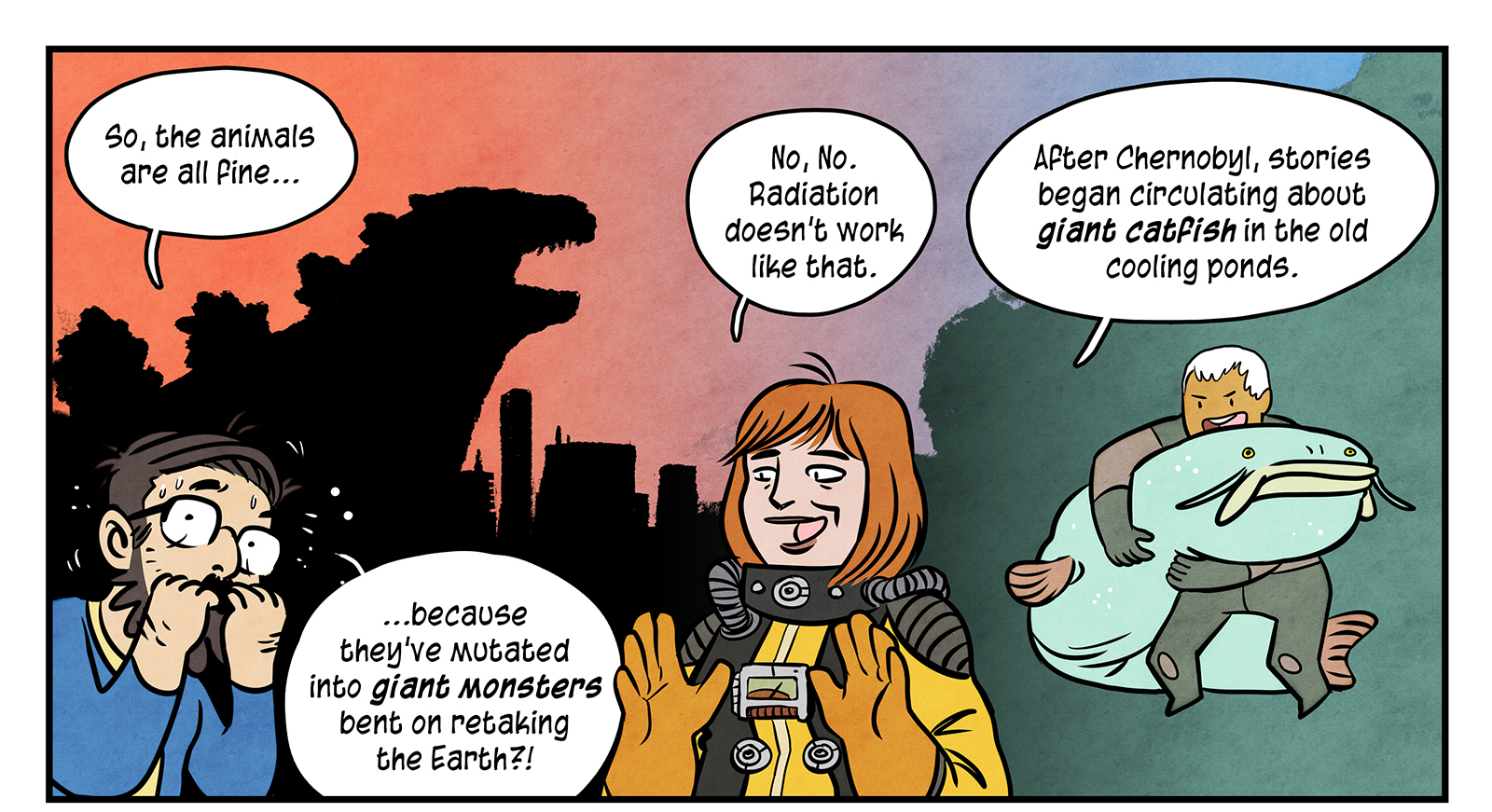
Maki with a silhouette of Godzilla behind him: So, the animals are all fine because they’ve mutated into giant monsters bent on retaking the Earth?! Kathryn, holding her hands up: No, no. Radiation doesn't work like that. Behind her, a scene of a man holding an enormous catfish: After Chernobyl, stories began circulating about giant catfish in the old cooling ponds.
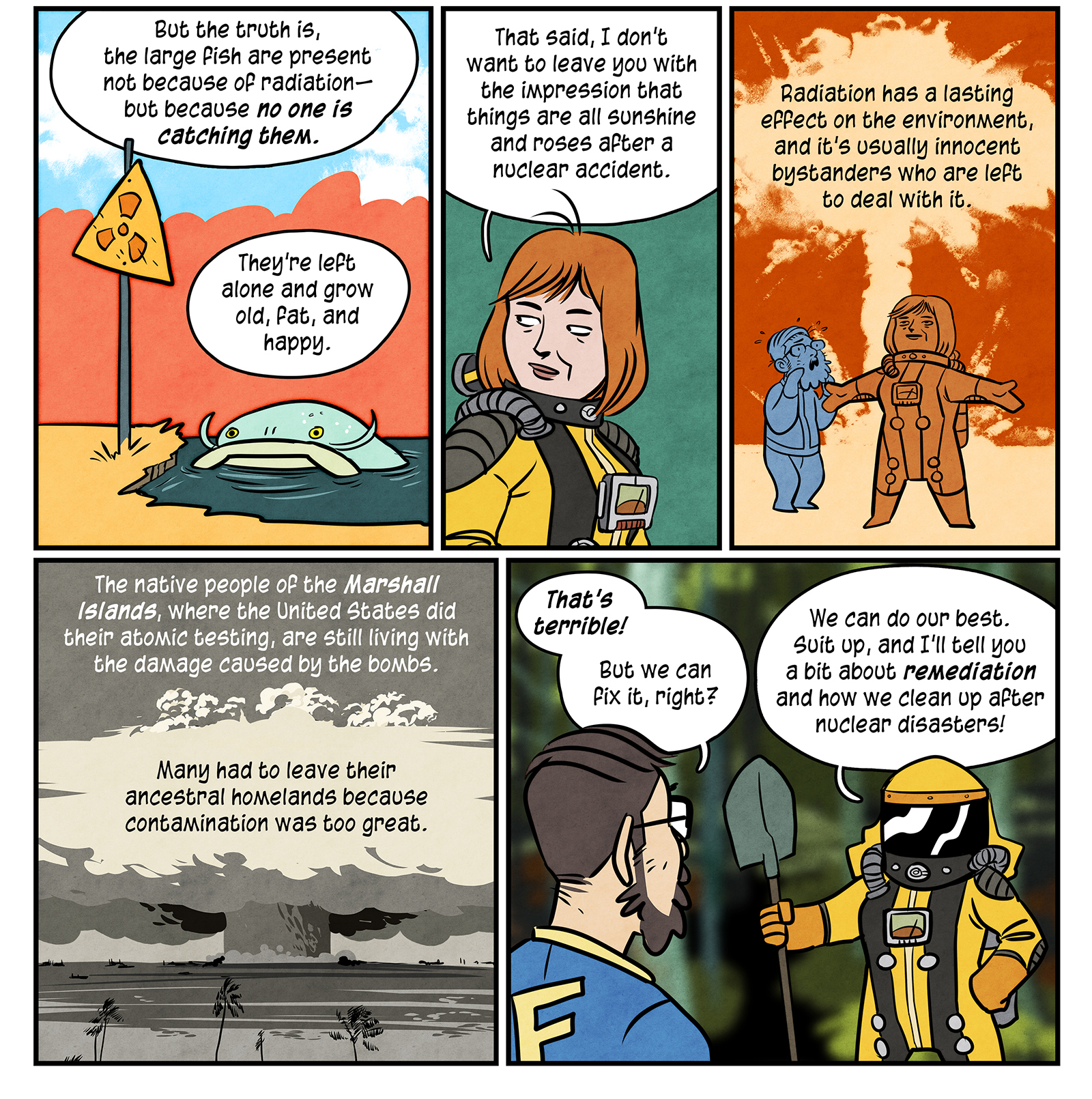
The catfish, in a pond with a large radiation warning sign. Kathryn continues: But the truth is, the large fish are present not because of radiation—but because no one is catching them. They’re left alone and grow old, fat, and happy. That said, I don’t want to leave you with the impression that things are all sunshine and roses after a nuclear accident. A giant imagined mushroom cloud erupts behind them as she continues: Radiation has a lasting effect on the environment, and it’s usually innocent bystanders who are left to deal with it. The scene of the nuclear tests in the pacific again. Kathryn: The native people of the Marshall Islands, where the United States did their atomic testing, are still living with the damage caused by the bombs. Many had to leave their ancestral homelands because contamination was too great. Maki: That's terrible! But we can fix it right? Kathryn, now donning the helmet of the radiation suit, which looks like the one from Back to the Future. It's bulky, cylindrical, with a wide visor and an air valve in the front. She holds a shovel: We can do our best. Suit up, and I’ll tell you a bit about remediation and how we clean up after nuclear disasters!
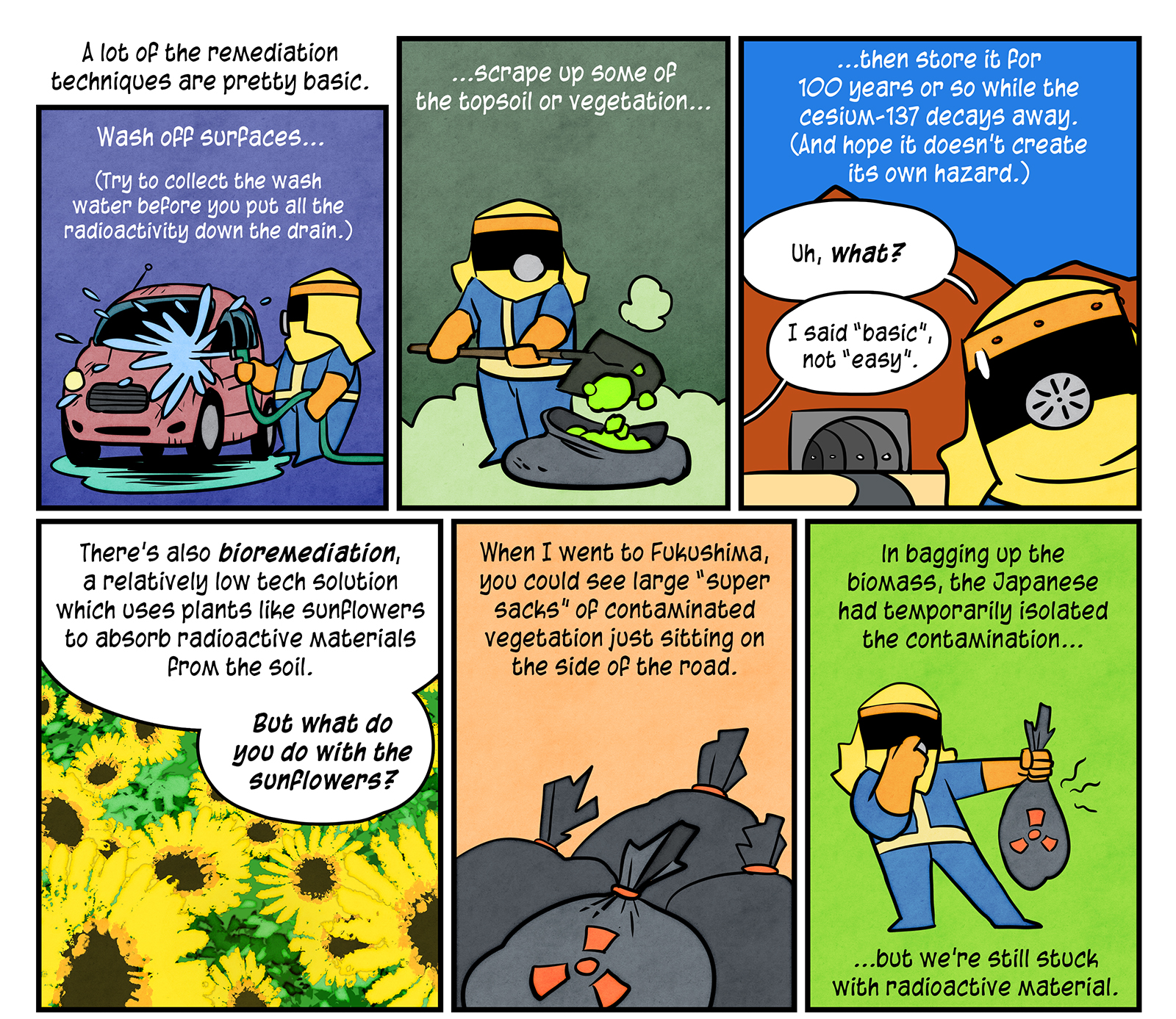
Several scenes of Maki, now also in an antiquated radiation helmet washing a car and shoveling neon green material into garbage bags as Kathryn narrates: A lot of the remediation techniques are pretty basic. Wash off surfaces. (Try to collect the wash water before you put all the radioactivity down the drain.) Scrape up some of the topsoil or vegetation. Maki stands in front of a tunnel going into a mountain. Kathryn continues: ...then store it for 100 years or so while the cesium-137 decays away. (And hope it doesn’t create its own hazard.) Maki: Uh, what? Kathryn: I said basic, not easy. A field of sunflowers, vibrant and healthy: There’s also bioremediation, a relatively low tech solution which uses plants like sunflowers to absorb radioactive materials from the soil. But what do you do with the sunflowers? A pile of garbage bags marked with radiation symbols: When I went to Fukushima, you could see large “super sacks” of contaminated vegetation just sitting on the side of the road. ln bagging up the biomass, the Japanese had temporarily isolated the contamination but we’re still stuck with radioactive material.
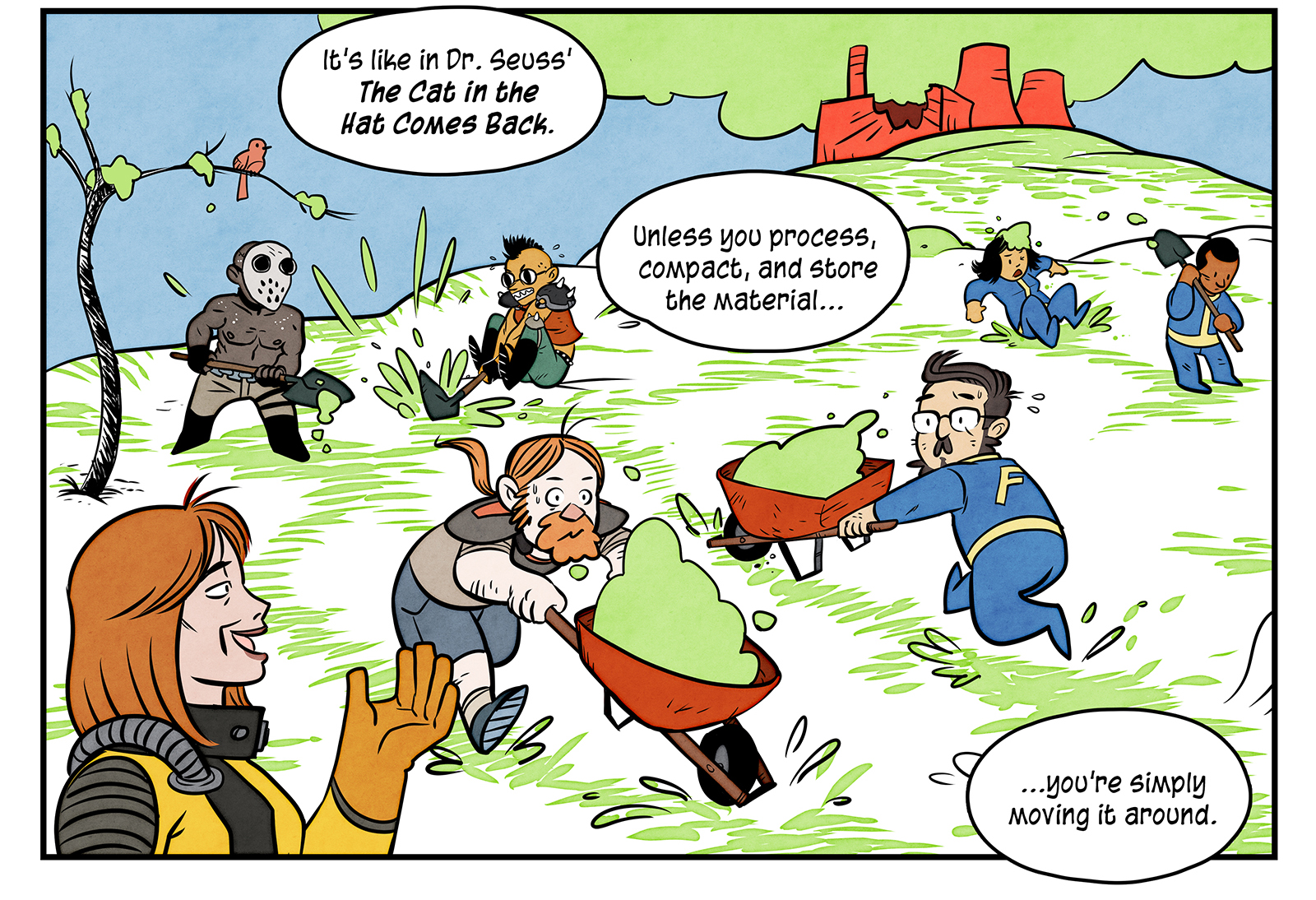
A scene unfolds of a large white hill with a ruined nuclear plant on top spewing green clouds into the air. On the hill, Maki and Phil run around with wheelbarrows full of neon green waste. The Mad Max wasteland warrior scientists, and some more vault dwellers are shoveling waste scattered on the hill but all they seem to be doing is throwing it at each other and spreading it around. Kathryn: It’s like in Dr. Seuss’ The Cat in the Hat Comes Back. Unless you process, compact, and store the material you’re simply moving it around.
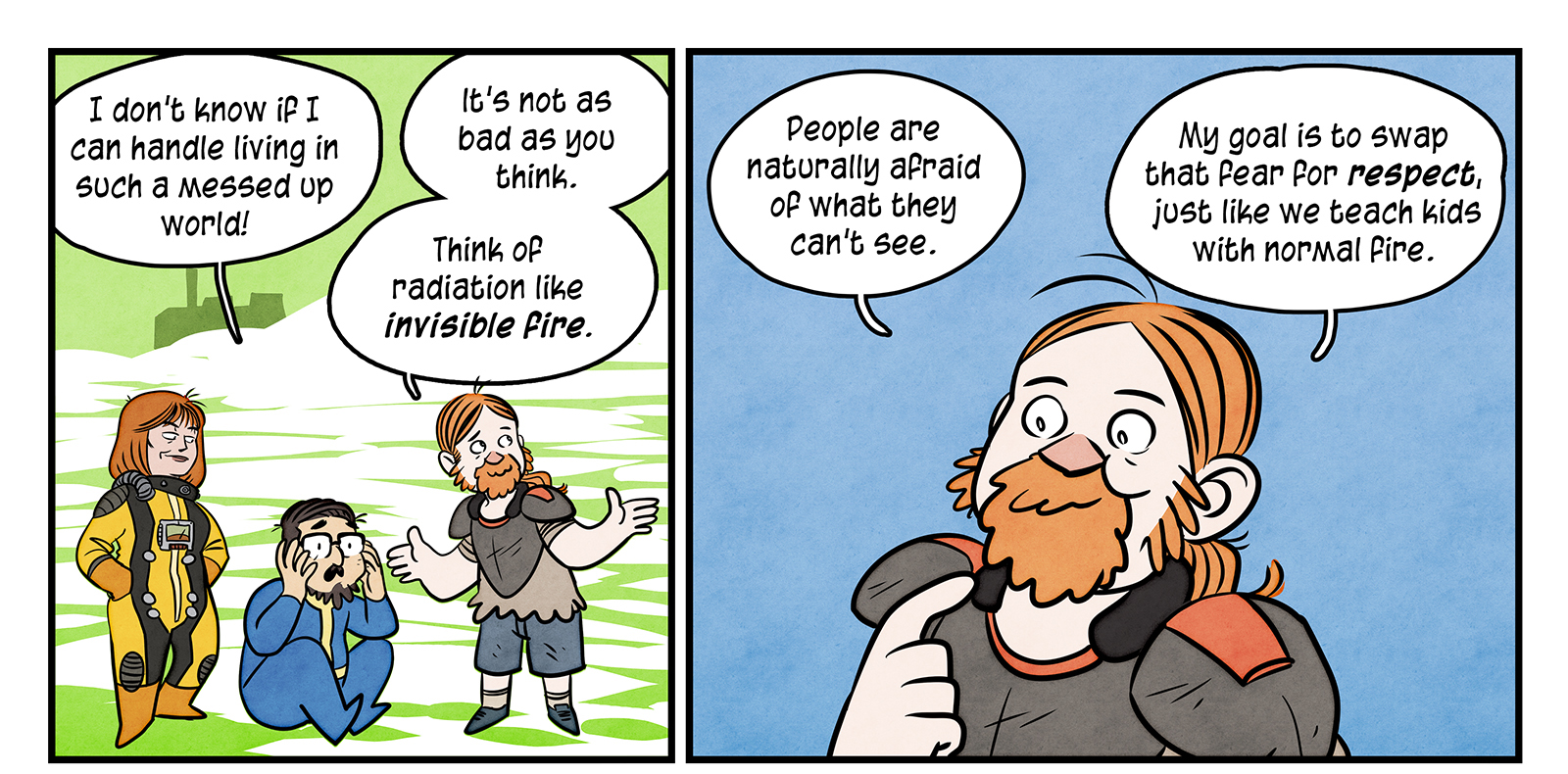
Maki sits on the waste filled hill, looking defeated: I don’t know if I can handle living in such a messed up world! Phil has caught up to the pair: It’s not as bad as you think. Think of radiation like invisible fire. People are naturally afraid of what they can’t see. My goal is to swap that fear for respect, just like we teach kids with normal fire.
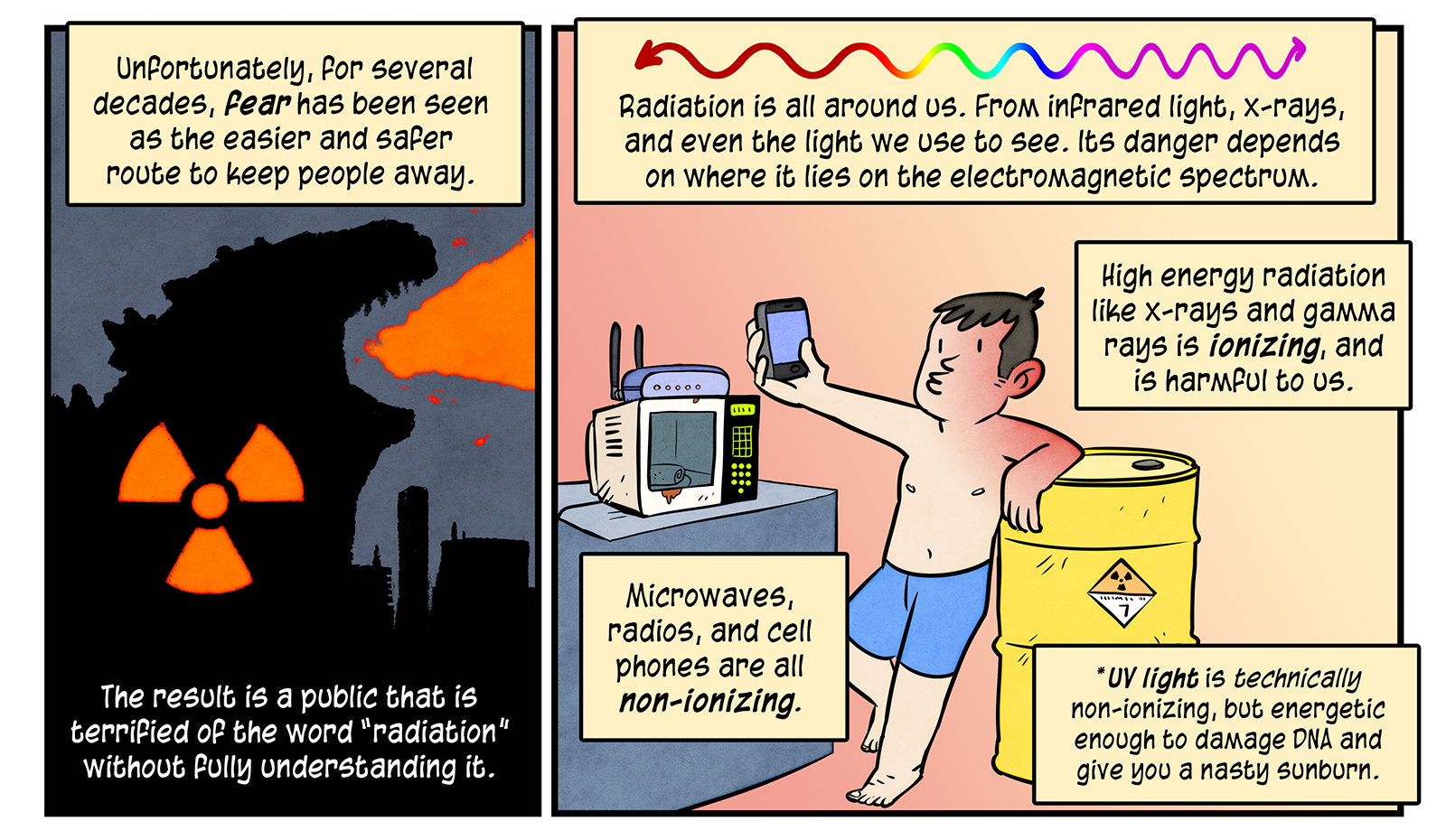
A looming Godzilla shooting a radioactive beam out of his mouth is pictured as Phil continues: Unfortunately, for several decades, fear has been seen as the the easier and safer route to keep people away. The result is a public that is terrified of the word “radiation” without fully understanding it. A shirtless man holds his phone at arms length while leaning on a radiation barrel. His skin is turning red where it is touching the barrel. Above him is a diagram of the electromagnetic spectrum showing dark infrared light to the left and high energy gamma radiation to the left. Phil: Radiation is all around us. From infrared light, x-rays, and even the light we use to see. lts danger depends on where it lies on the electromagnetic spectrum. High energy radiation like x-rays and gamma rays is ionizing, and is harmful to us. Microwaves, radios, and cell phones are all non-ionizing. Disclaimer: *UV light is technically non-ionizing, but energetic enough to damage DNA and give you a nasty sunburn.
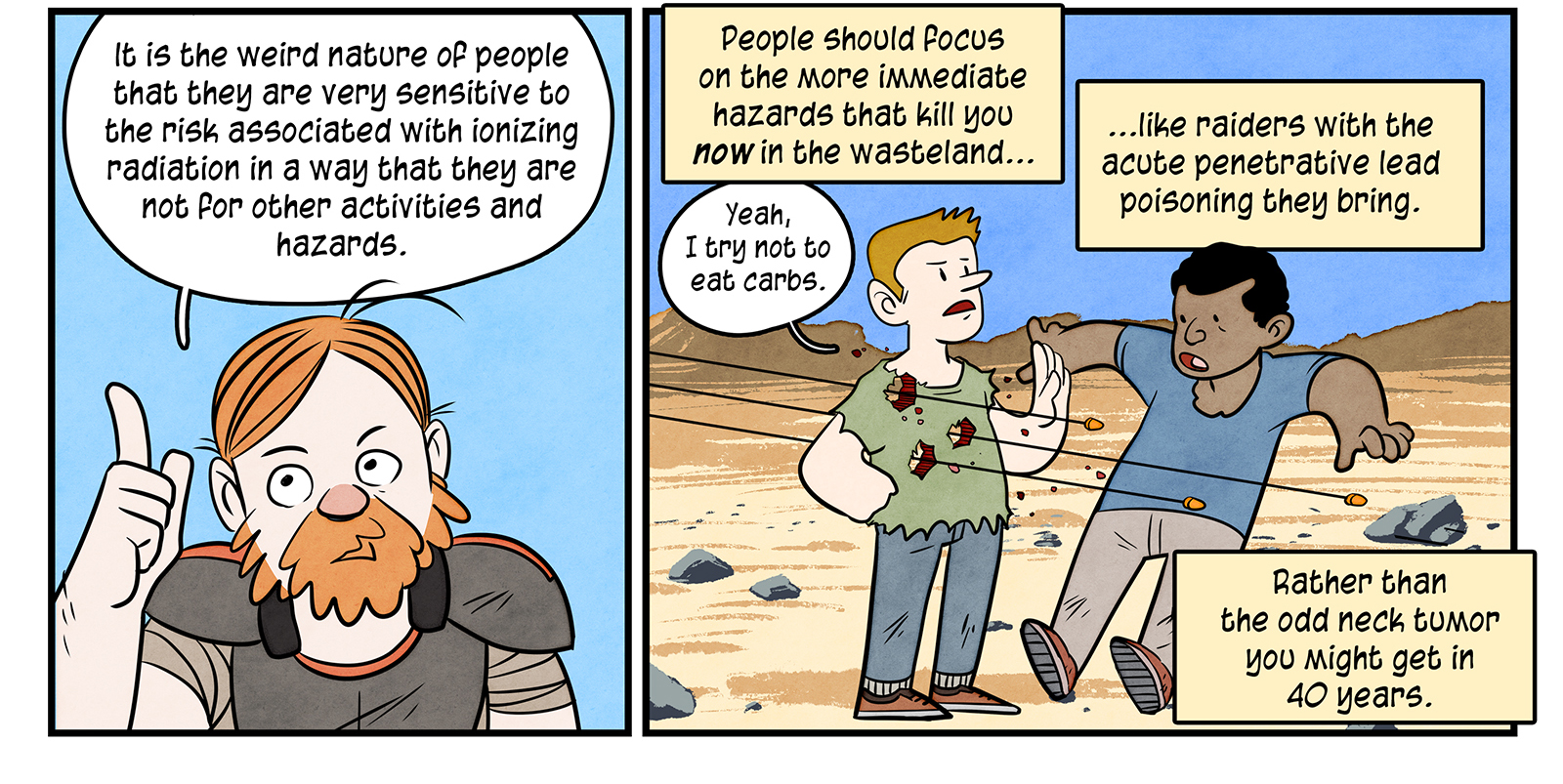
It is the weird nature of people that they are very sensitive to the risk associated with ionizing radiation in a way that they are not for other activities and hazards. Two men stand in the desert wearing tattered clothes. One holds a hand up saying, "Yeah, I try not to eat carbs." as three bullets comically rip through his body. The other man jumps backwards out of their way. Phil: People should focus on the more immediate hazards that kill you now in the wasteland. Like raiders with the acute penetrative lead poisoning they bring. Rather than the odd neck tumor you might get in 40 years.
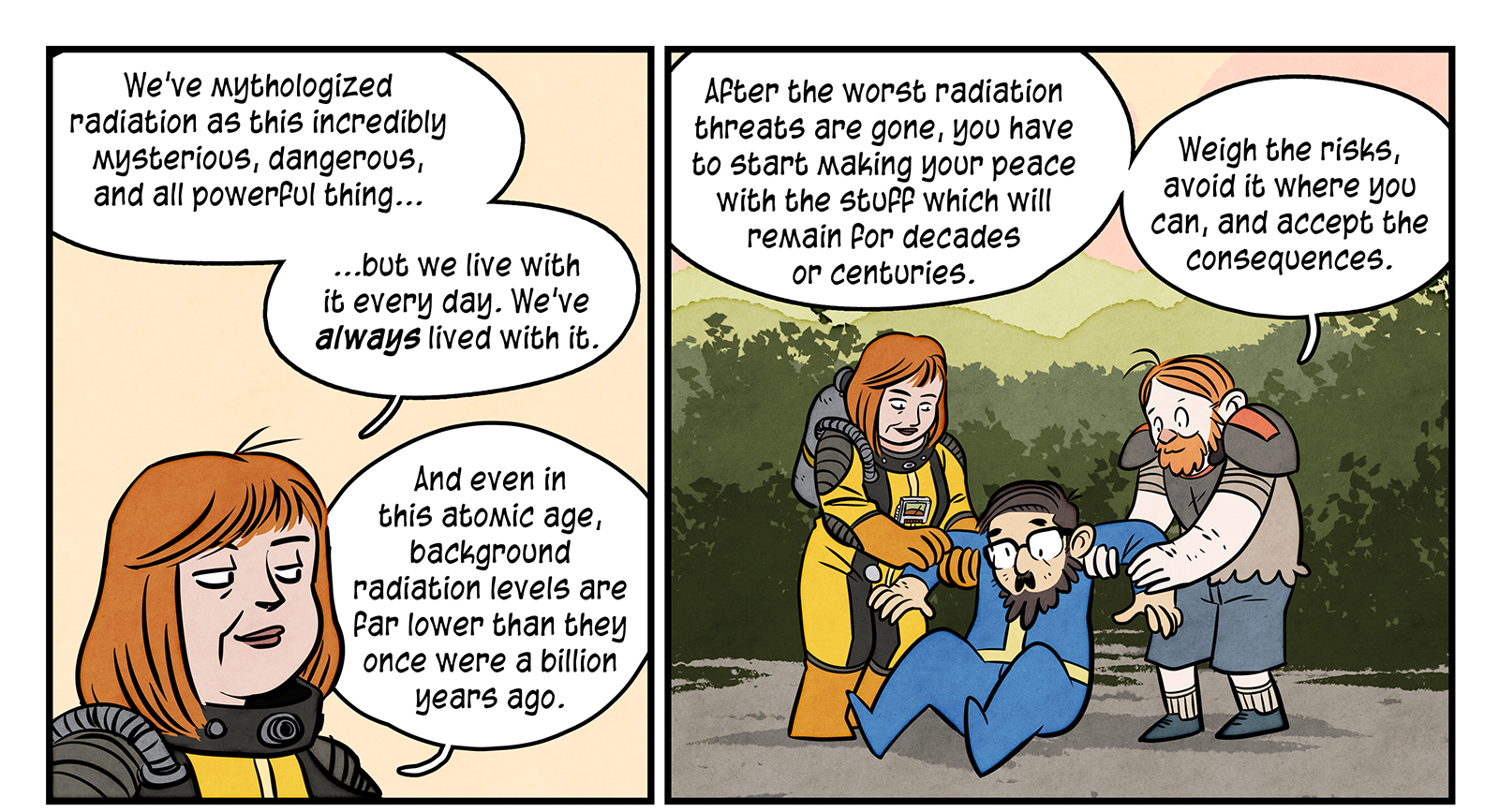
Kathryn and Phil help Maki up. Kathryn: We’ve mythologized radiation as this incredibly mysterious, dangerous, and all powerful thing, but we live with it every day. We’ve always lived with it. And even in this atomic age, background radiation levels are far lower than they once were a billion years ago. Phil: After the worst radiation threats are gone, you have to start making your peace with the stuff which will remain for decades or centuries. Weigh the risks, avoid it where you can, and accept the consequences.
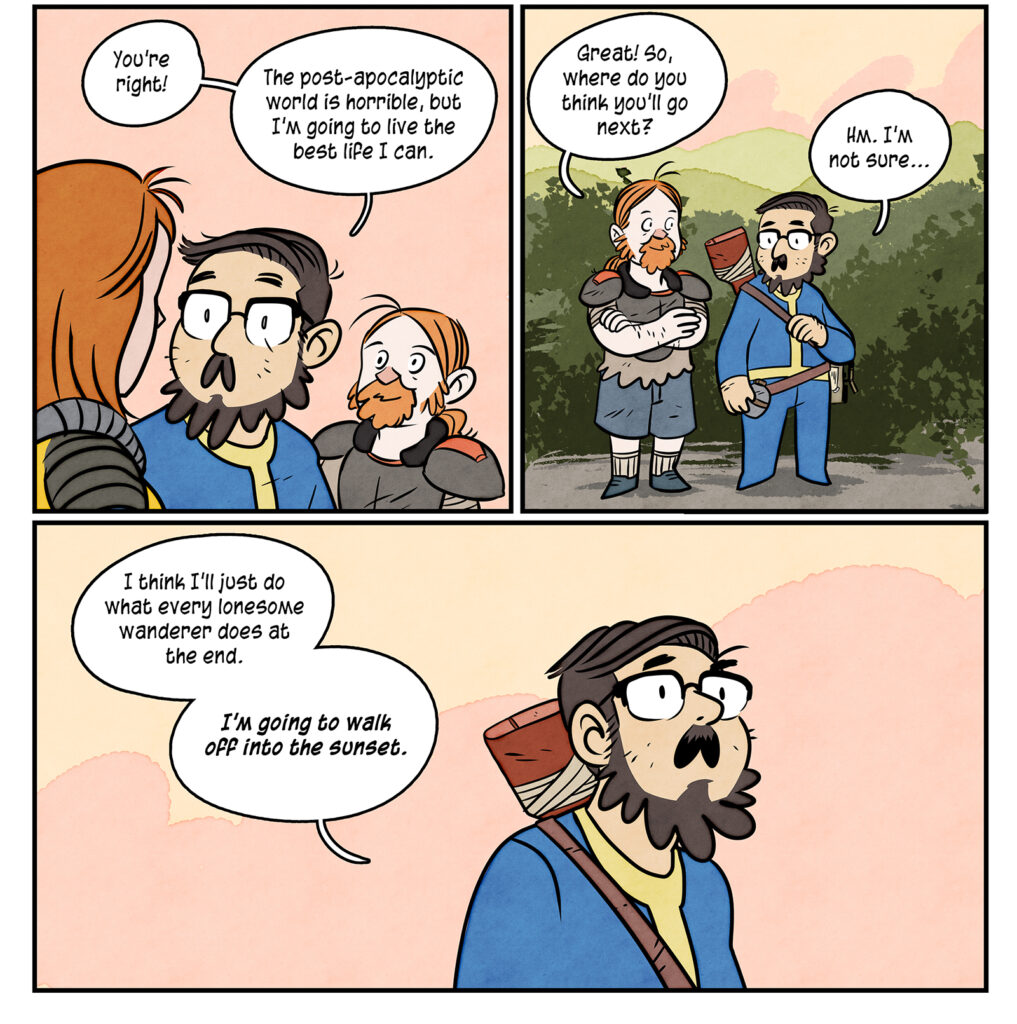
Maki, looking at the two experts: You're right! The post-apocalyptic world is horrible, but I’m going to live the best life I can. Phil: Great! Where do you think you'll go next? Maki, packing up his gear: Hm. I'm not sure. I think I’ll just do what every lonesome wanderer does at the end. I’m going to walk off into the sunset.
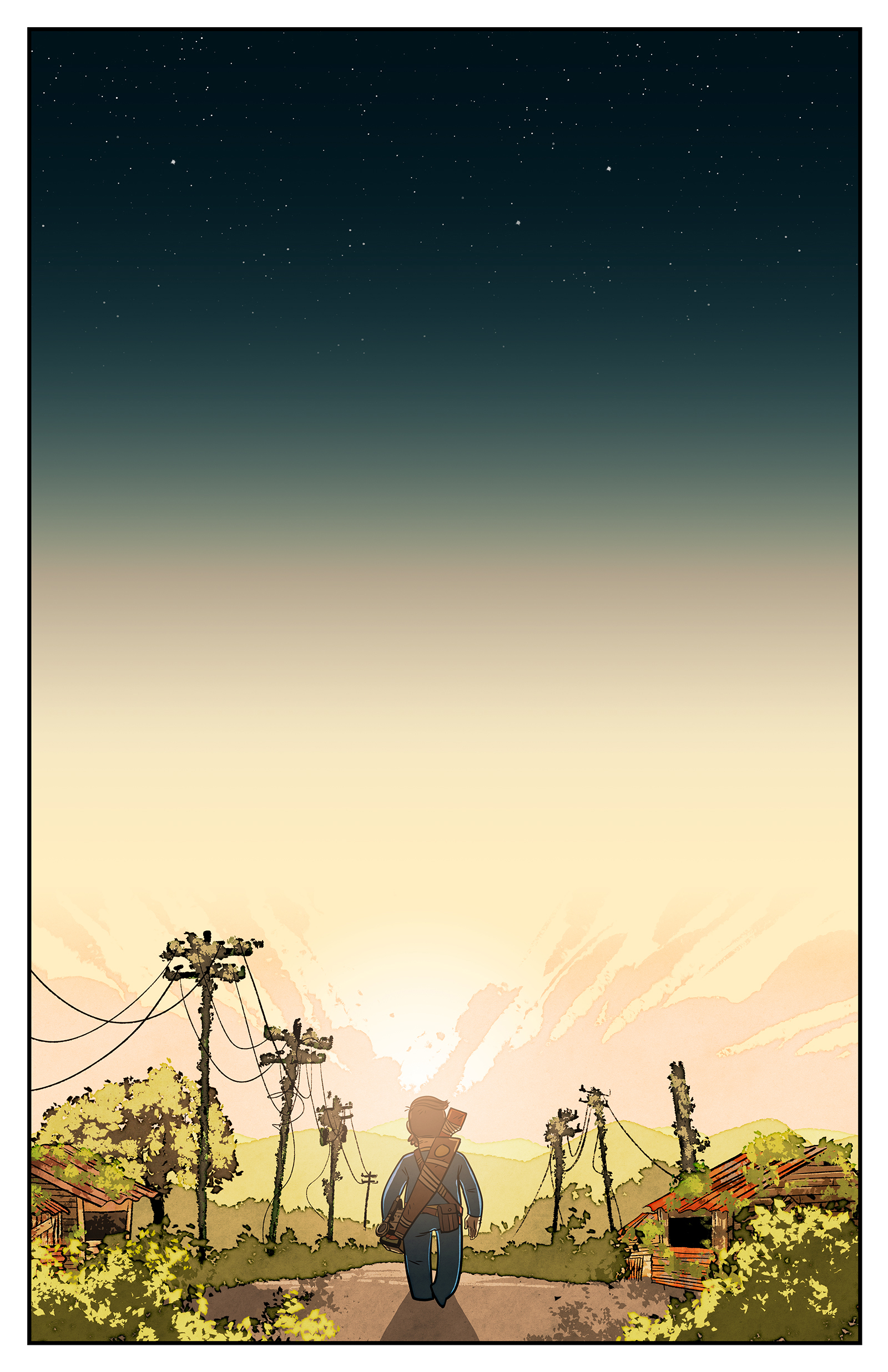
Maki walks away from the viewer, the setting sun washing him out in the glare. Around him are the ruins of telephone poles and old houses, now covered with greenery. The clouds and vanilla skies give way to twilight and the inky darkness of night in the upper bounds of the image.
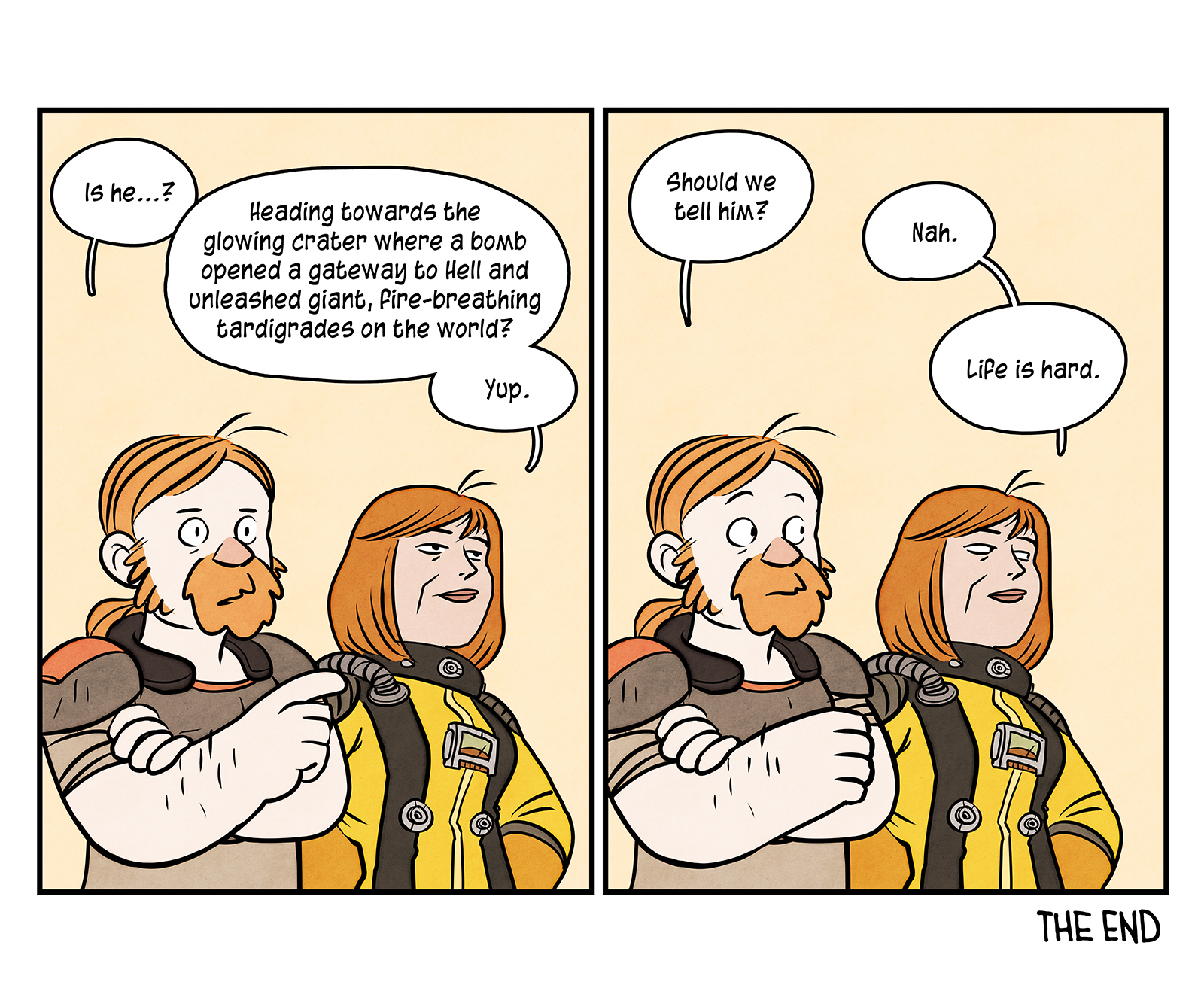
Phil watches Maki leave, slightly concerned. Phil, pointing: Is he...? Kathryn, with a straight face: Heading towards the glowing crater where a bomb opened a gateway to Hell and unleashed giant, fire-breathing tardigrades on the world? Yup. Phil: Should we tell him? Kathryn, unconcerned by the whole thing: Nah. Life is Hard.

Description

  • 2016

In this educational fan comic, the author emerges from an underground bunker to find himself in the ashes of a world destroyed by nuclear war. Or has it?

During his journey, he meets with two real life experts who dispel the pop culture myths around radiation and nuclear fallout.

Additional Credits

  • Featuring: Phil Broughton
  • Featuring: Kathryn Higley