image
  • About Me
  • Portfolio
    • Comics
    • Illustration
  • Commissions
  • Store
  • Contact
© 2026 Maki Naro All rights reserved. Violators will be cursed.
image

Food Used to Be a Lot More Dangerous

ln 2018, five Americans died and nearly three hundred were infected with E. coli after eating contaminated romaine lettuce in two separate outbreaks.
A green head of romaine lettuce over a microscope view of purple e coli bacteria.
The lettuce was recalled and the FDA eventually pinpointed the source in Santa Barbara but not before the lettuce, along with other recent food recalls, managed to both stoke public fear and encourage cynicism of government regulation. An exasperated black woman in an orange shirt stands in front of a map of the western US showing popups of other food recalls including hamburger patties, baby carrots, chicken nuggets, and spinach. She asks "What CAN I eat?" Food poisoning is just as common as it is scary, with one in six Americans suffering from foodborne illnesses every year.
48 million cases annually. 128,000 hospitalizations. 3,000 deaths. According to the CDC
A sepia-toned farmland with fields stretching to the horizon. While it’s true that our food safety systems are imperfect, there was a time before they existed. And things were much worse. The farmland gives way to a city clogged with smoke. During the lndustrial Revolution, as the nation grew less agrarian and more urbanized, Americans became less directly involved in their own food production.
A boxcar is unloaded at a train station by several men in hats and suspenders. Food could be transported over larger distances with the help of new technologies, such as refrigerated railroad cars, yet states did not have the ability to regulate them. Companies could not be held accountable for the safety of their products.
A series of old time advertisements for mostly made-up dubious medicines and supplements including "Brain Salt" (real) with a snake around a bottle, "Pond's Extract" (also real), "The Doctor's Special Rum" (showing an addled old man, high on his own supply), and "Just Cocaine." There was no way to tell what was truly in the food and medicines advertised by companies. Adulteration, mislabeling, and false advertising were rampant.
As a result, city dwellers turned to periodicals, such as The Ladies Home Journal or Collier’s Weekly, to get quality assurance from investigative journalists. From the cover of his book, The Great American Fraud, Samuel Hopkins Adams says, "Gullible America will spend this year some seventy-five millions of dollars in the purchase of patent medicines. ln consideration of this sum it will swallow huge quantities of alcohol, an appalling amount of opiates and narcotics, a wide assortment of varied drugs ranging from powerful and dangerous heart depressants to insidious liver stimulants; and far in excess of all other ingredients, undiluted fraud.”
One man who had made it his life’s work to study and fight adulteration was Dr. Harvey W. Wiley.
Wiley gives a lecture, showing a popular Collier's cover in which a row of bottles being filled by a grim reaper from two barrels form an even larger skull. Appointed Chief Chemist in the Department of Agriculture in 1883, he planned to expand the federal government’s role in protecting consumers from tainted and mislabeled foods.
Wiley clashed with the USDA’s Secretary of Agriculture, James Wilson, who did not believe in regulating corporations. Wiley found an unorthodox way to test his theories of food adulteration. He stands before a group of men. Wiley: Humble servants of the state, thank you for volunteering your time to participate in a revolutionary study.
Wiley recruited 12 young civil servants from the Department of Agriculture, who doctors then dosed with commonly used food preservatives in order to study their health impacts. This group came to be known as the...
Framed by a movie explosion, a group of eight white men in old fashioned suits make various action poses around another white man, Harvey Washington Wiley, who stands heroically in the center. Above and below him are the words "POISON SQUAD" rendered in creepy green text with a skull in the negative space of the second O in poison.
The terms of the study were strict: A one year commitment. Three meals a day prepared and eaten in the USDA kitchen. Regular physicals and specimen collections. Waived rights to sue the government for damages, including death. One of the previously posing men looks surprised, saying, "Wait, what?"
A close crop of several men eating at a table. The Poison Squad dined on meals spiked with common food additives and other chemicals, such as formaldehyde, sulfuric acid, copper sulfate, and benzoic acid. Wiley became known as “Old Borax”, due to his specific interest in the compound.
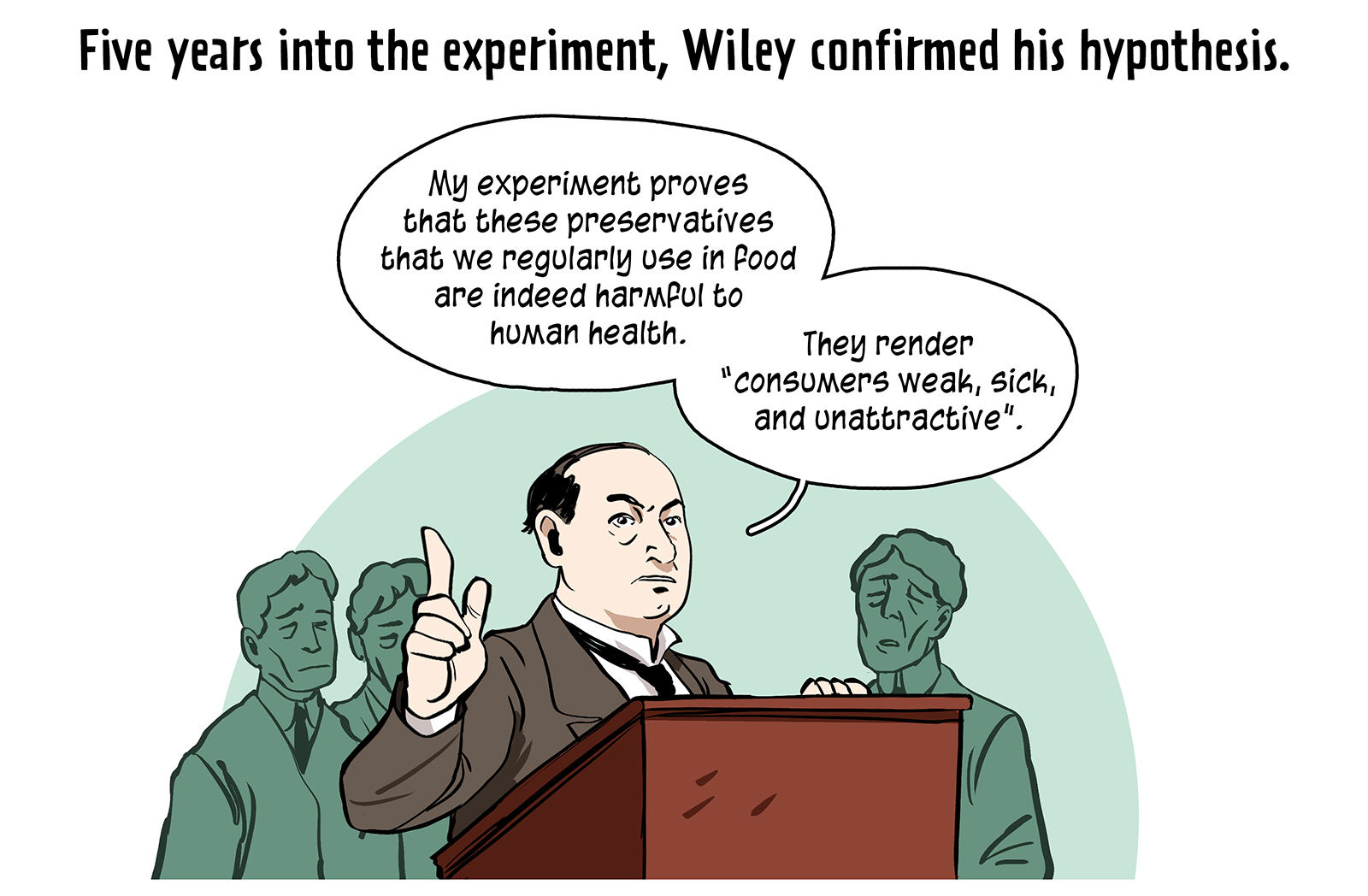
Five years into the experiment, Wiley confirmed his hypothesis. Wiley stands at a podium in front of several of the now very sick and weak looking squad members. My experiment proves that these preservatives that we regularly use in food are indeed harmful to human health. They render “consumers weak, sick, and unattractive”. One of the members seems to take mild offense at the description. Secretary Wilson tried to suppress Wiley’s report as legislators found an abundance of excuses to not pass a pure food and drug bill.
Then, as now, Congresspeople did not want to oppose the big businesses that would support their re-election campaigns. A scene from congress, where three apathetic, angry, and dismissive, men give excuses and push back. "We have more pressing legislation! " "Leave it up to the states! No need for a federal law!" "I agree in principle, but do not agree with the construction of the drafts."
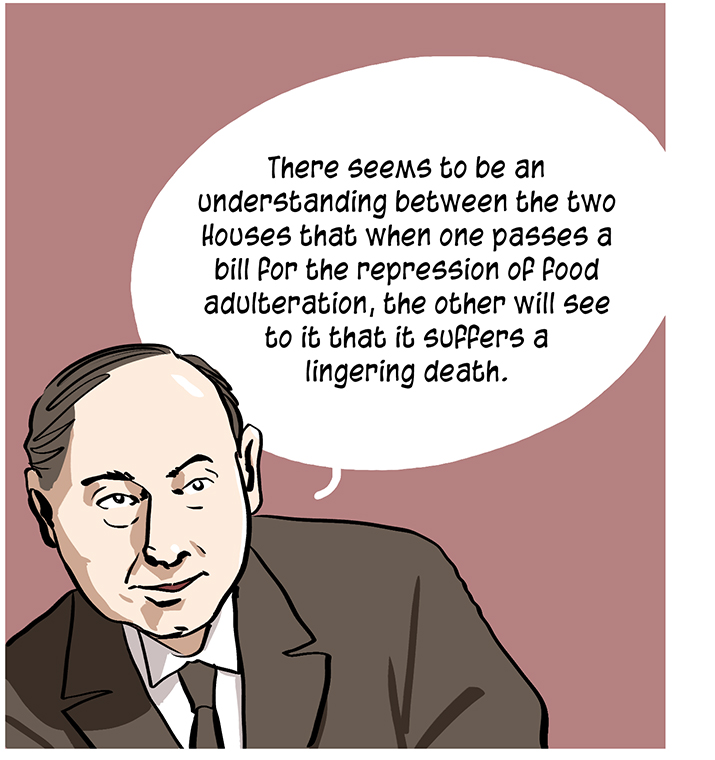
Wiley: There seems to be an understanding between the two Houses that when one passes a bill for the repression of food adulteration, the other will see to it that it suffers a lingering death.
An angry Teddy Roosevelt reads a newspaper with the headline "FILTHY FLOORS" Progressive investigative journalists wrote about situations like this, exposing corporate and government corruption to the public. These “Muckrakers”, a term coined by President Theodore Roosevelt, were often accused of being socialists and communists in an attempt to discredit them. Roosevelt: There is filth on the floor, and it must be scraped up with the “muck-rake”!
Upton Sinclair, a young handsome white man in a green suit takes notes while talking to a factory worker in a cap, who looks over their shoulder nervously. Upton Sinclair, a Columbia University graduate who was writing for a socialist magazine, was sent by his editor to cover a union strike in Packingtown, Chicago, the largest meatpacking area in the city.
The Jungle, first published in 1905, offered a fictional account of his trip. lt follows Jurvis, a Lithuanian immigrant, and his family, as they struggle to establish a life in Packingtown, Chicago.
Sinclair primarily intended to showcase the plight of the workers, including a chapter on contaminated meat products as an afterthought. To his surprise, this chapter seemed to affect readers the most, leading to a sudden drop in domestic meat sales. Sinclair, standing before a scene where a woman becomes nauseous when passing a rancid meat stand: I aimed at the public’s heart and by accident I hit it in the stomach.
Deeply moved by The Jungle, President Roosevelt asked for a USDA investigation into the meatpacking industry. Roosevelt, filled with righteous fury: The specific evils you point out shall, if their existence be proved, and if I have power, be eradicated!
Despite his conservative, anti-regulatory politics, this topic was very personal to him. During his time with the Rough Riders in Cuba during the Spanish-American War, many of Roosevelt’s fellow troops died from food poisoning after eating cans of spoiled meat. More died from food poisoning than in battle. A soldier eats food out of a can with a skull on it.
While the USDA inspection confirmed Sinclair’s claims, Roosevelt feared that releasing the report publicly would disrupt the livestock market and opted to suppress its release. He is seen nervously with the report looking around. A passage from it reads, "During an inspection, a slaughtered hog fell into a toilet and was then put onto assembly line without cleaning. " Also from the report, the same woman from the start of the comic interjects: Why was there even a toilet there?
Bathed in red, two men and a woman furiously read the results in a newspaper. The New York Times released the details of the report on June 5, 1906, with the help of Sinclair. The American public began to demand more accountability from meatpackers. Going with the flow of public opinion, Roosevelt called for food misbranding and adulteration legislation in 1906.
In a dark room, an old rich white man talks to his butler. Just outside the window, a mob with torches and pitchforks waits. Meat packers initially resisted, but soon realized that government inspection was necessary to save their industry. Rich man: lt is the only thing that will restore the public’s trust in us.
Wiley’s years of hard work came to fruition on June 30, 1906, with Roosevelt’s signing of the Pure Food and Drugs Act. Roosevelt is seen signing a large official act. The first federal law of its kind prohibited interstate transport of unlawful foods and drugs, the addition of hazardous and contaminated ingredients in food, and false and misleading labeling.
Four men stand around a similar official looking paper: On the same day the bill was signed, the meat inspection rider was signed into law as part of the Agricultural Appropriations Bill.
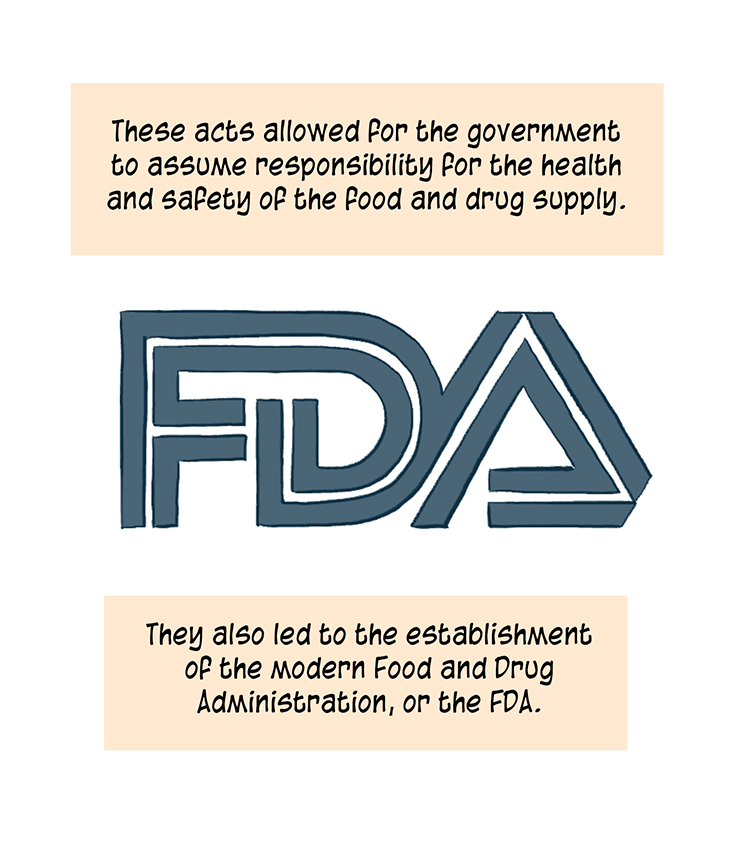
The modern day FDA logo is displayed with accompanying text: These acts allowed for the government to assume responsibility for the health and safety of the food and drug supply. They also led to the establishment of the modern Food and Drug Administration, or the FDA.
Roosevelt schmoozes with another man, handing him a gold pen, while Wiley fumes in the background. Wiley and Roosevelt’s relationship soured over time, as Roosevelt refused to give Wiley public credit for his contributions to the Pure Food and Drug Act.
Wiley hides in the bushes outside the oval office, thumbing his nose at a red-faced Roosevelt who is dumping artificial sweetener in his coffee. Their last correspondence involved an argument over the safety of saccharin, a favorite supplement of the President. Roosevelt: You say saccharin is hazardous to health? Why my doctor gives it to me every day! Anyone who says it is injurious to health is an idiot!!!

Description

  • The Nib

  • 2019

Before the establishment of the modern FDA, anti-regulation attitudes ruled the world of food.

Additional Credits

  • Writer: Whit Taylor
  • Editor: Eleri Harris