image
  • About Me
  • Portfolio
    • Comics
    • Illustration
  • Commissions
  • Store
  • Contact
© 2026 Maki Naro All rights reserved. Violators will be cursed.
image

“Peanuts” and Vaccines
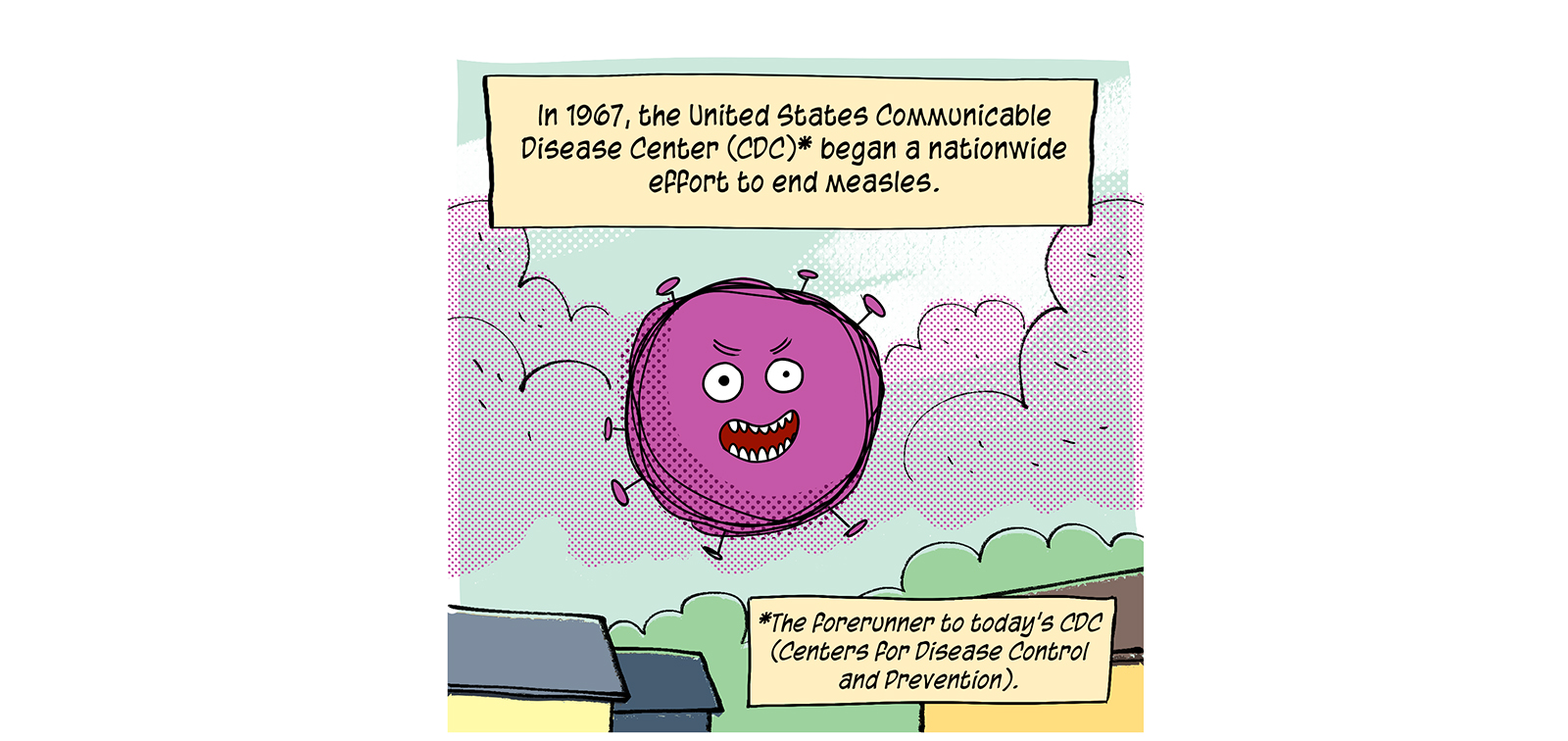
A purple virus covered with protein spikes and bearing a mischievous laughing face floats through the air above some houses. The comic is rendered in scribbly lines and slightly offset halftone colors, giving it the appearance of a Peanuts newspaper comic strip. Caption: ln 1967, the United States Communicable Disease Center (CDC)* began a nationwide effort to end measles. Caption: *The forerunner to today's CDC (Centers for Disease Control and Prevention).
Three panels featuring a child with a Band-Aid on their arm standing under a banner that says "Vaccinate." A neighborhood with a billboard featuring 1960s style cartoon art saying "Stop Measles" Three Peanuts-style dancing children. Captions: The CDC plan was based on persuasion: encouraging people to vaccinate their children using billboards, posters, and (no doubt totally groovy) "health happenings" with prizes for kids.
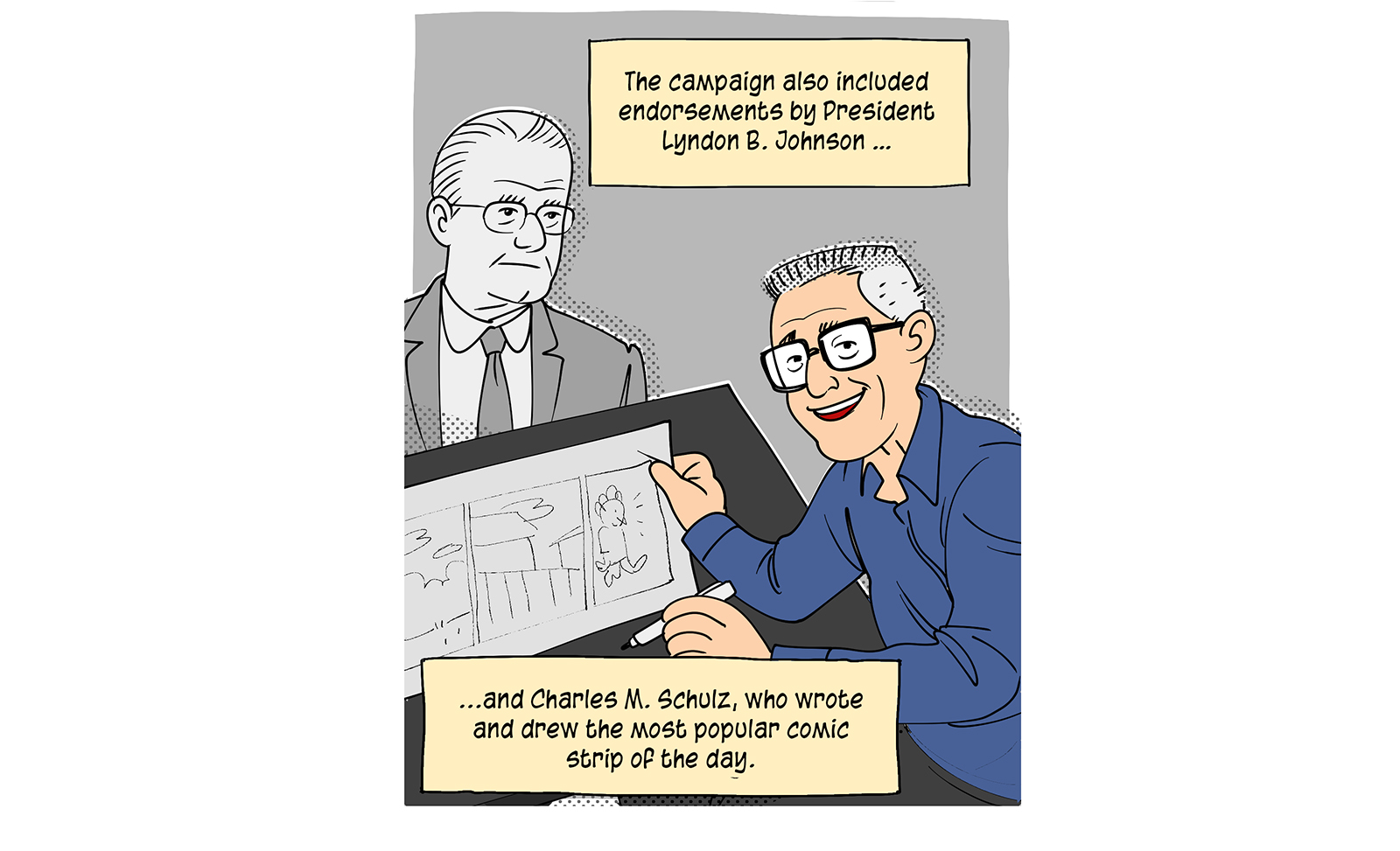
Cartoonist Charles M. Schulz sits at his drawing board, holding up a comic strip as the President looks on. Caption: The campaign also included endorsements by President Lyndon B. Johnson and Charles M. Schulz, who wrote and drew the most popular comic strip of the day.
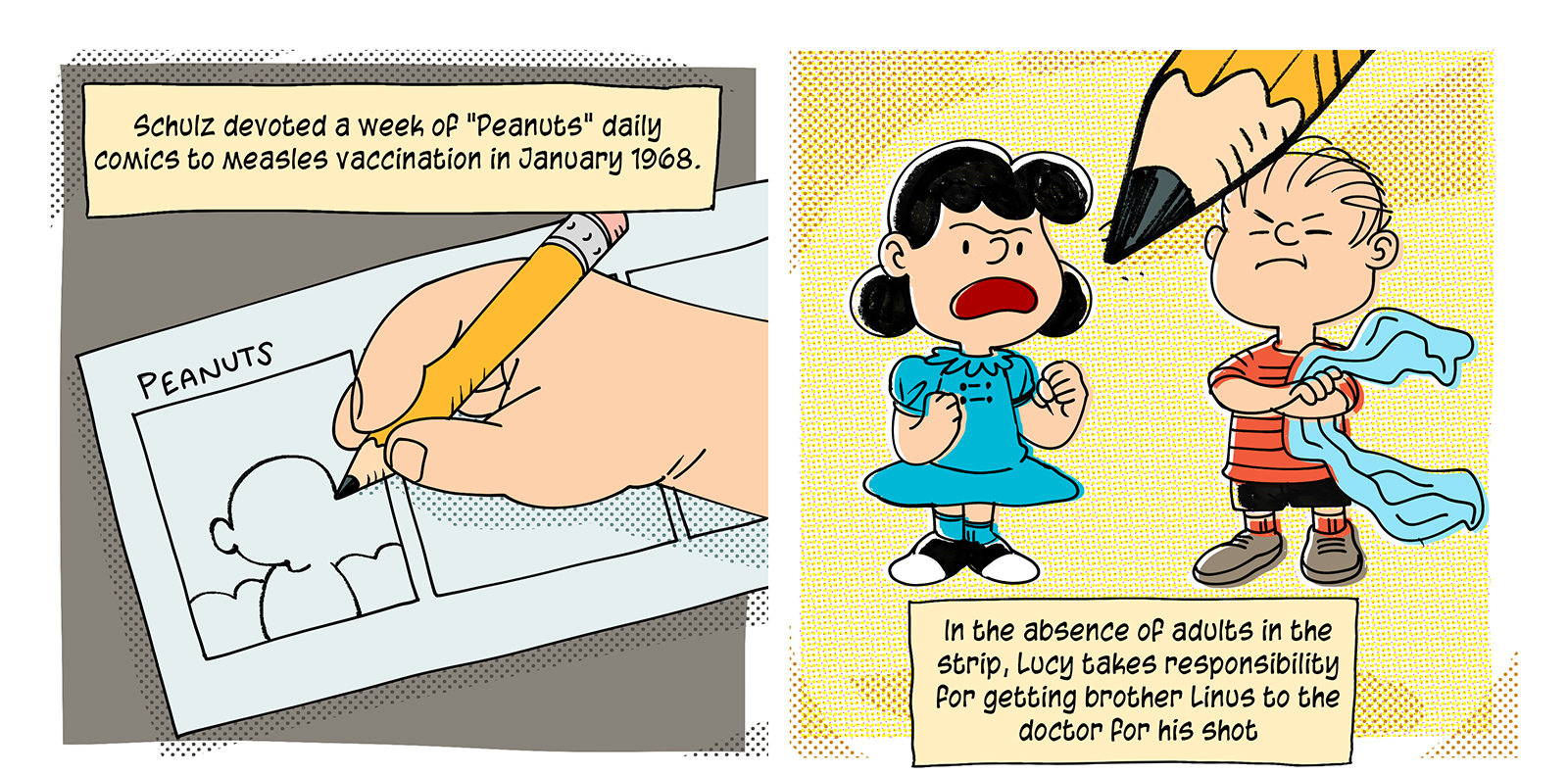
Schulz's hand draws a Peanuts strip as the story is narrated with the characters from the comic. Lucy is seen angrily talking to Linus, who seems to obstinately opposing something. Caption: Schulz devoted a week of "Peanuts" daily comics to measles vaccination in January 1968. ln the absence of adults in the strip, Lucy takes responsibility for getting brother Linus to the doctor for his shot.
In three panels, Linus goes from angry to shocked, to excitedly talking to Sally. Caption: Linus uses a number of excuses — some familiar today — for why he doesn't need a vaccine. Ultimately he is convinced when he reads the list of potential complications from having measles. Finally, he attempts to persuade Sally to get her own shot.
Back to Schulz at his drawing table. Caption: It's unclear if Schulz or his publishing syndicate actually coordinated with anyone from the CDC, or if this was just his way of supporting a cause he believed in. However it wasn't the first time "Peanuts" had included pro-vaccination content.
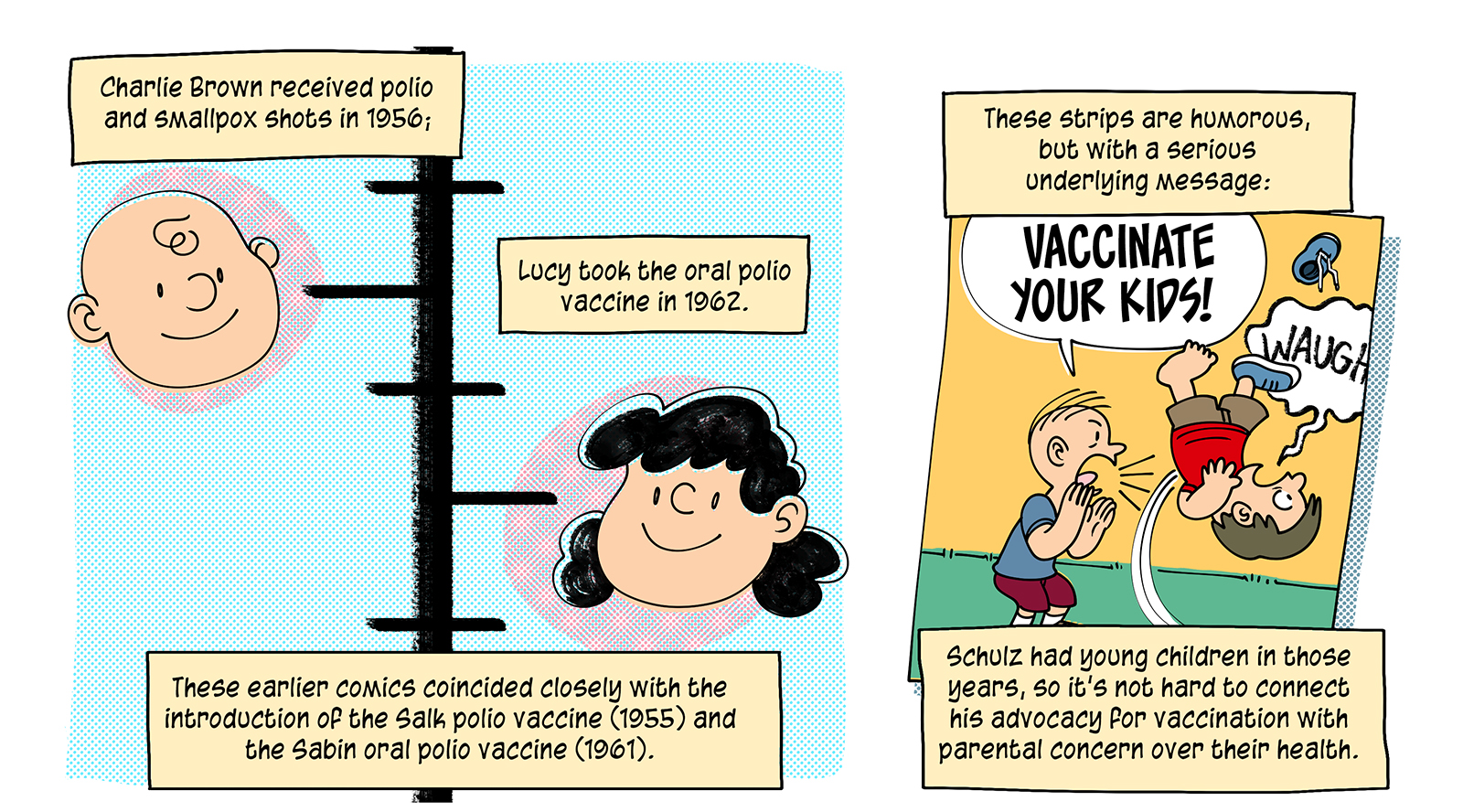
Two panels featuring a timeline showing vaccine related events in Peanuts with the character's faces at each point. Caption: Charlie Brown received polio and smallpox shots in 1956; Lucy took the oral polio vaccine in 1962. These earlier comics coincided closely with the introduction of the Salk polio vaccine (1955) and the Sabin oral polio vaccine (1961). These strips are humorous, but with a serious underlying message: Vaccinate Your Kids! (The text is illustrated by a generic Peanuts-style character yelling at another, who is thrown into the air so hard their shoe falls off). Caption: Schulz had young children in those years, so it's not hard to connect his advocacy for vaccination with parental concern over their health.
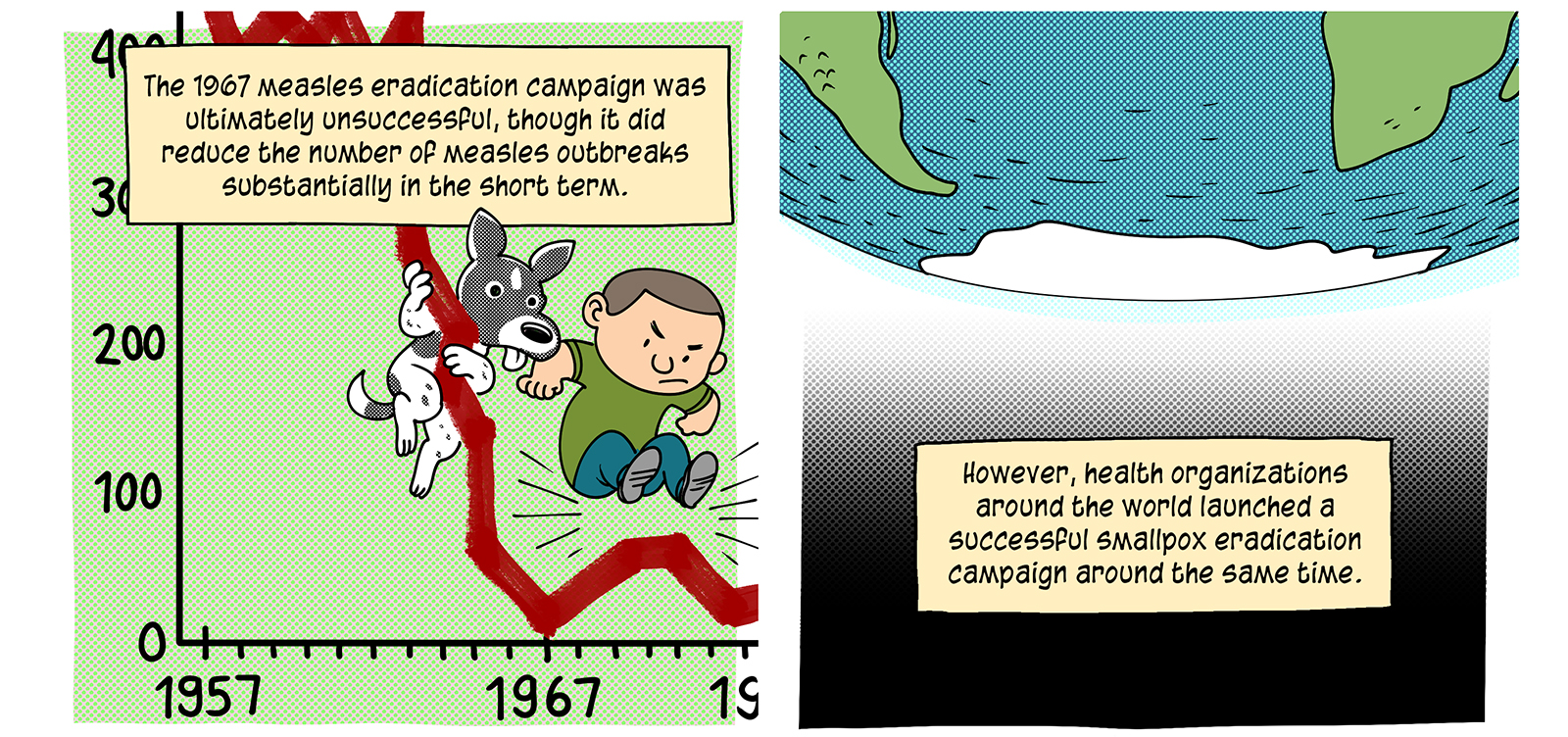
A short-haired Peanuts style character and a cartoon rat-terrier slide down a chart's descending line, stomping it down at the end. The chart is labeled with years on the X-Axis and with cases on the Y-Axis. Caption: The 1967 measles eradication campaign was ultimately unsuccessful, though it did reduce the number of measles outbreaks substantially in the short term. However, health organizations around the world launched a successful smallpox eradication campaign around the same time.
A newspaper with a photo of a smiling child and the headline, "ERADICATED" is shown in front of a cow grazing in a field. Caption: Smallpox is much deadlier than measles, but less infectious. As a result, it was relatively easier to stamp out and more urgent to do so. ln fact, the last domestic case of smallpox in the US was in 1949, thanks to widespread vaccination. The World Health Organization declared smallpox vanquished globally in 1980. Fun aside: the word "vaccination" is derived from the Latin word "vaccinus" for cow, since the earliest smallpox inoculation was derived from the disease cowpox. So when you get vaccinated, you're getting beefed up.
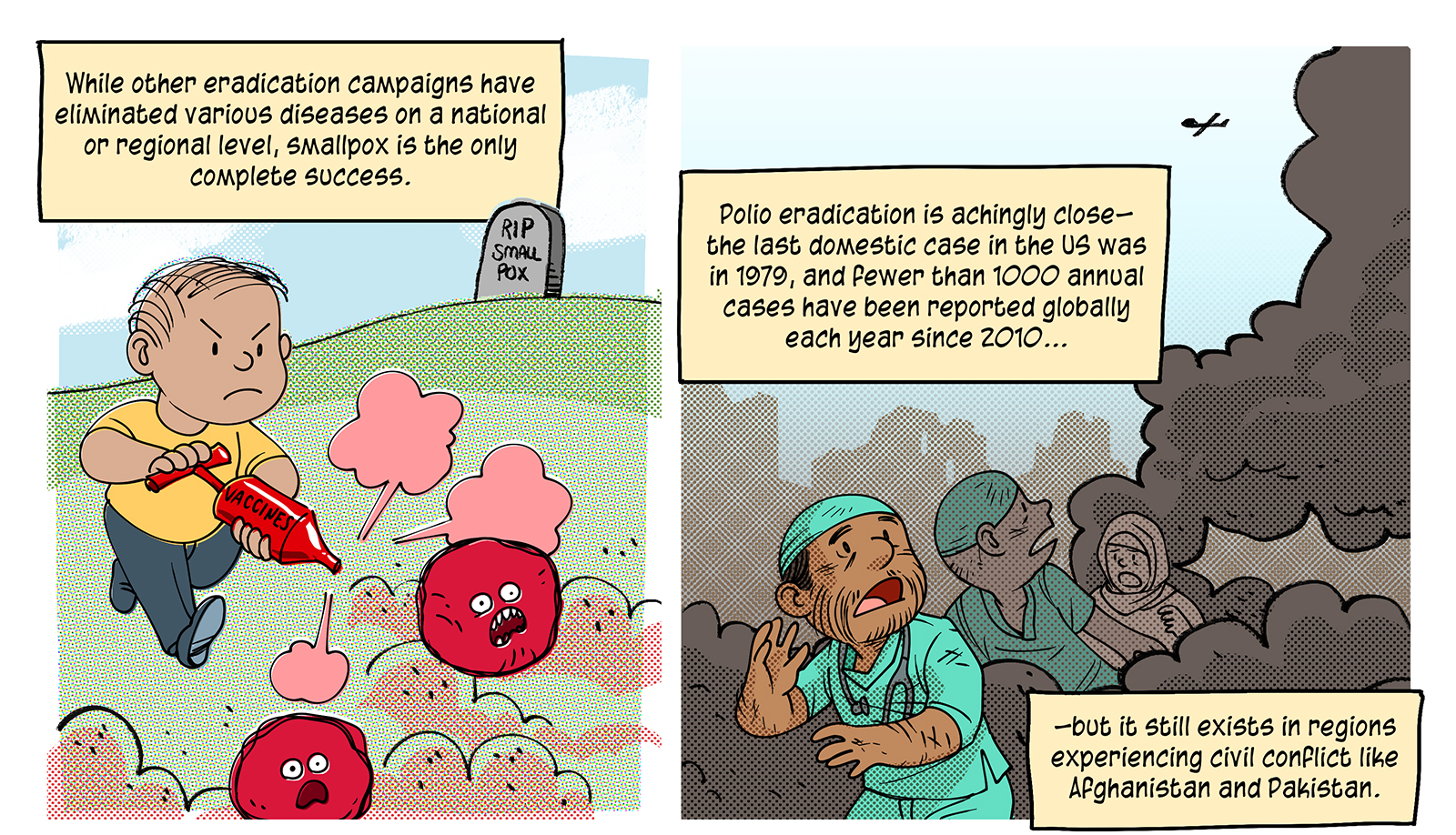
On the top of a hill, grave stone for smallpox sits alone while a child uses an old-fashioned sprayer labeled "Vaccine" to shoo viruses away. In another panel, muslim doctors and nurses navigate through clouds of smoke as a drone flies overhead. Caption: While other eradication campaigns have eliminated various diseases on a national or regional level, smallpox is the only complete success. Polio eradication is achingly close– the last domestic case in the US was in 1979, and fewer than 1000 annual cases have been reported globally each year since 2010. But it still exists in regions experiencing civil conflict like Afghanistan and Pakistan.
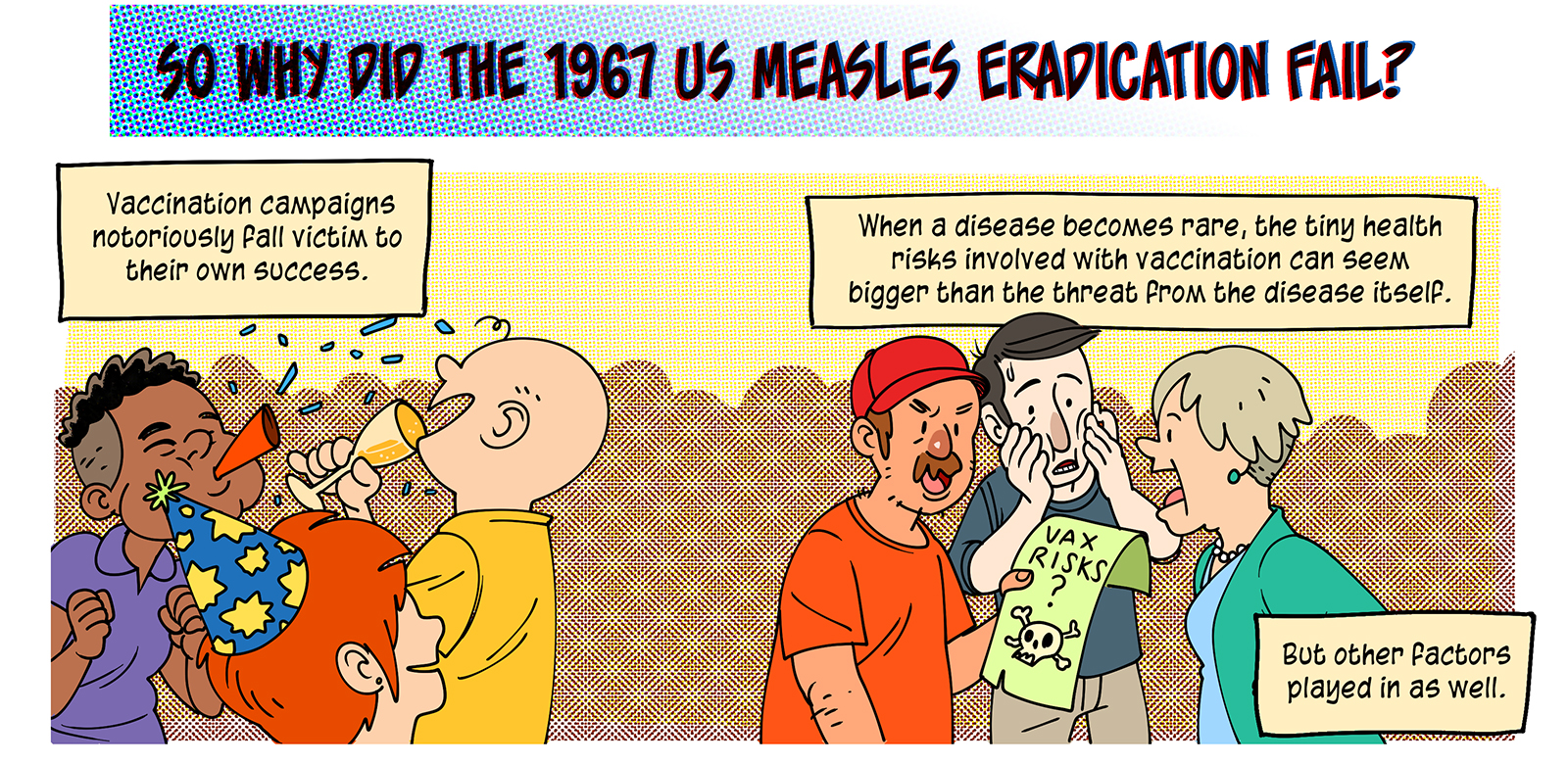
So why did the 1967 Measles Eradication Fail? In a party scene, several people celebrate with confetti, hats, and drinks, while on the other side a group of adults seem dismayed and angry while looking at a flyer labeled "Vax Risks" that has a skull on it. Caption: Vaccination campaigns notoriously fall victim to their own success. When a disease becomes rare, the tiny health risks involved with vaccination can seem bigger than the threat from the disease itself. But other factors played in as well.
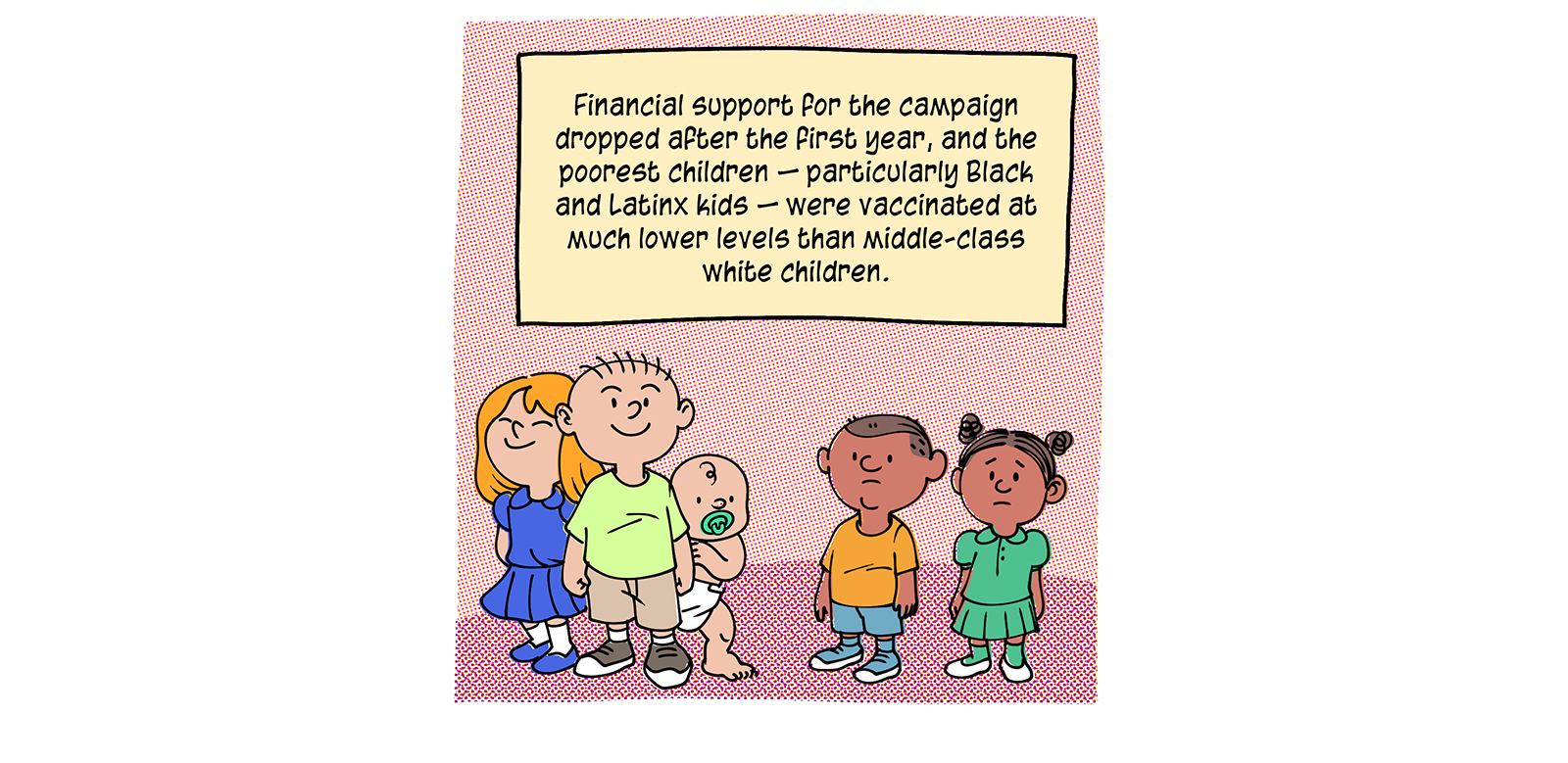
Two groups of children, one white, the the other Black, stand on opposite sides of the panel. Caption: Financial support for the campaign dropped after the first year, and the poorest children — particularly Black and Latinx kids — were vaccinated at much lower levels than middle-class white children.
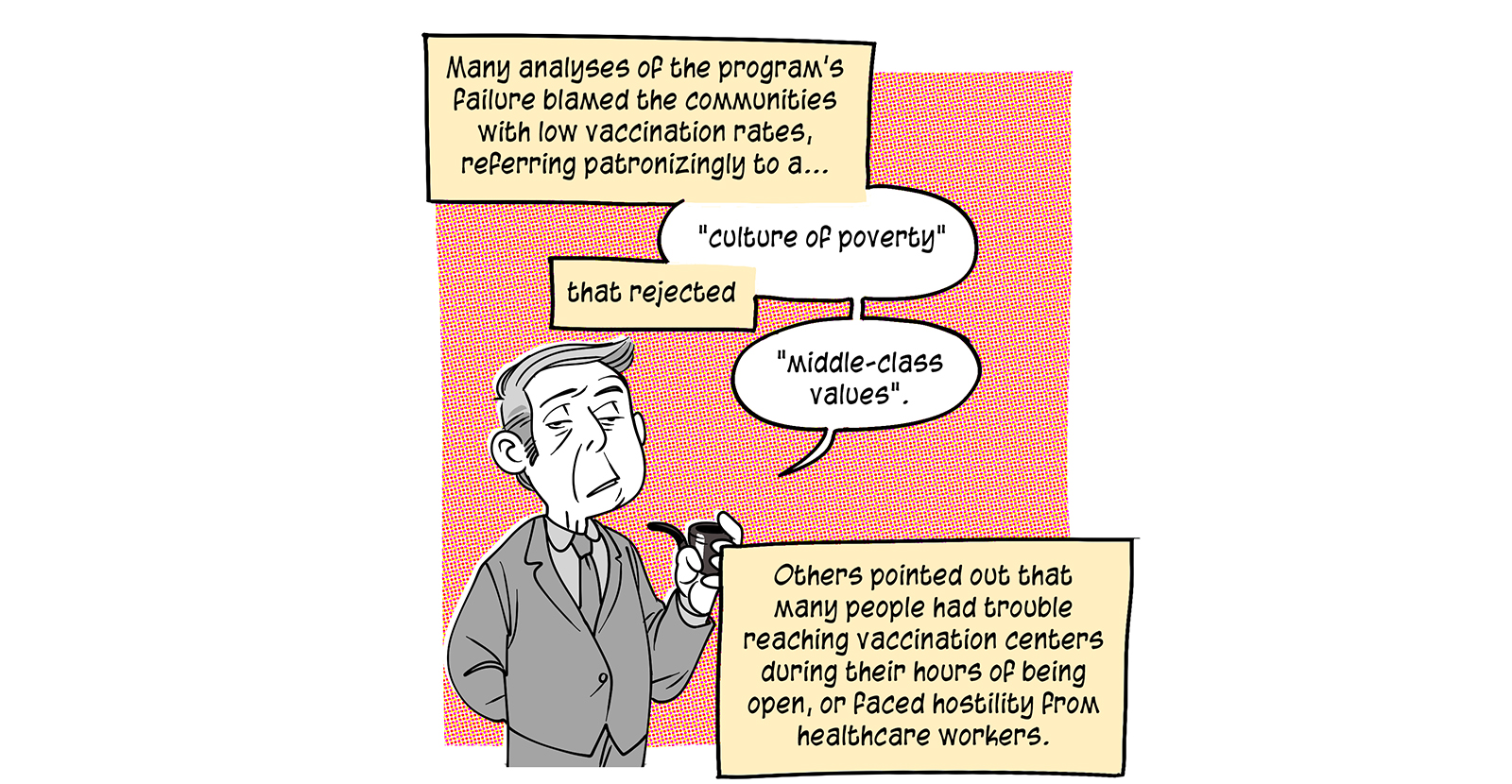
A stuffy older white man with a pipe looks condescendingly at the viewer. The caption is mixed with his speech: Many analyses of the program's failure blamed the communities with low vaccination rates, referring patronizingly to a "culture of poverty" that rejected "middle-class values." Others pointed out that many people had trouble reaching vaccination centers during their hours of being open, or faced hostility from healthcare workers.
"Peanuts" unfortunately symbolized part of the problem. Pictured are the strip's two non-white characters: Franklin — its first African-American character — didn't appear until July 1968, six months after the measles vaccination storyline. A non-speaking Mexican-Swedish character named José Peterson appeared in the strip in 1967.
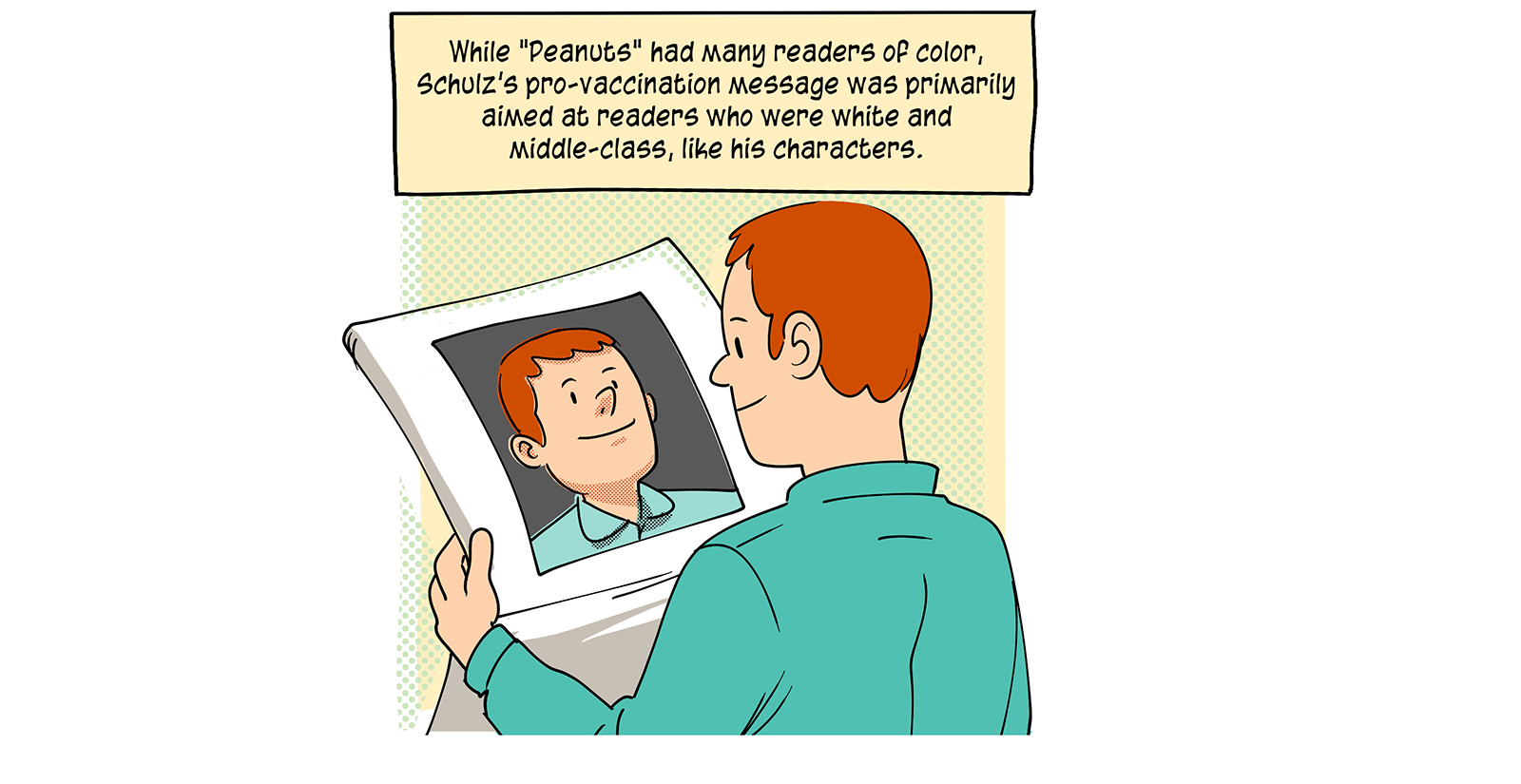
A white man with red hair looks at a newspaper which has his face on it. Caption: While "Peanuts" had many readers of color, Schulz’s pro-vaccination message was primarily aimed at readers who were white and middle-class, like his characters.
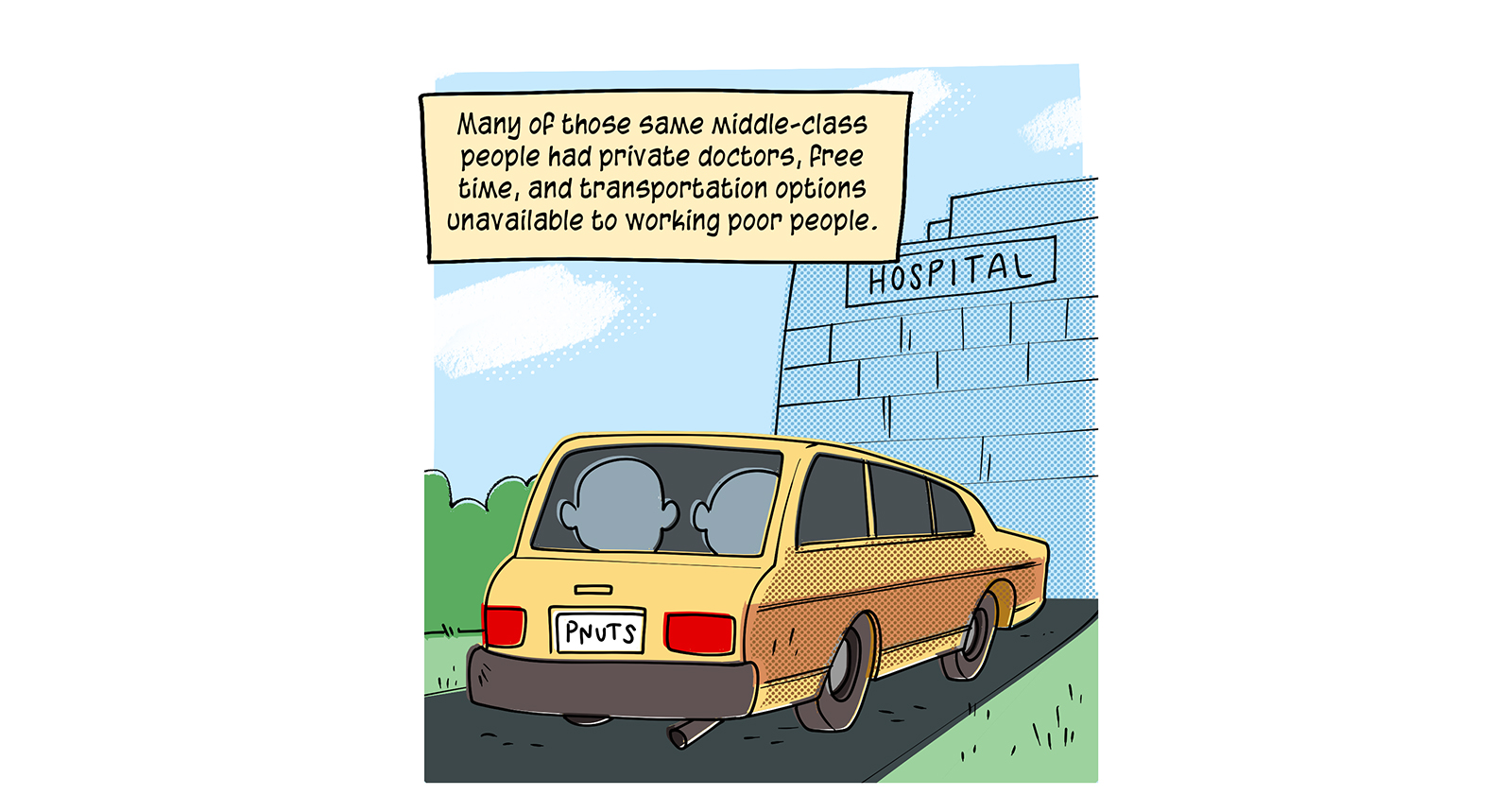
A station wagon with the license plate "PNUTS" drives to a hospital. Caption: Many of those same middle-class people had private doctors, free time, and transportation options unavailable to working poor people.
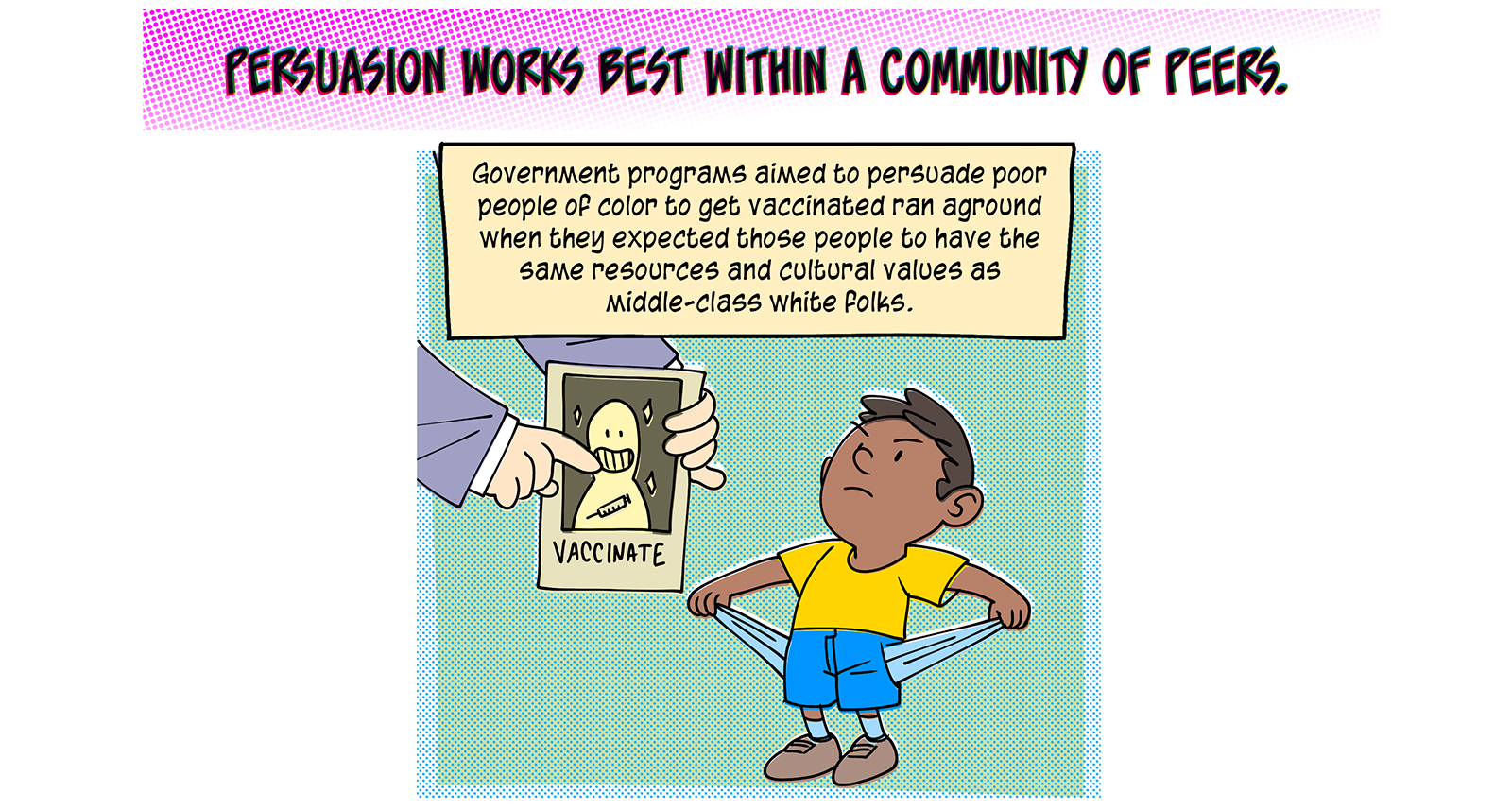
Persuasion works best within a community of peers. A brown child pulls out their empty pockets in response to an unseen adult holding a "VACCINATE" flyer. Caption: Government programs aimed to persuade poor people of color to get vaccinated ran aground when they expected those people to have the same resources and cultural values as middle-class white folks.
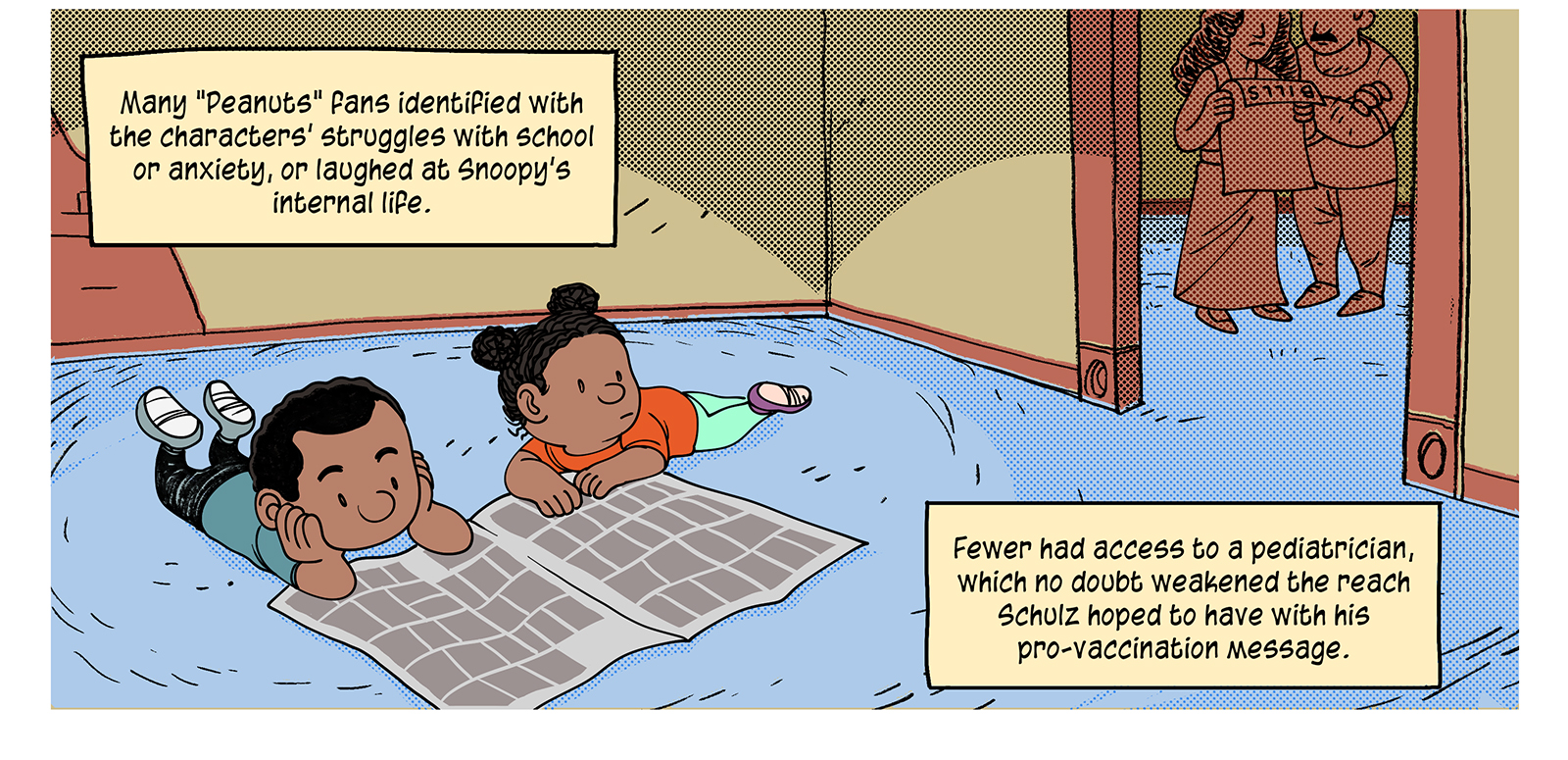
Two Black children read newspaper funnies while their parents in the other room look at bills. Caption: Many "Peanuts" fans identified with the characters' struggles with school or anxiety, or laughed at Snoopy's internal life. Fewer had access to a pediatrician, which no doubt weakened the reach Schulz hoped to have with his pro-vaccination message.
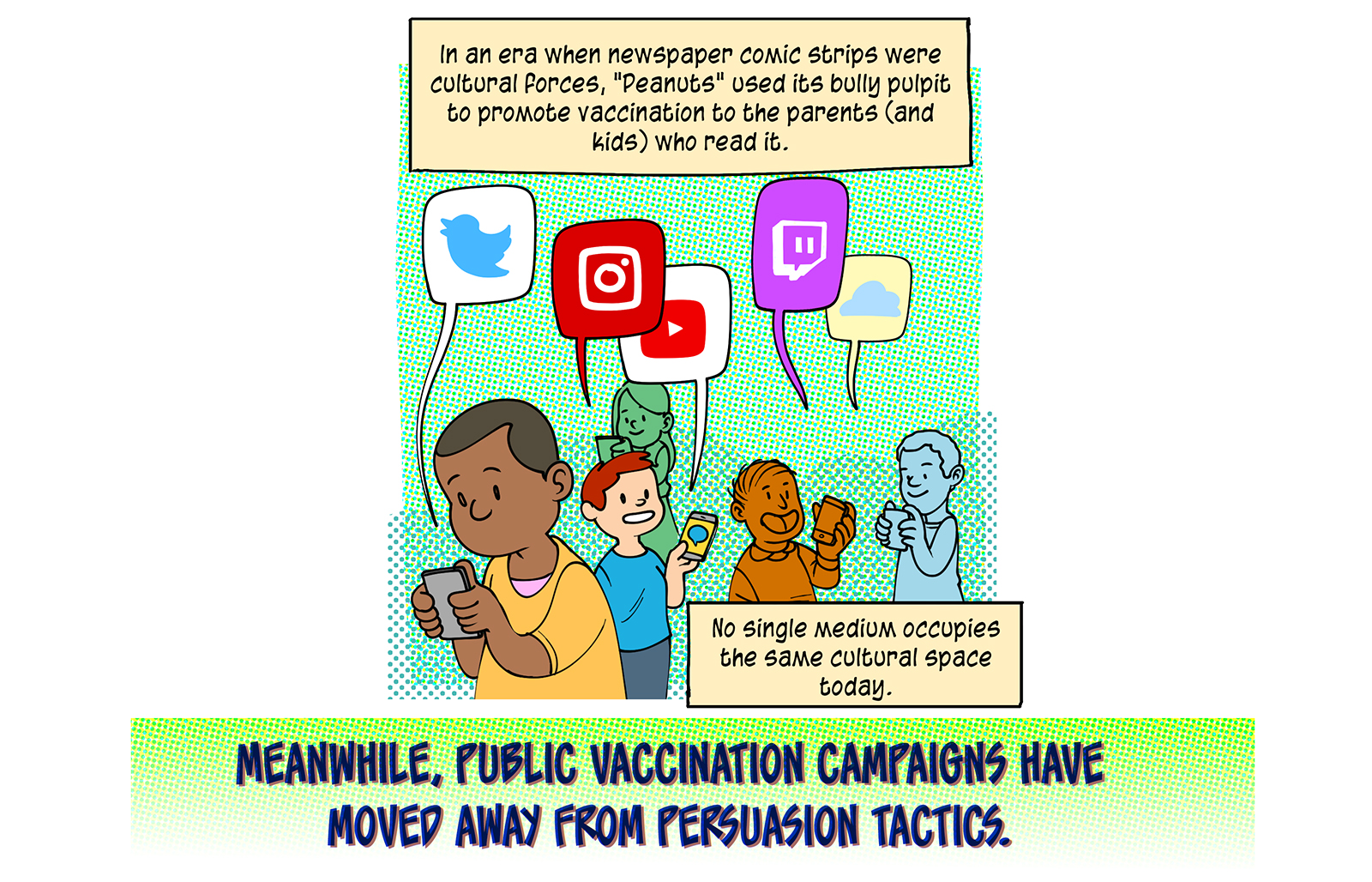
A mixed crowd of people look at their phones, with speech bubbles containing various social media icons coming out of them. Caption: ln an era when newspaper comic strips were cultural forces, "Peanuts" used its bully pulpit to promote vaccination to the parents (and kids) who read it. No single medium occupies the same cultural space today. Meanwhile, public vaccination campaigns have moved away from persuasion tactics.
A large hand keeps a coughing child surrounded by viruses away while in another panel, Jenny McCarthy angrily tells her story. Caption: Many states require children to be vaccinated before they can attend school (with exceptions for those who cannot receive vaccines) while too often white media figures promote anti-vaccination conspiracy theories. Quote: [My son] died in front of me for two minutes. Give me mumps and measles. I'll take that way over autism any day. Larry King Live, 2008.
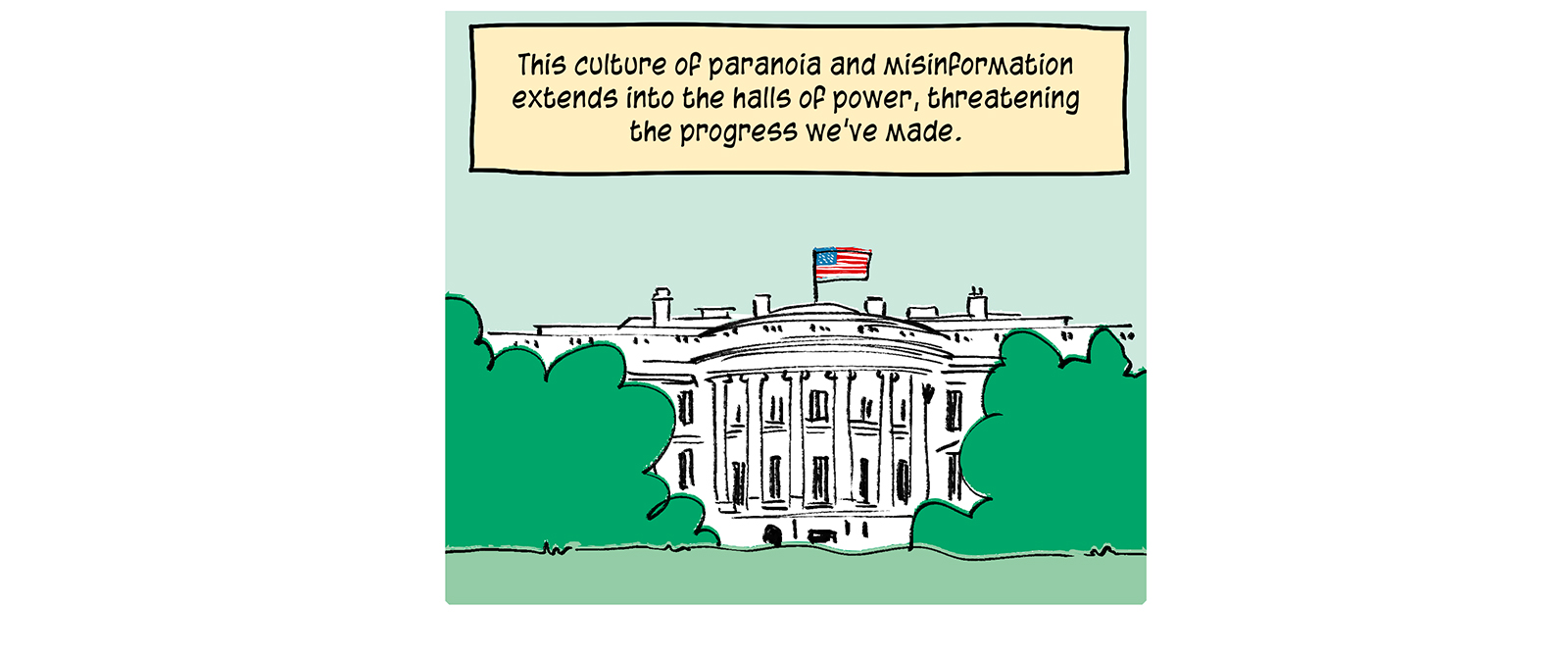
A peanuts style drawing of the White House. Caption: This culture of paranoia and misinformation extends into the halls of power, threatening the progress we’ve made.
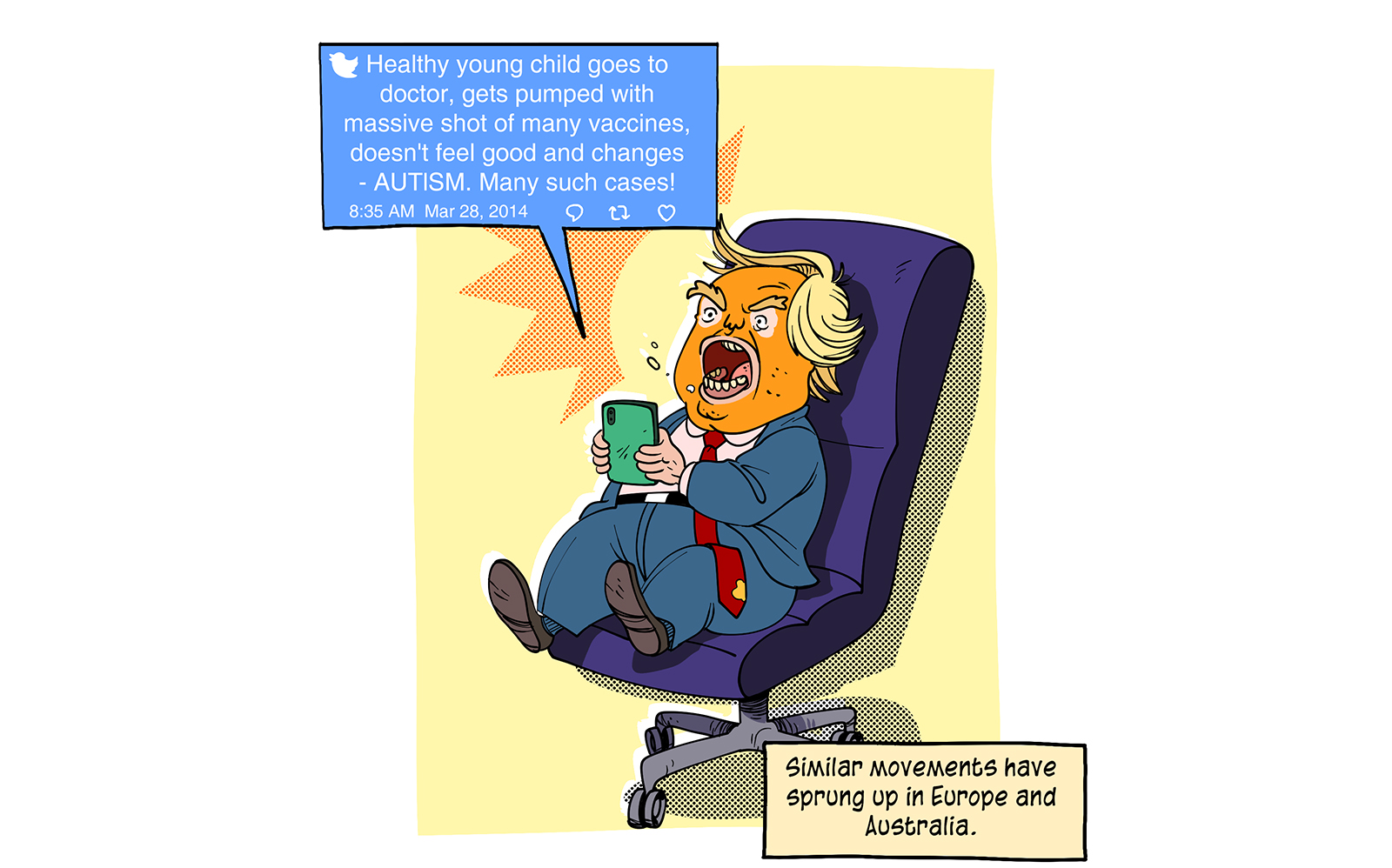
Donald Trump sits on an oversized chair as he yells and spits out tweet from 2014: Healthy young child goes to doctor, gets pumped with massive shot of many vaccines, doesn't feel good and changes - AUTlSM. Many such cases! Caption: Similar movements have sprung up in Europe and Australia.
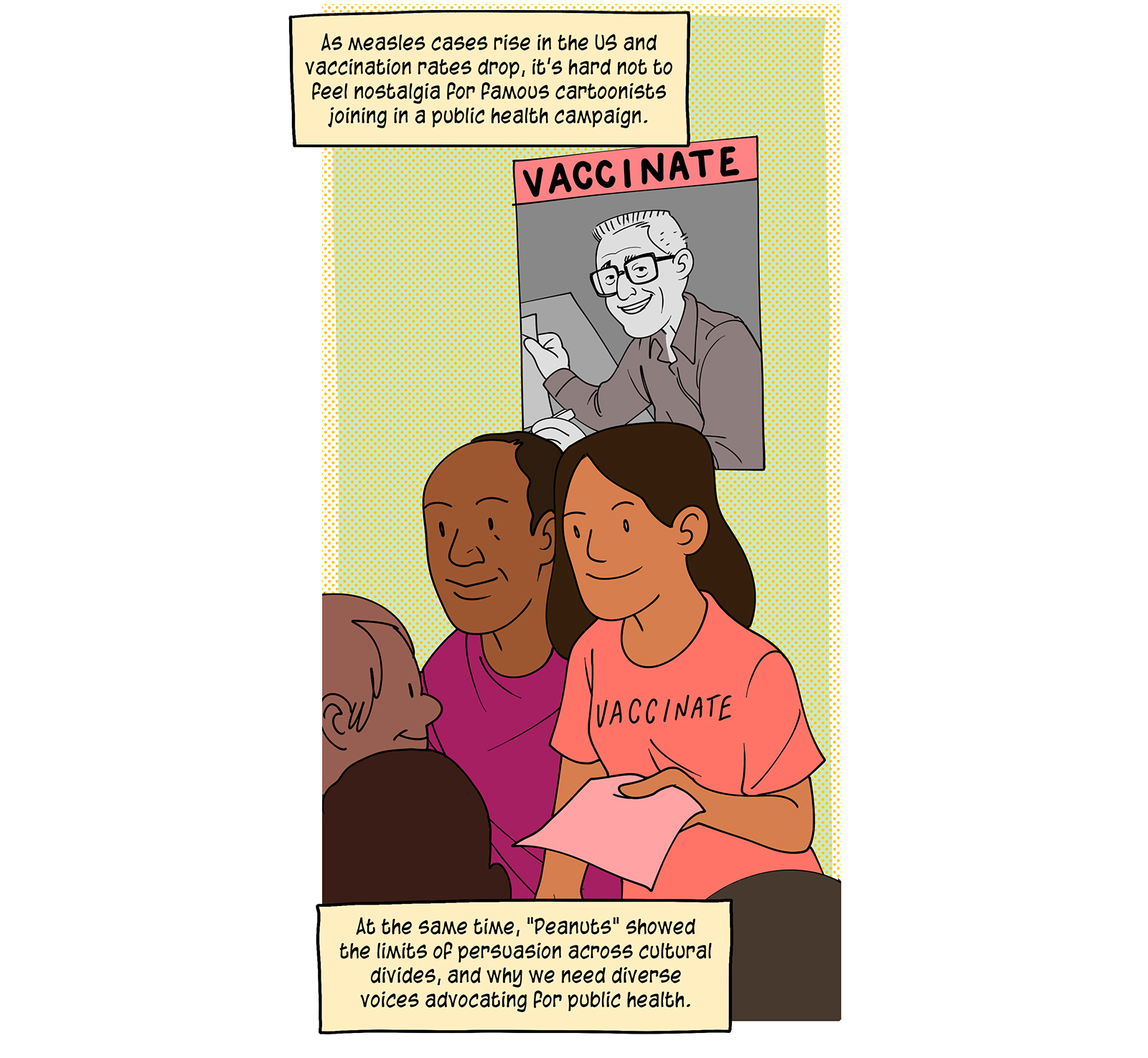
Two people of color standing before a poster of Schulz, wearing "vaccinate" t-shirts hand out flyers to mixed group. Caption: As measles cases rise in the US and vaccination rates drop, it's hard not to feel nostalgia for famous cartoonists joining in a public health campaign. At the same time, "Peanuts" showed the limits of persuasion across cultural divides, and why we need diverse voices advocating for public health.

Description

  • The Nib

  • When "Peanuts" Went All-In on Vaccinations

Charles Schulz used his culturally monolithic comic strip to advocate for public health. But his approach had some serious shortcomings.

Additional Credits

  • Writer: Matthew R Francis
  • Editor: Andy Warner