image
  • About Me
  • Portfolio
    • Comics
    • Illustration
    • Concept and Design
  • Commissions
  • Store
  • Contact
© 2026 Maki Naro All rights reserved. Violators will be cursed.
image

The Evolution of the Nervous System
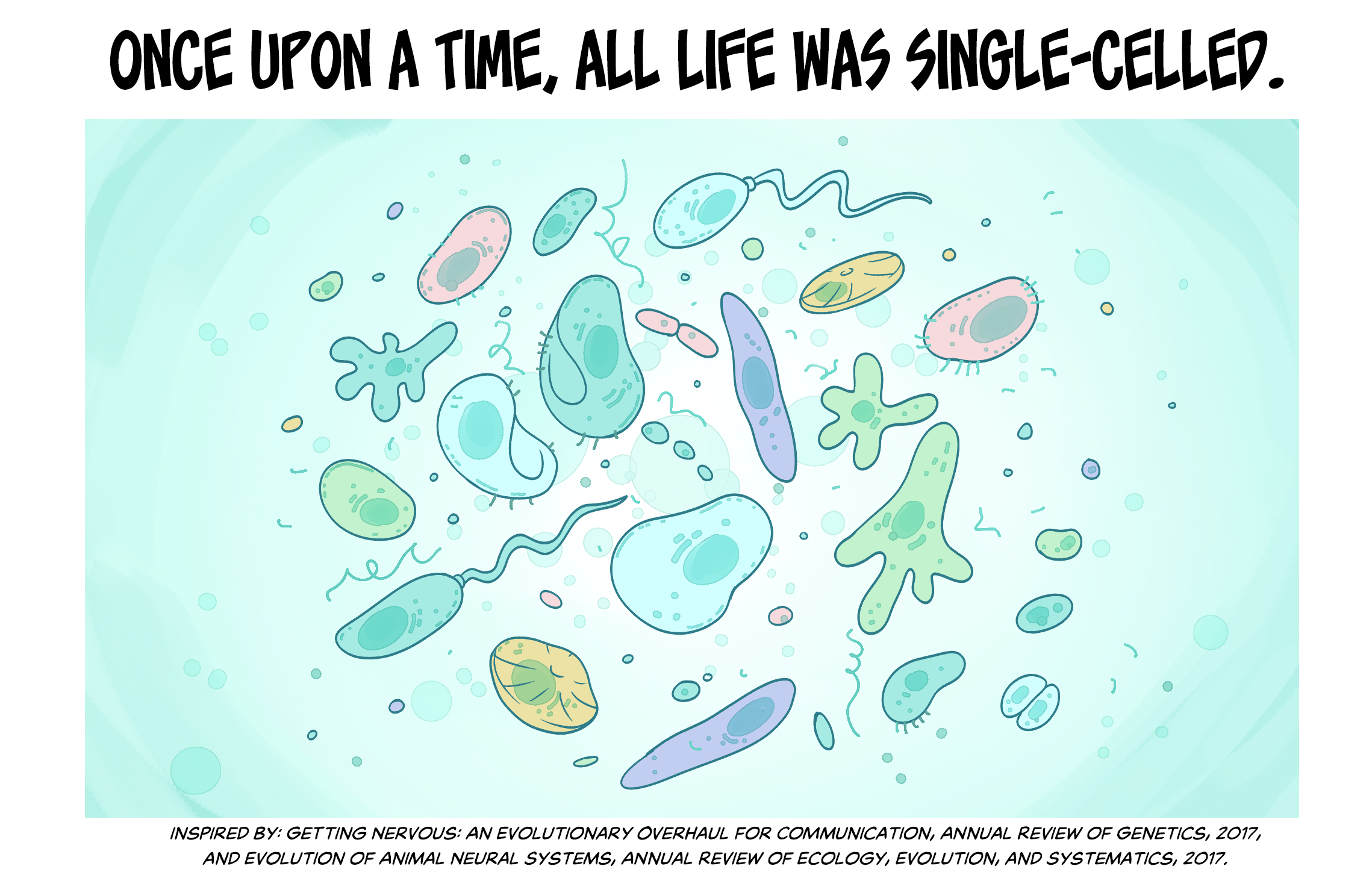
Text: Once upon a time, all life was single-celled. Illustration: In a softly backlit scene from a microscope slide, a colorful collection of single celled organisms of all shapes and sizes loosely fills a circular space in the frame. Subtitle: Inspired by: Getting Nervous: An Evolutionary Overhaul for Communication, Annual Review of Genetics, 2017, and Evolution of Animal Neural Systems, Annual Review of Ecology, Evolution, and Systematics, 2017.
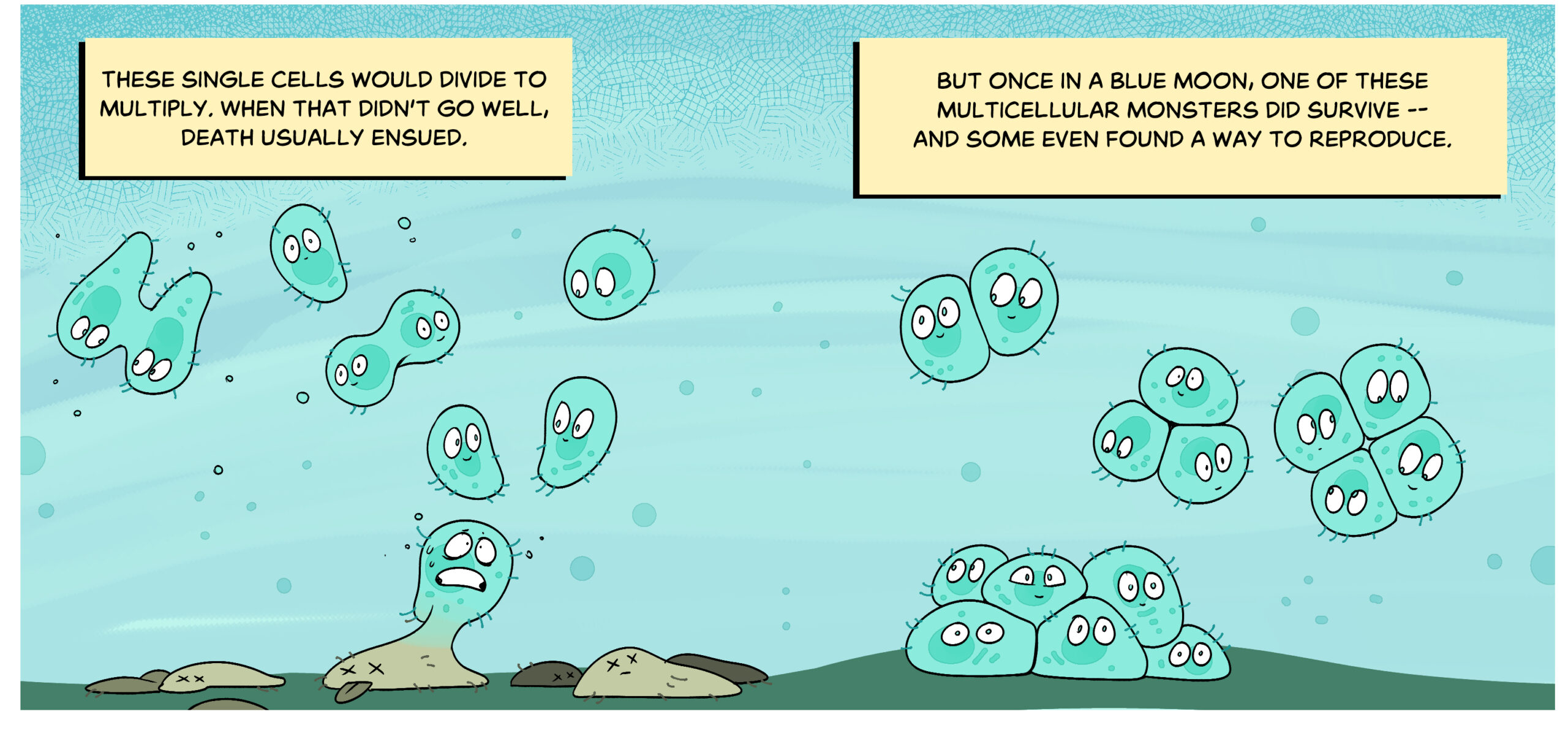
Text: These single cells would divide to multiply. When that didn’t go well, death usually ensued. But once in a blue moon, one of these multicellular monsters did survive — and some even found a way to reproduce. Illustration: A progression of green cells with hairlike cilia swim in a shallow sea. They begin to split into two new cells, some successfully, some not. The dead litter the sea floor. On the other side of the panel, the cells are improving, forming familiar bunches of 2, 3, and 4. On the floor is now a happier mound of living cells.
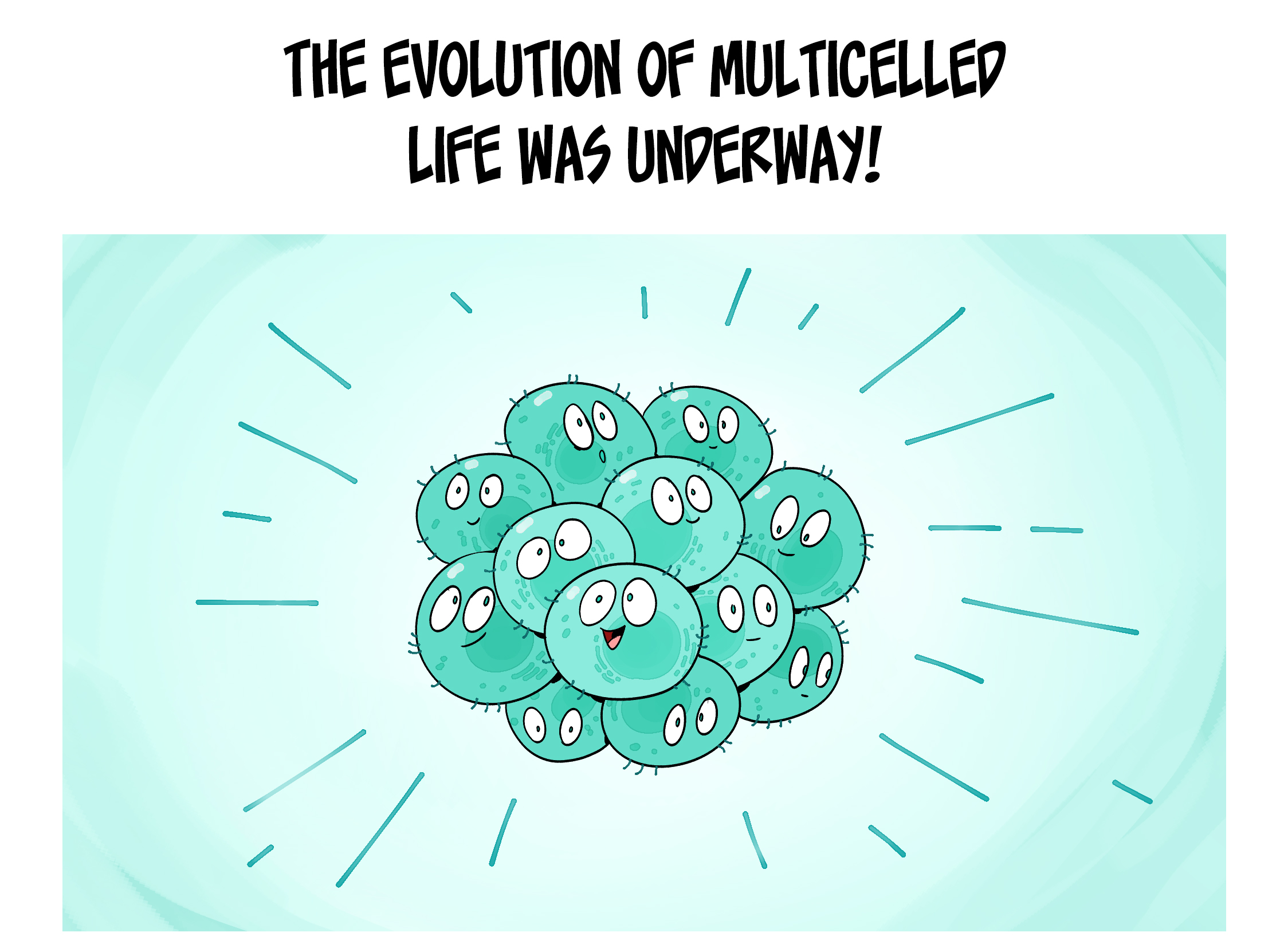
Text: The evolution of multicelled life was underway! Illustration: The loose circular gaggle of cells from the first panel have been replaced by a tighter, more uniformly packed collection of identical happy cells.
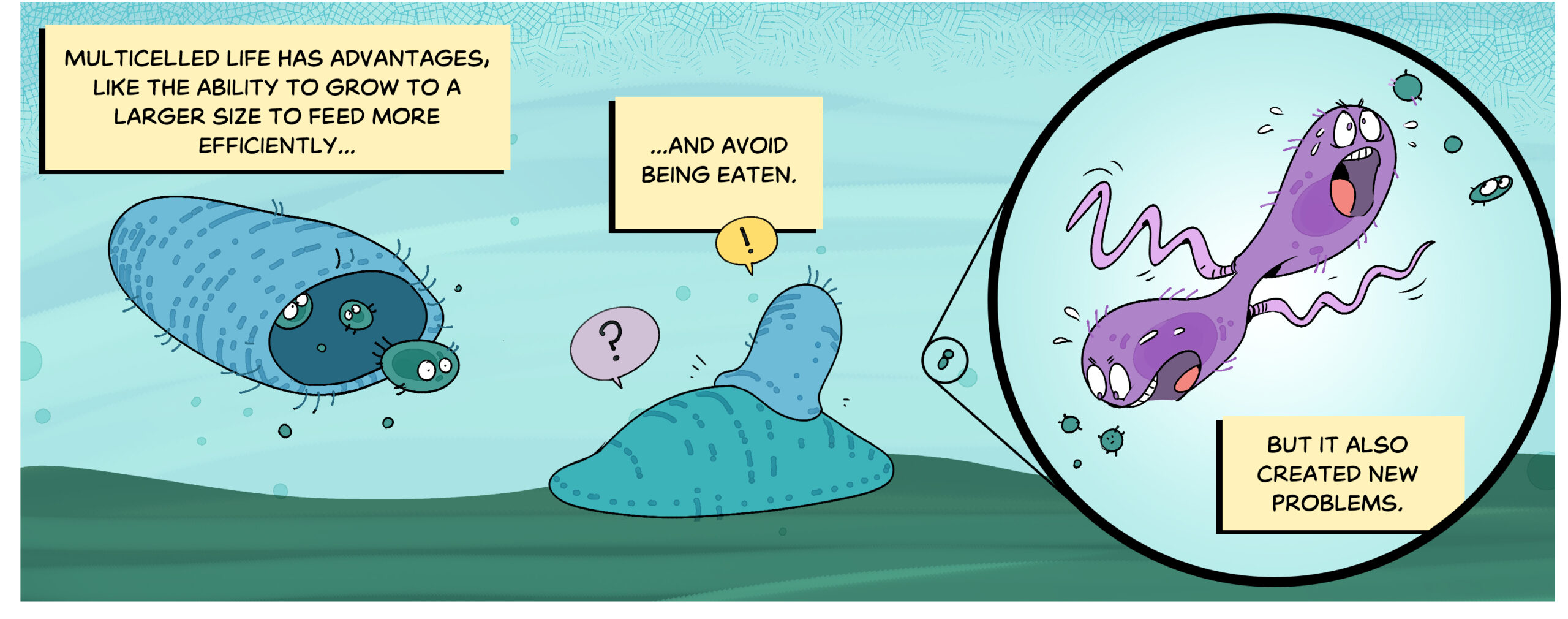
Text: Multicelled life has advantages, like the ability to grow to a larger size to feed more efficiently and avoid being eaten. But it also created new problems. Illustration: Back on the sea floor, a featureless tube made up of many cells swallows up lone stragglers. Another tube organism latches onto a larger one, but is unable to swallow it up. In a magnified view section of the scene, two purple oval shaped cells with whip-like flagella struggle to swim after pieces of food in opposite directions.
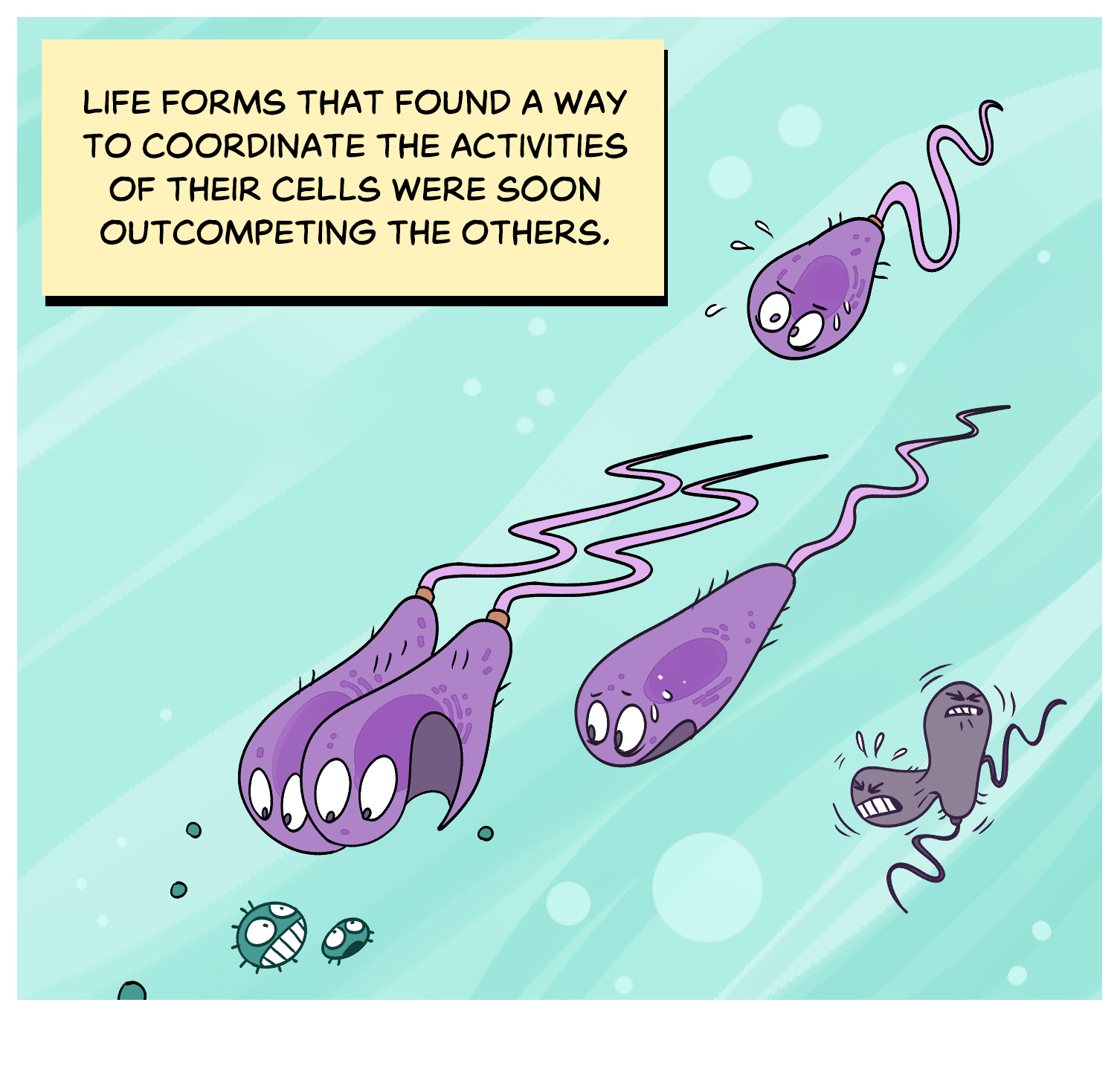
Text: Life forms that found a way to coordinate the activities of their cells were soon outcompeting the others. Illustration: Another two of these cells swim in unison with open mouths toward a smaller cell. Rapidly overtaking a lone cell going after the same prey.
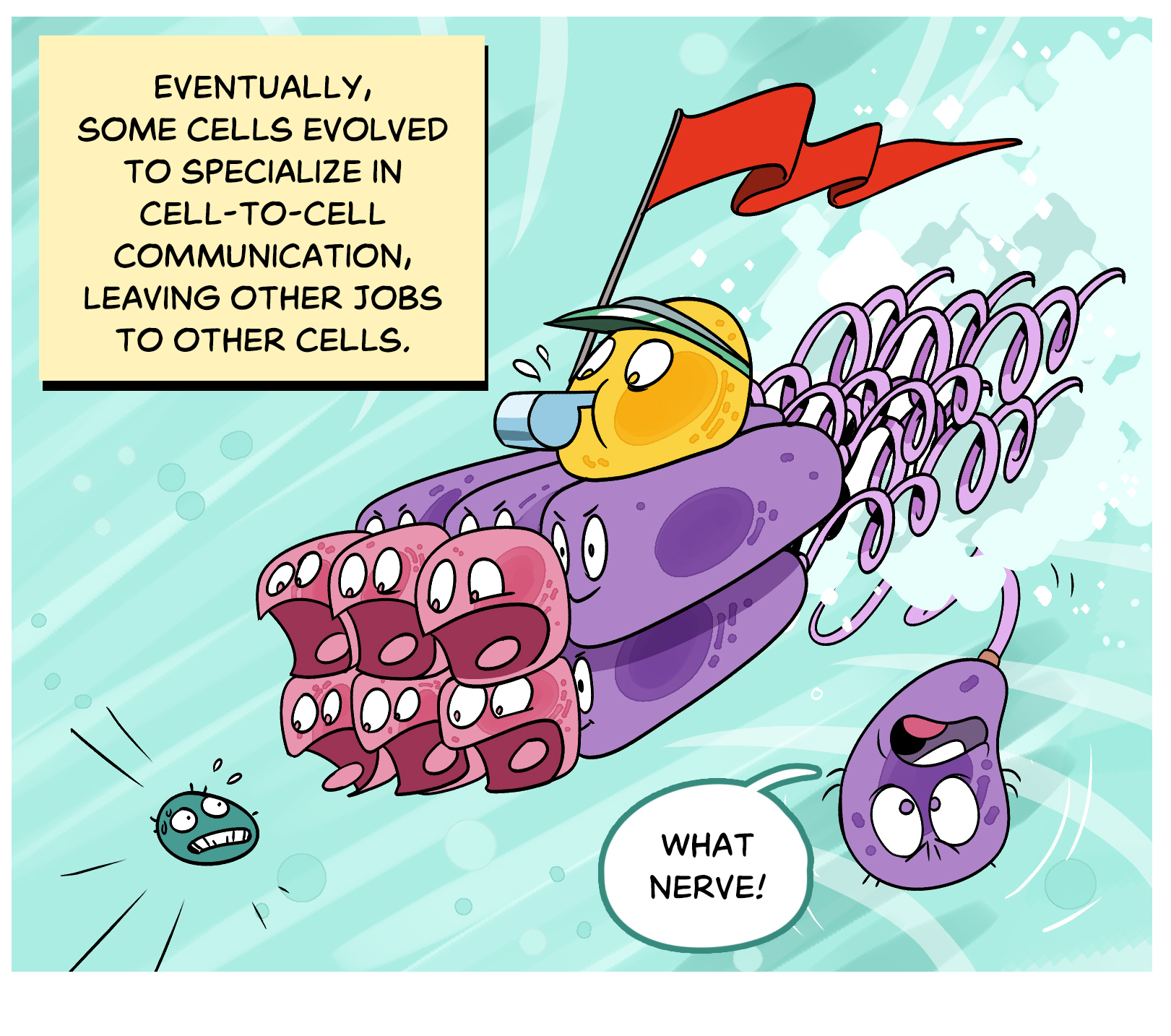
Text: Eventually, some cells evolved to specialize in cell-to-cell communication, leaving other jobs to other cells. Illustration: The two cells have upgraded to 6 swimming cells, 6 shorter, rounder cells with open mouths, and one yellow cell with a pennant, visor, and whistle seemingly directing them. The tails of the new organism whirl rapidly, kicking up bubbles and tossing a lone cell to the side who remarks, “What nerve!”
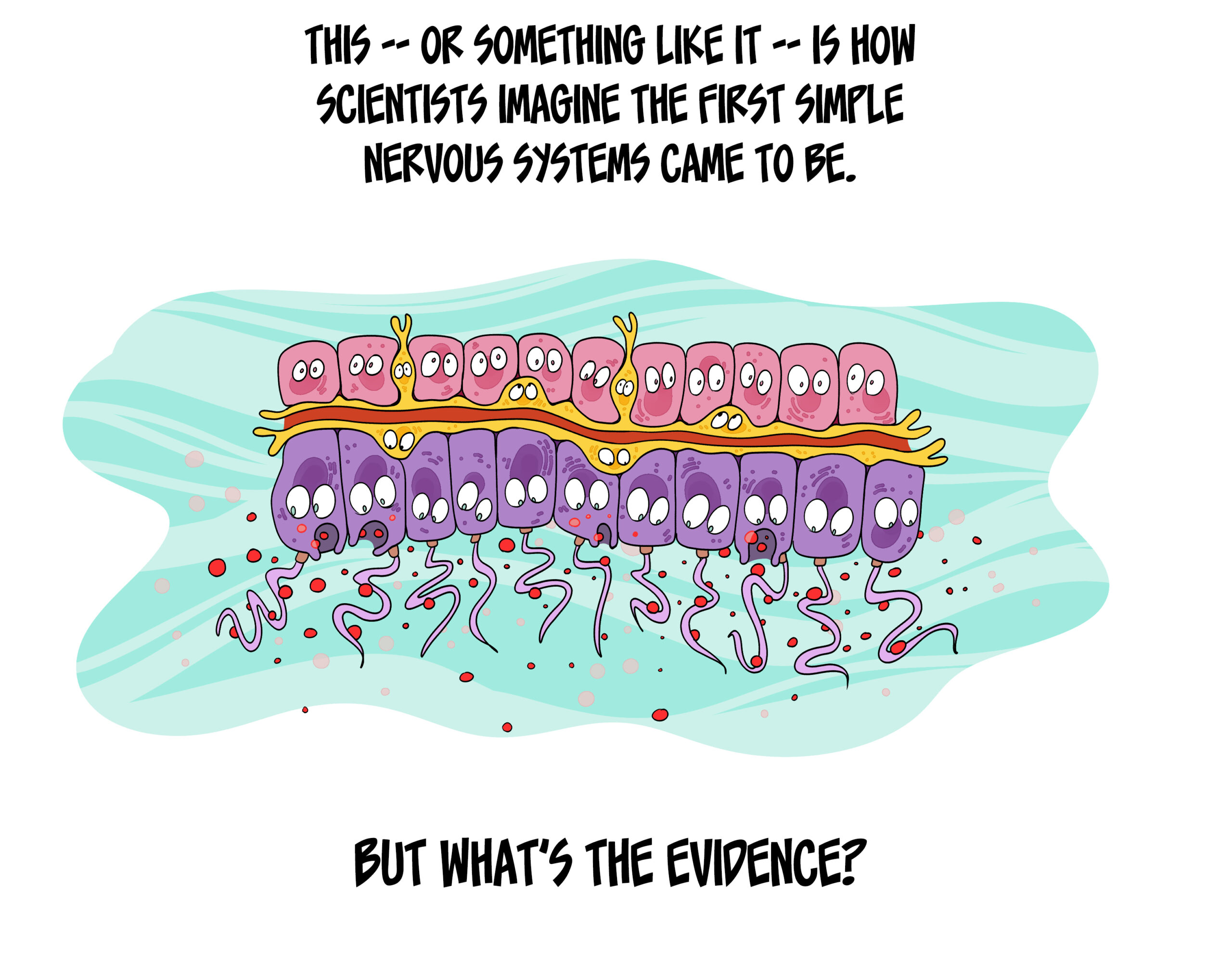
Text: This — or something like it — is how scientists imagine the first simple nervous systems came to be. But what's the evidence? Illustration: In a cross-section view, we see the different cells arranged by their task. Some using their flagella to gather up food, others lining the cells like muscle tissue, while another group snakes through them like nerves.
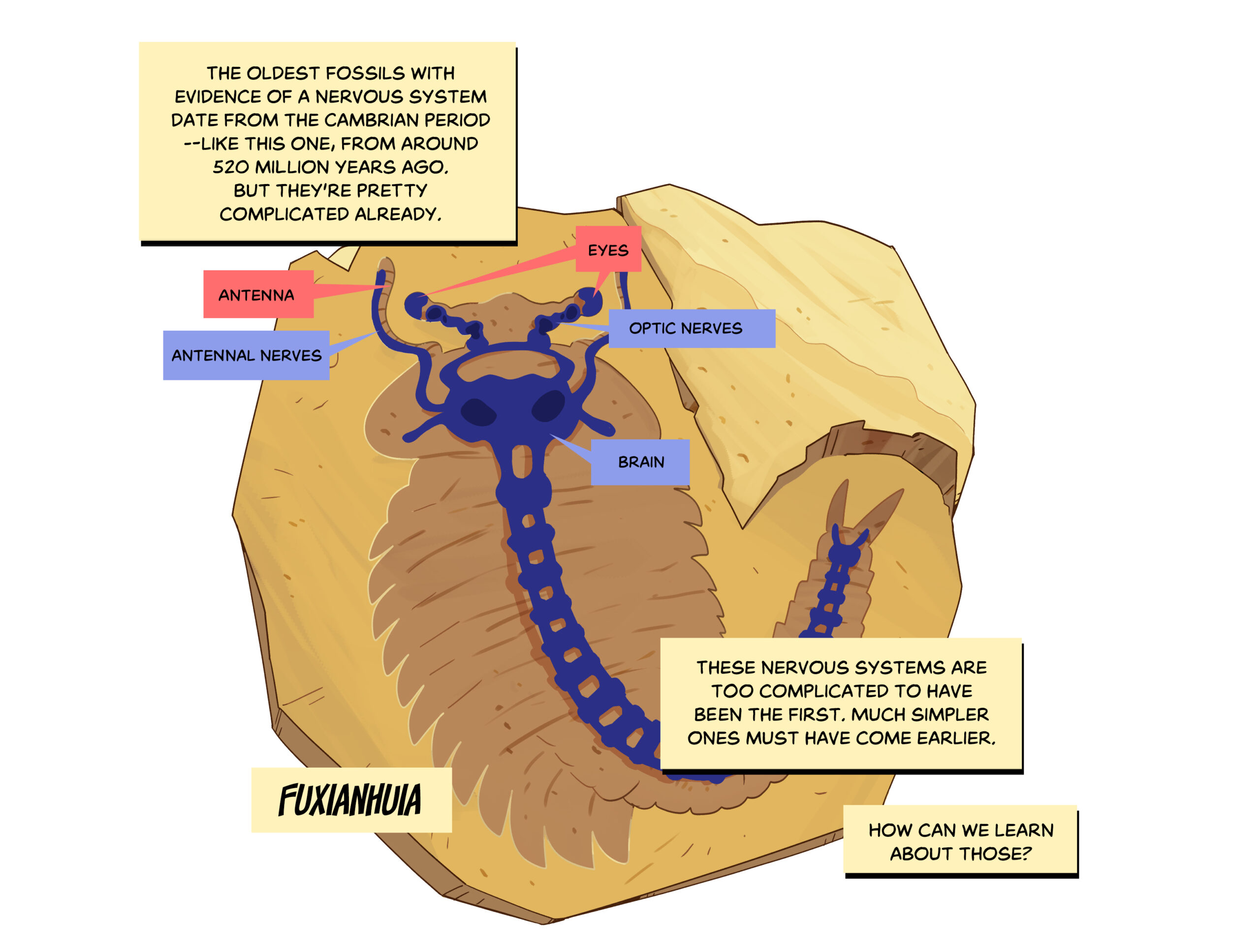
Text: The oldest fossils with evidence of a nervous system date from the Cambrian period –like this one, from around 520 million years ago. But they’re pretty complicated already. These nervous systems are too complicated to have been the first. Much simpler ones must have come earlier. How can we learn about those? Illustration: A fossil of Fuxianhuia, a trilobite-like organism with overlapping segments, a tail, and a clear head with eye stalks and antennae. Overlaid on top of it is a diagram pointing out the eyes, nerves, and brain.
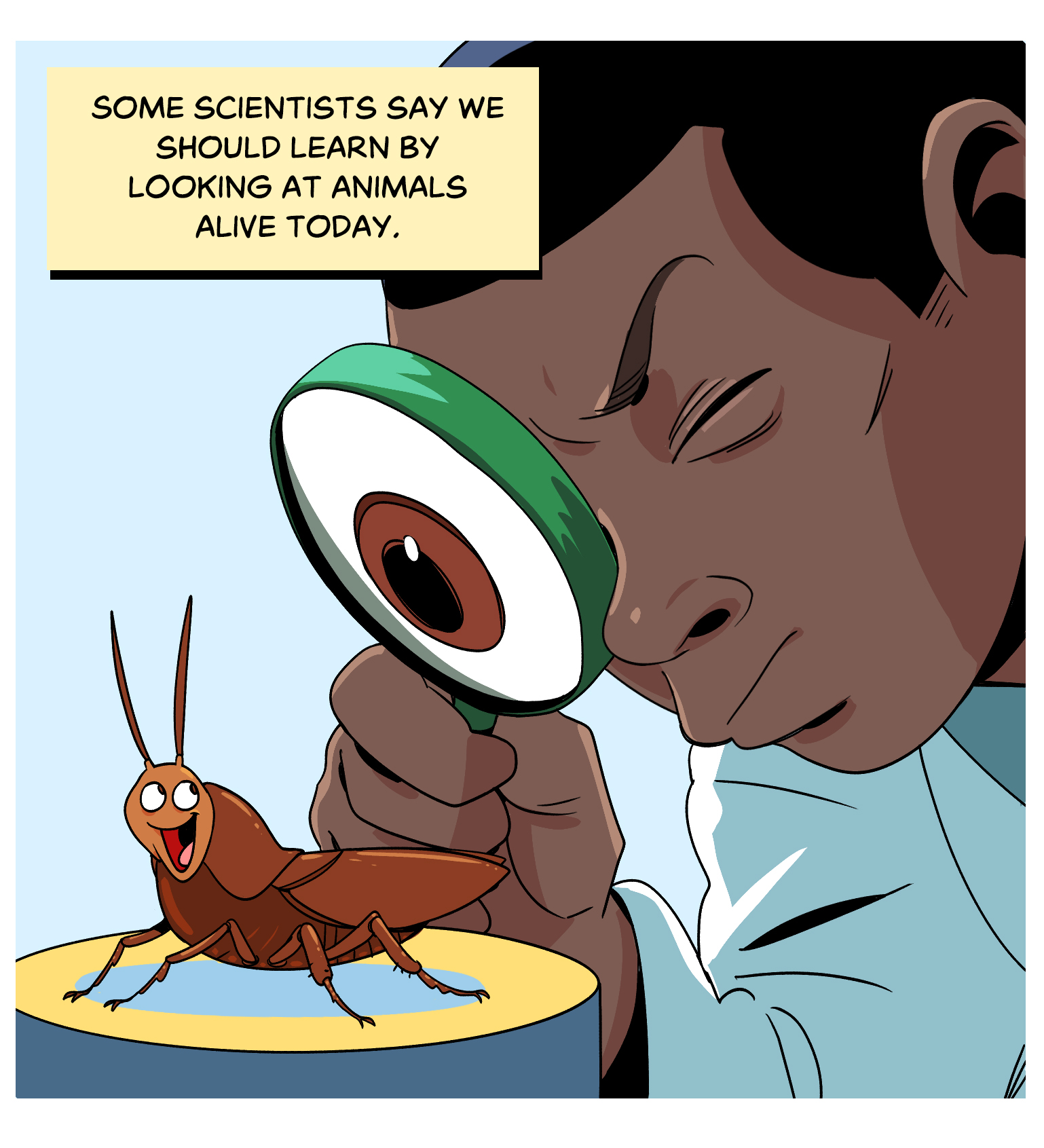
Text: Some scientists say we should learn by looking at animals alive today. Illustration: A young black scientist peers dramatically through a magnifying glass, looming over a very happy cockroach that looks back at him.
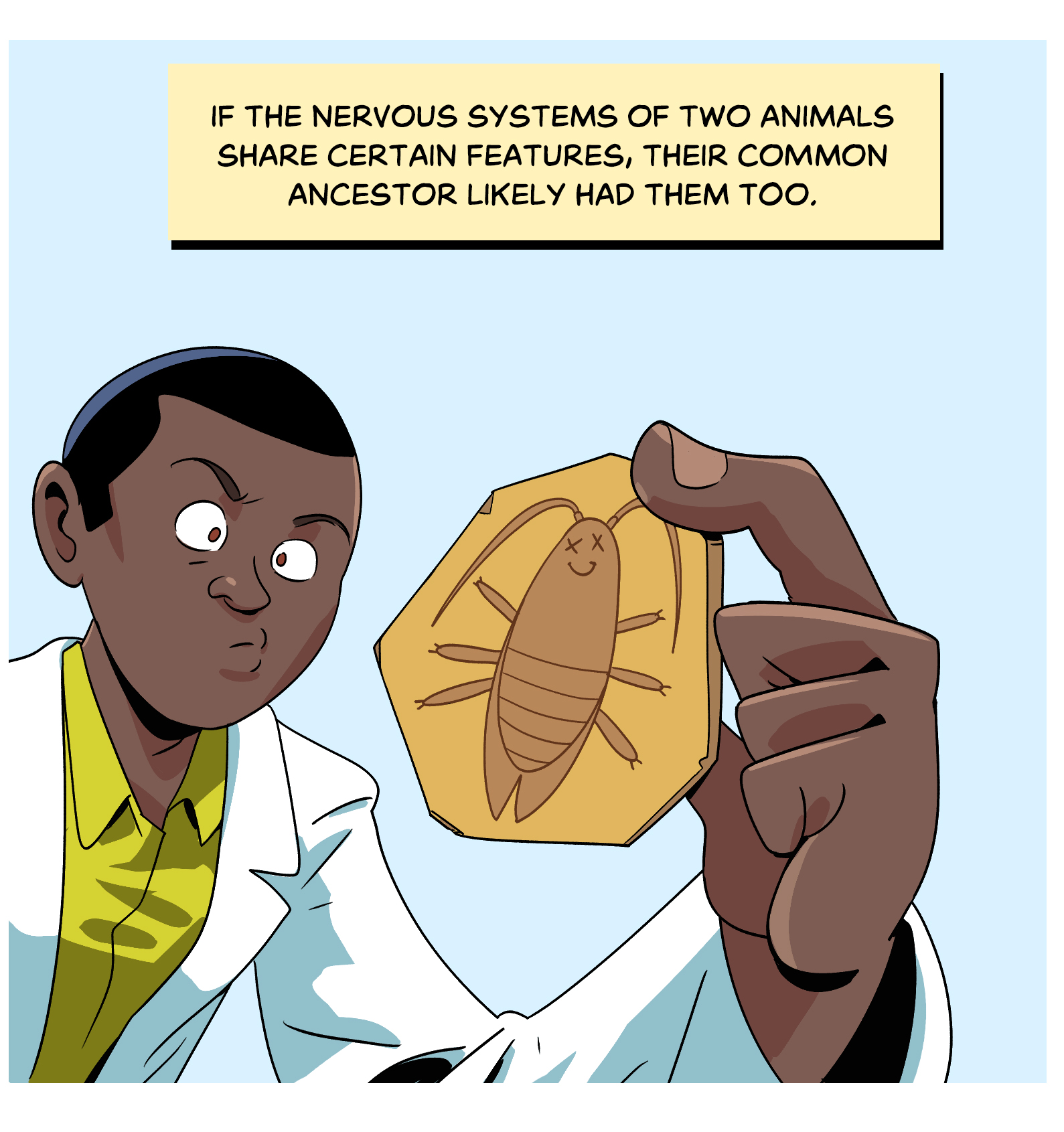
Text: If the nervous systems of two animals share certain features, their common ancestor likely had them too. Illustration: The same scientist now holds a fossil specimen of an ancient cockroach. The flattened fossil is dead with crossed out eyes, but still smiling.
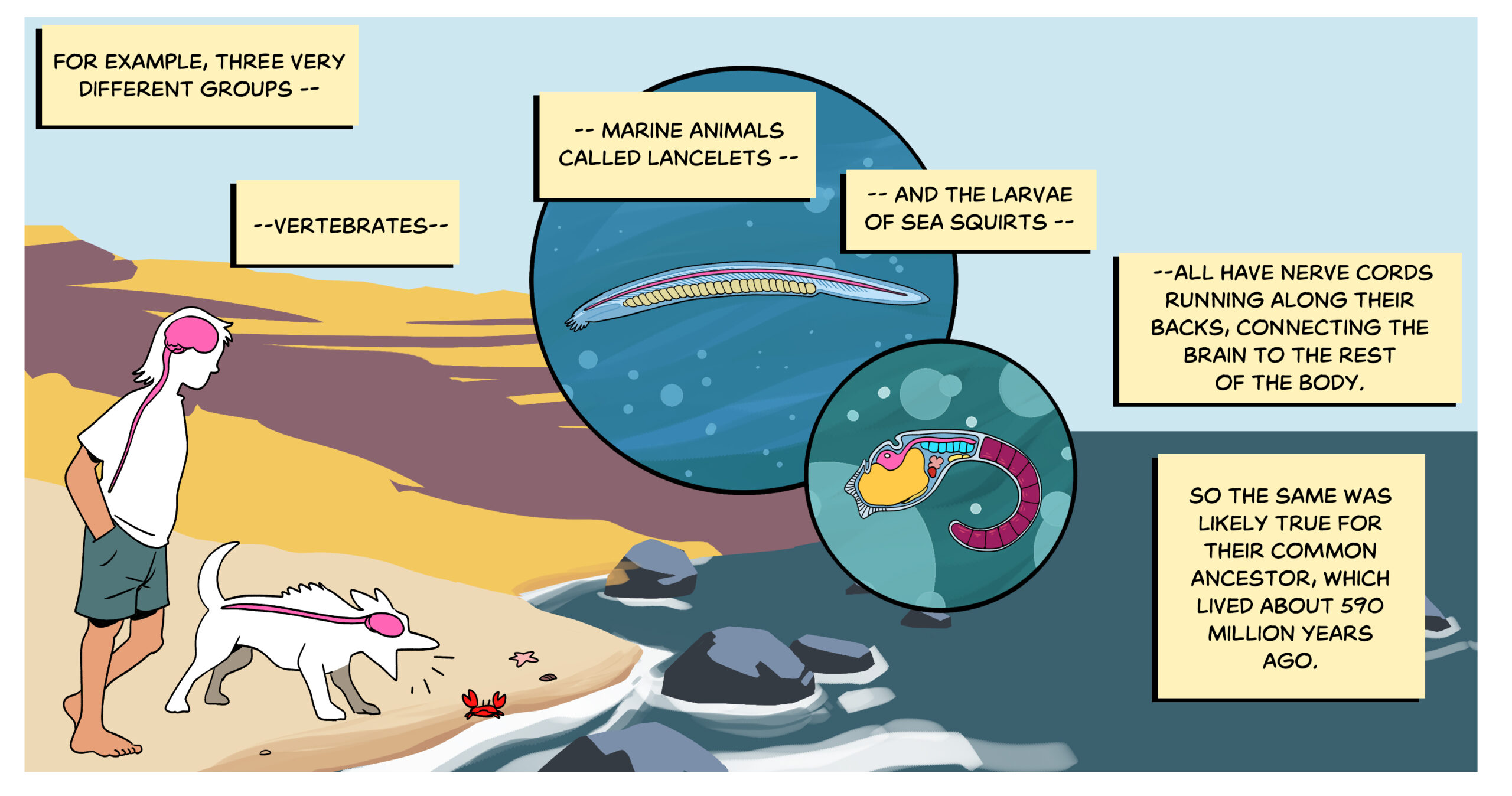
Text: For example, three very different groups — vertebrates, marine animals called lancelets, and the larvae of sea squirts all have nerve cords running along their backs, connecting the brain to the rest of the body. So the same was likely true for their common ancestor, which lived about 590 million years ago. Illustration: A person and their dog walk on a rocky beach. The dog barks at a small crab. Both figures are silhouettes that show their brain and spinal cord. In two inset panels over the ocean, cross section diagrams show the same structures in long worm like lancelets and tadpole shaped sea squirt larvae.
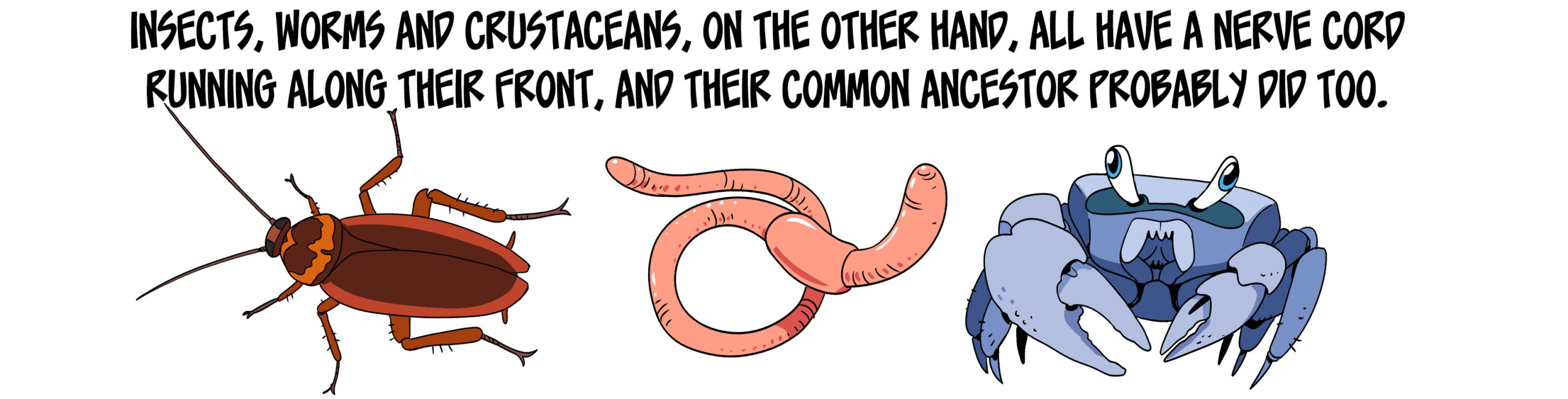
Text: Insects, worms and crustaceans, on the other hand, all have a nerve cord running along their front, and their common ancestor probably did too. Illustration: A more realistic depiction of a cockroach, earthworm, and a blue crab.
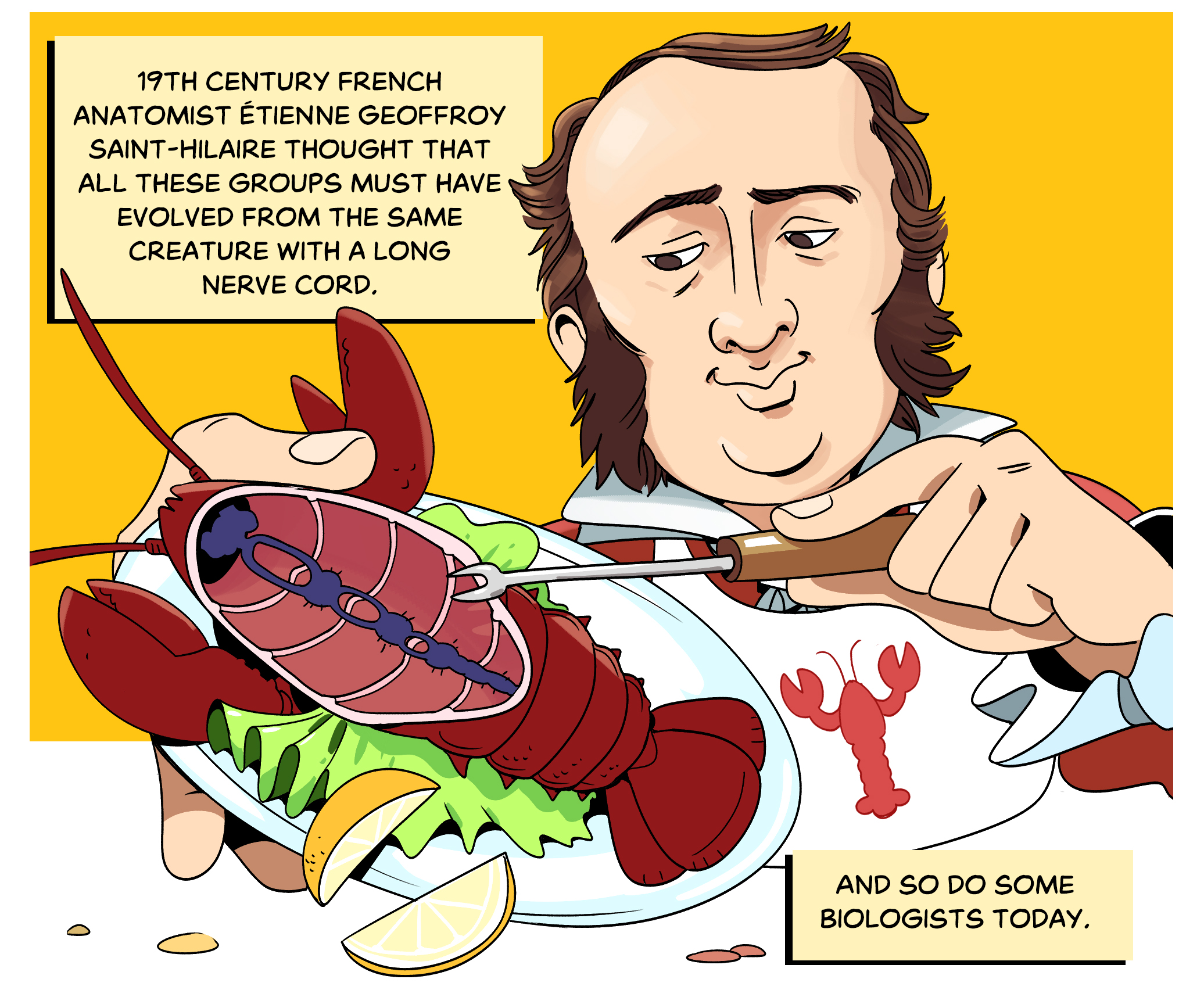
Text: 19th century French anatomist Étienne Geoffroy Saint-Hilaire thought that all these groups must have evolved from the same creature with a long nerve cord. And so do some biologists today. Illustration: Étienne, an older white man with thinning brown hair, mutton chops and a lobster bib, holds up the hollowed out shell of a lobster he is eating, spilling lemon slices onto the table. He points to the nerve cord with his seafood fork.
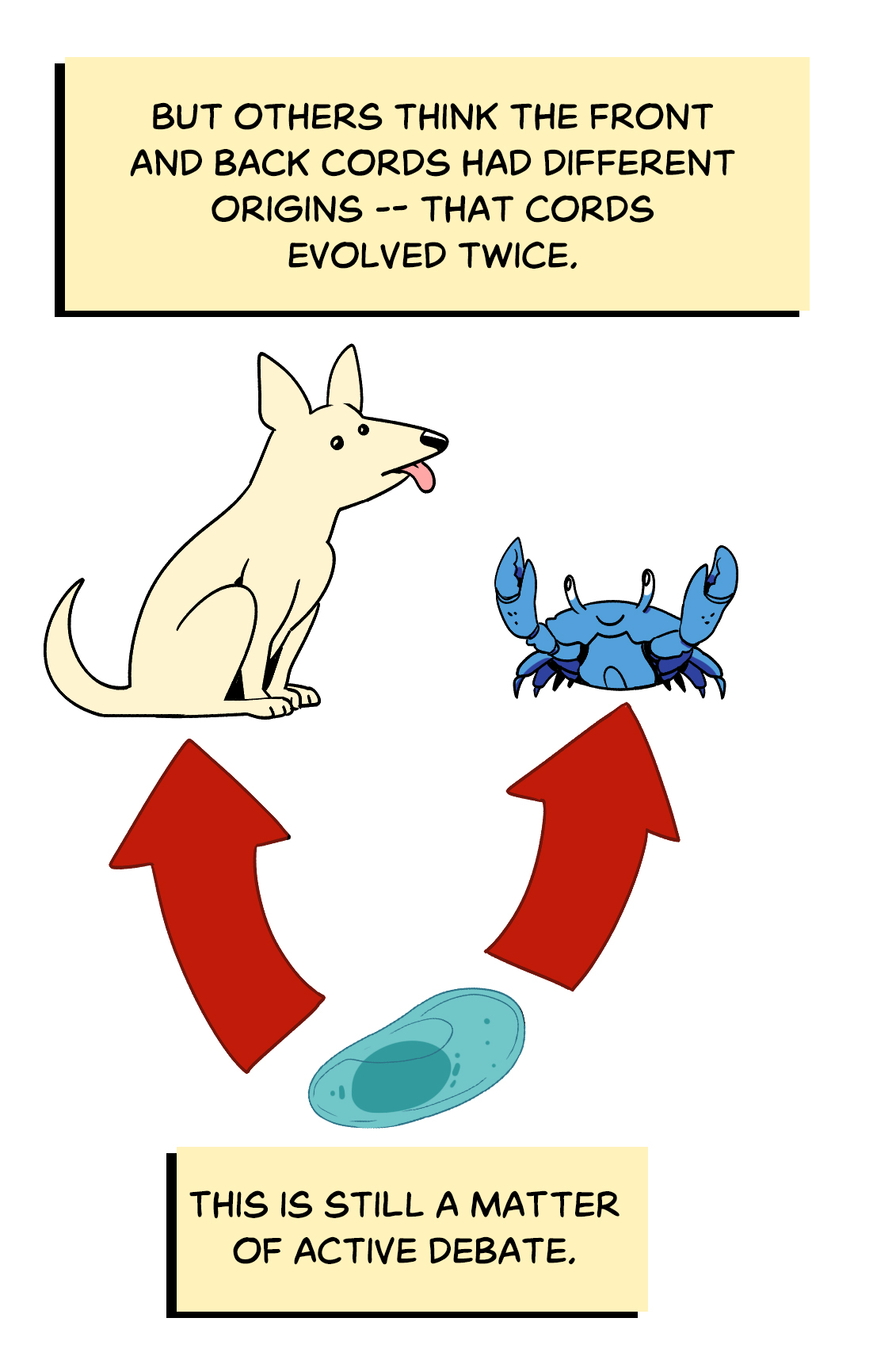
Text: But others think the front and back cords had different origins — that cords evolved twice. This is still a matter of active debate. Illustration: From a single cell, two arrows point towards a dog and a blue crab.
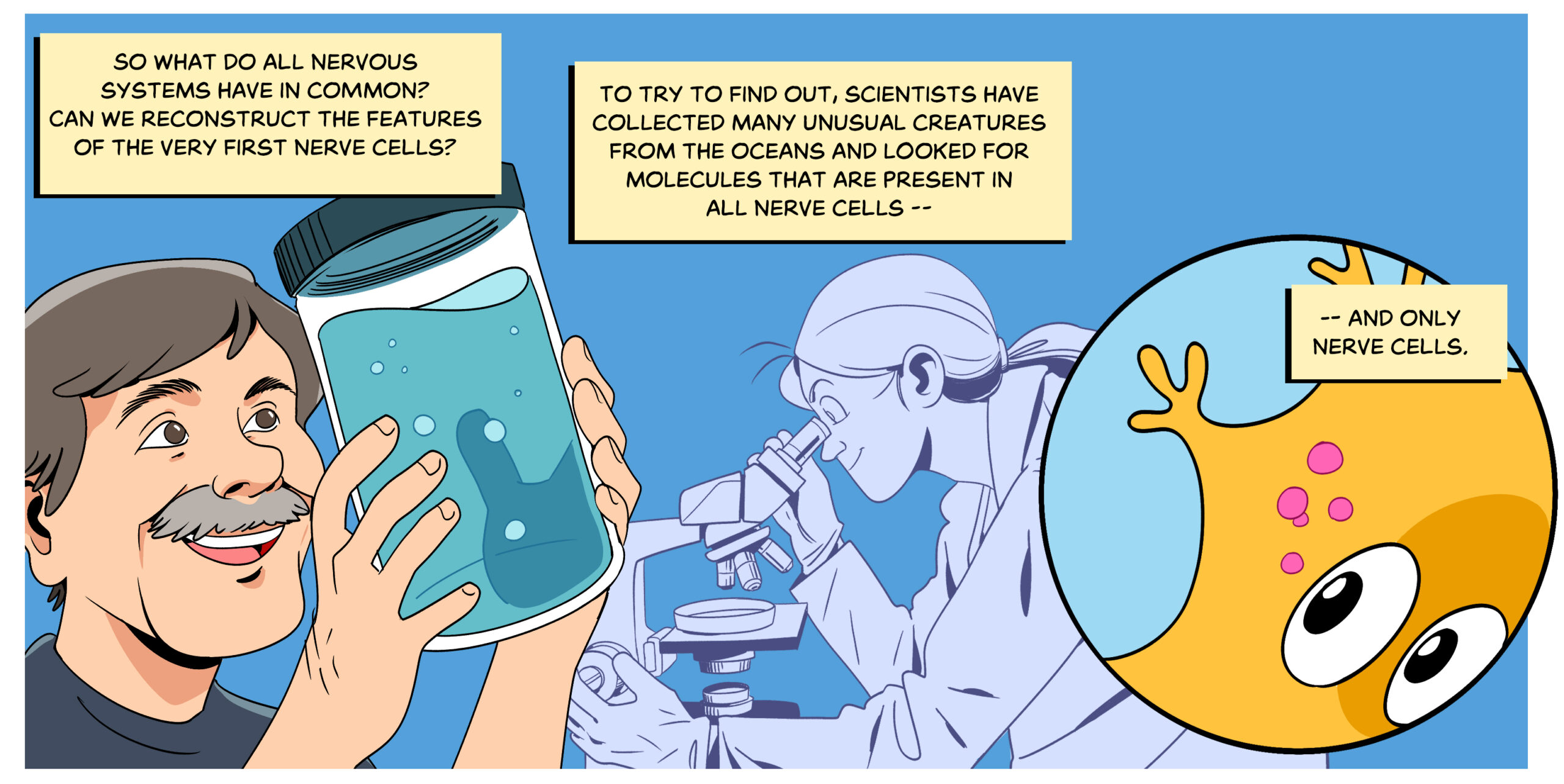
Text: So what do all nervous systems have in common? Can we reconstruct the features of the very first nerve cells? To try to find out, scientists have collected many unusual creatures from the oceans and looked for molecules that are present in all nerve cells — and only nerve cells. Illustration: A white male scientist with brown hair and a mustache smiles, holding up a jar of sea water. A female scientist with a ponytail wearing a lab coat looks through a microscope. In the microscope view, a close up look at a neuron with pink molecules inside it.
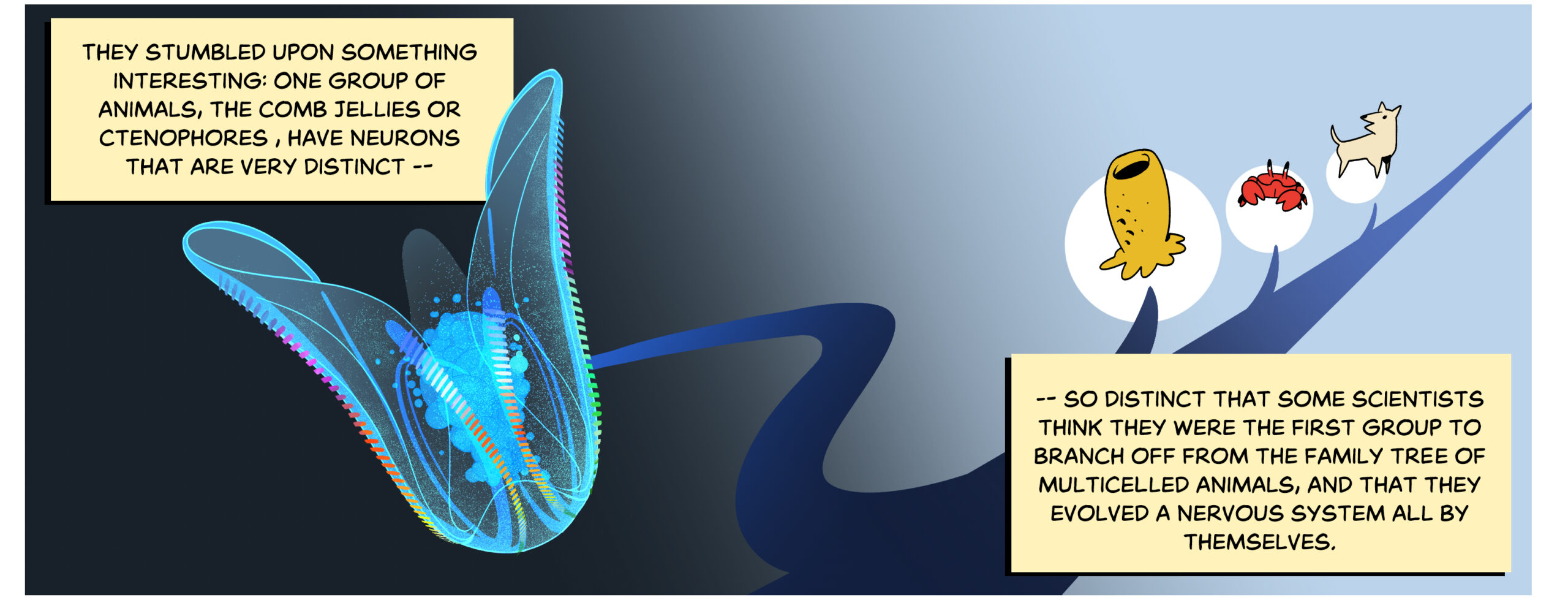
Text: They stumbled upon something interesting: One group of animals, the comb jellies or ctenophores , have neurons that are very distinct — so distinct that some scientists think they were the first group to branch off from the family tree of multicelled animals, and that they evolved a nervous system all by themselves. Illustration: Swimming in the dark sea, an ethereal, translucent comb jelly with vivid iridescent combs running up it’s flower-like body. Down the path from the jelly is an evolutionary branch with sea sponges, crabs, and dogs.
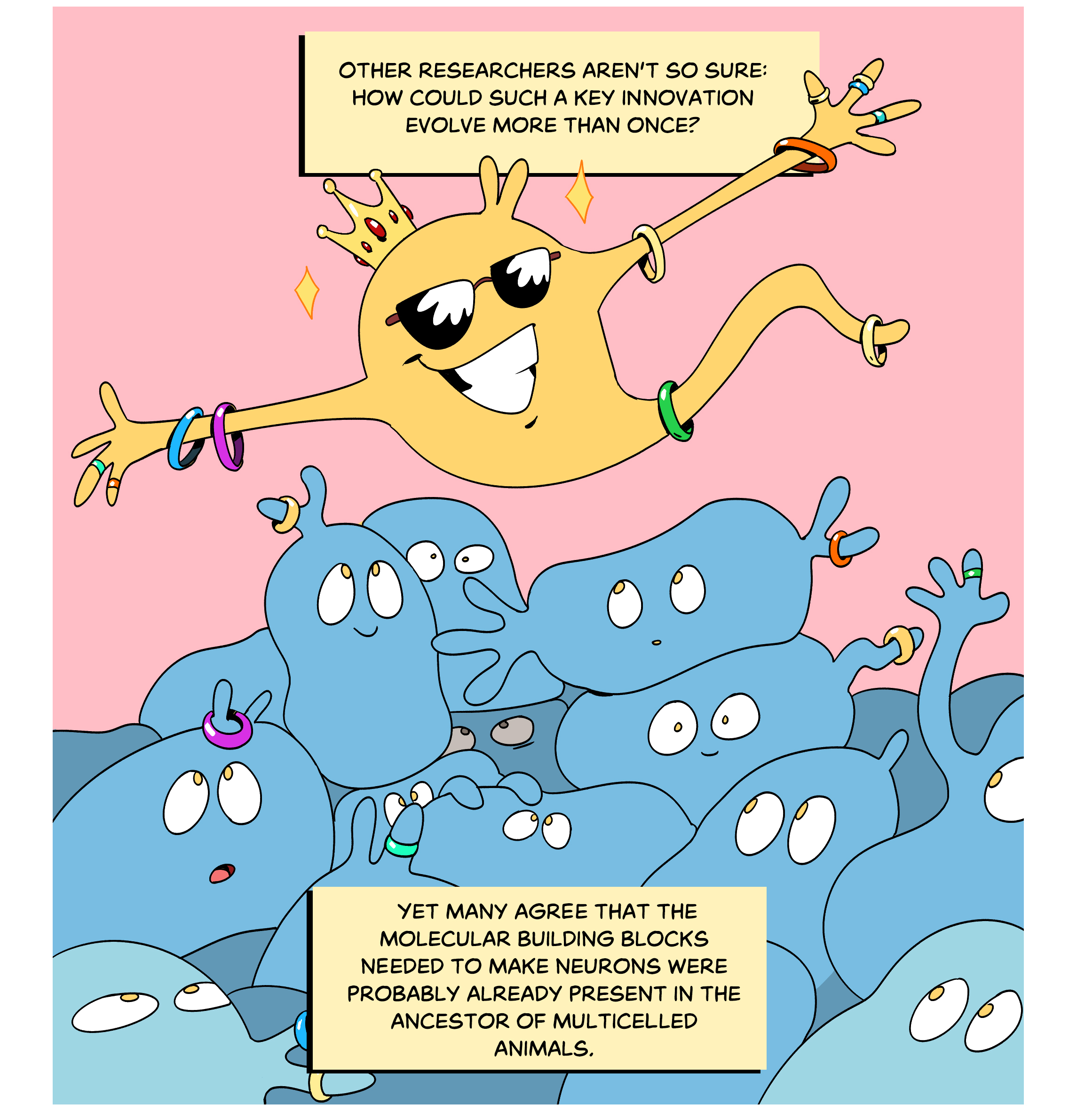
Text: Other researchers aren’t so sure: How could such a key innovation evolve more than once? Yet many agree that the molecular building blocks needed to make neurons were probably already present in the ancestor of multicelled animals. Illustration: Atop a pile of cells wearing different colored pieces of jewelry, lies a smug sunglass, wearing shining cell with all the pieces combined and a gold crown. It holds its arms out in self congratulation.
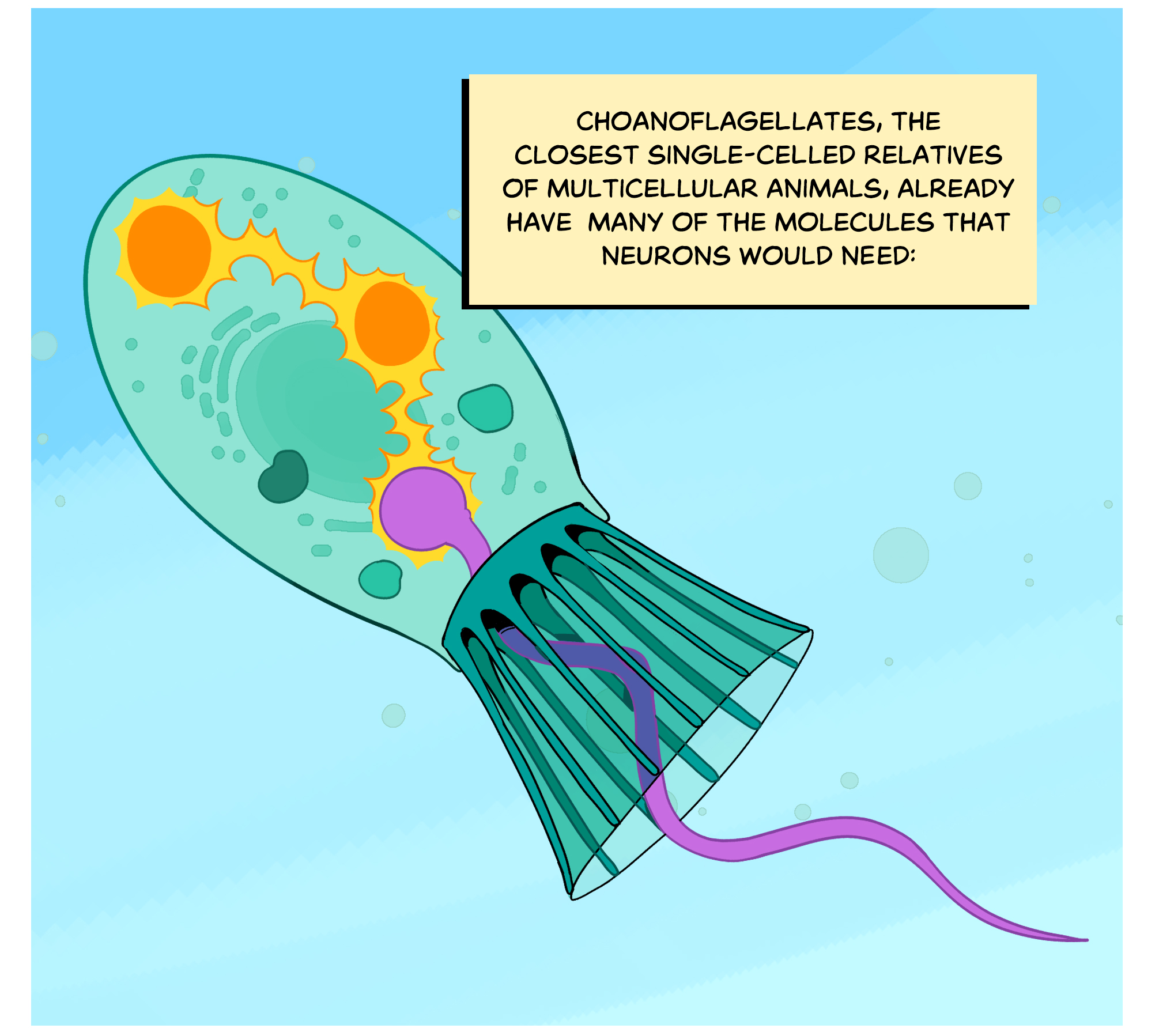
Text: Choanoflagellates, the closest single-celled relatives of multicellular animals, already have many of the molecules that neurons would need: Illustration: An oval shaped cell with a collar of webbed spines like a coffee cup from which its flagella emerges. Inside, a signal bounces between its organelles to the bulb of the flagella.
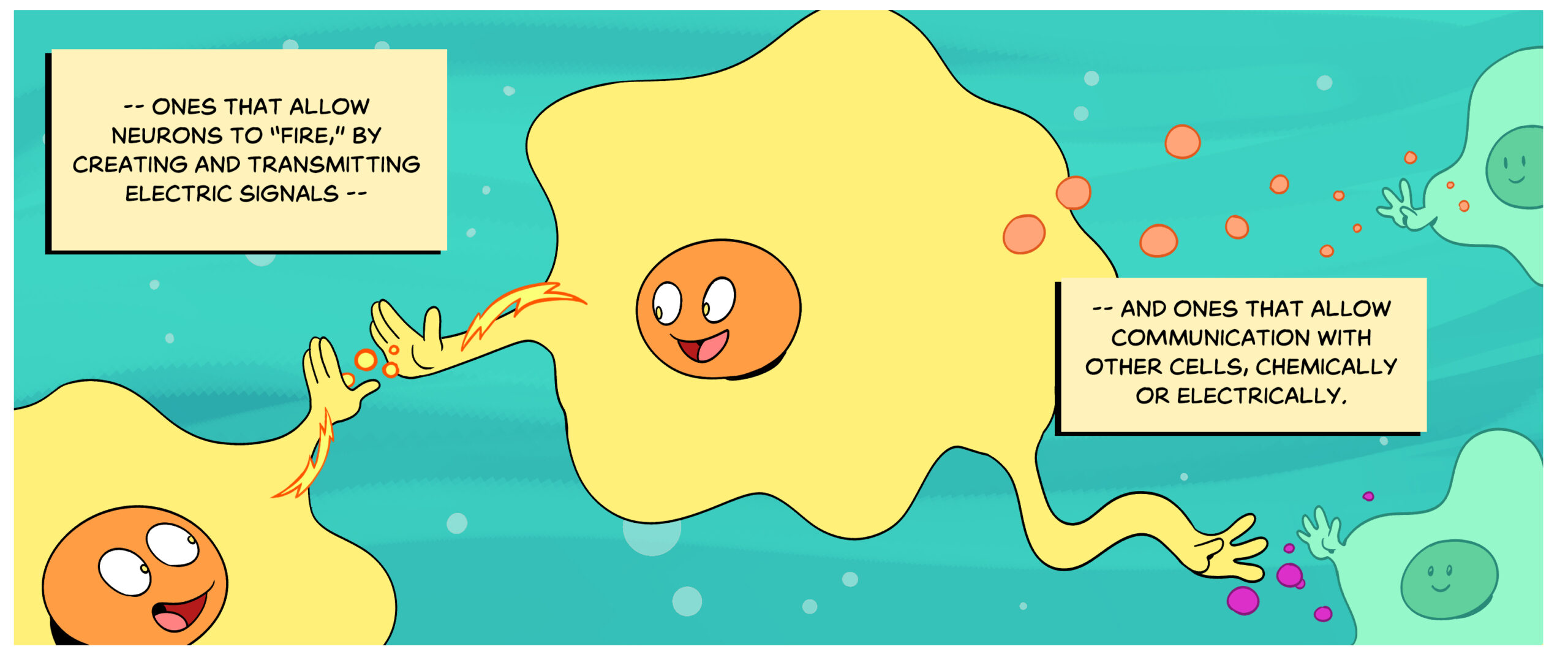
Text: — ones that allow neurons to “fire,” by creating and transmitting electric signals and ones that allow communication with other cells, chemically or electrically. Illustration: Two neurons high five each other, passing a signal between their hands. From the neuron’s other hand, molecules move towards another neuron in the background.
Text: With all of this in place, the stage was set for neurons to evolve, maybe more than once.
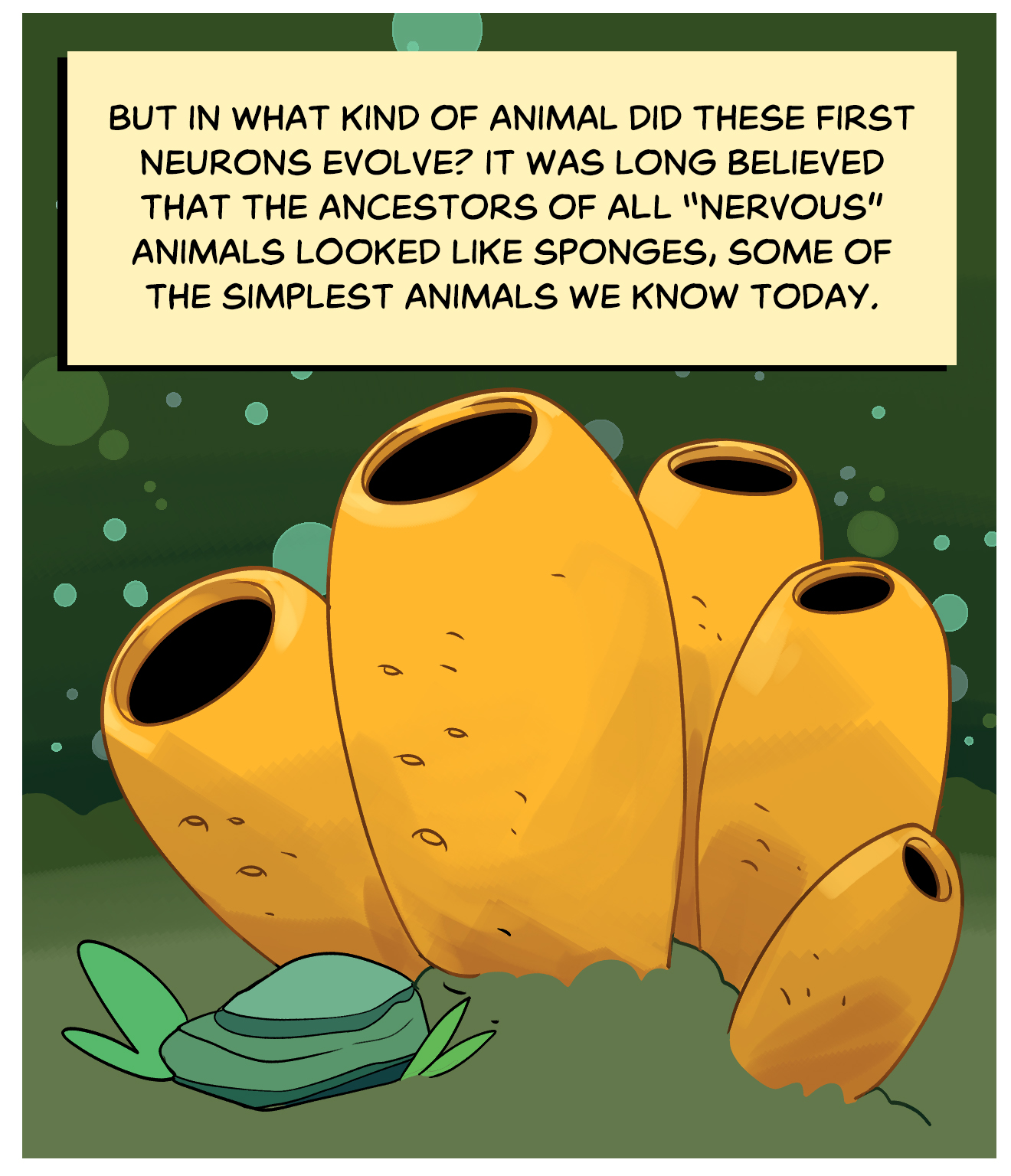
Text: But in what kind of animal did these first neurons evolve? It was long believed that the ancestors of all “nervous” animals looked like sponges, some of the simplest animals we know today. Illustration: A collection of yellow, tube shaped sea sponges on the ocean floor.
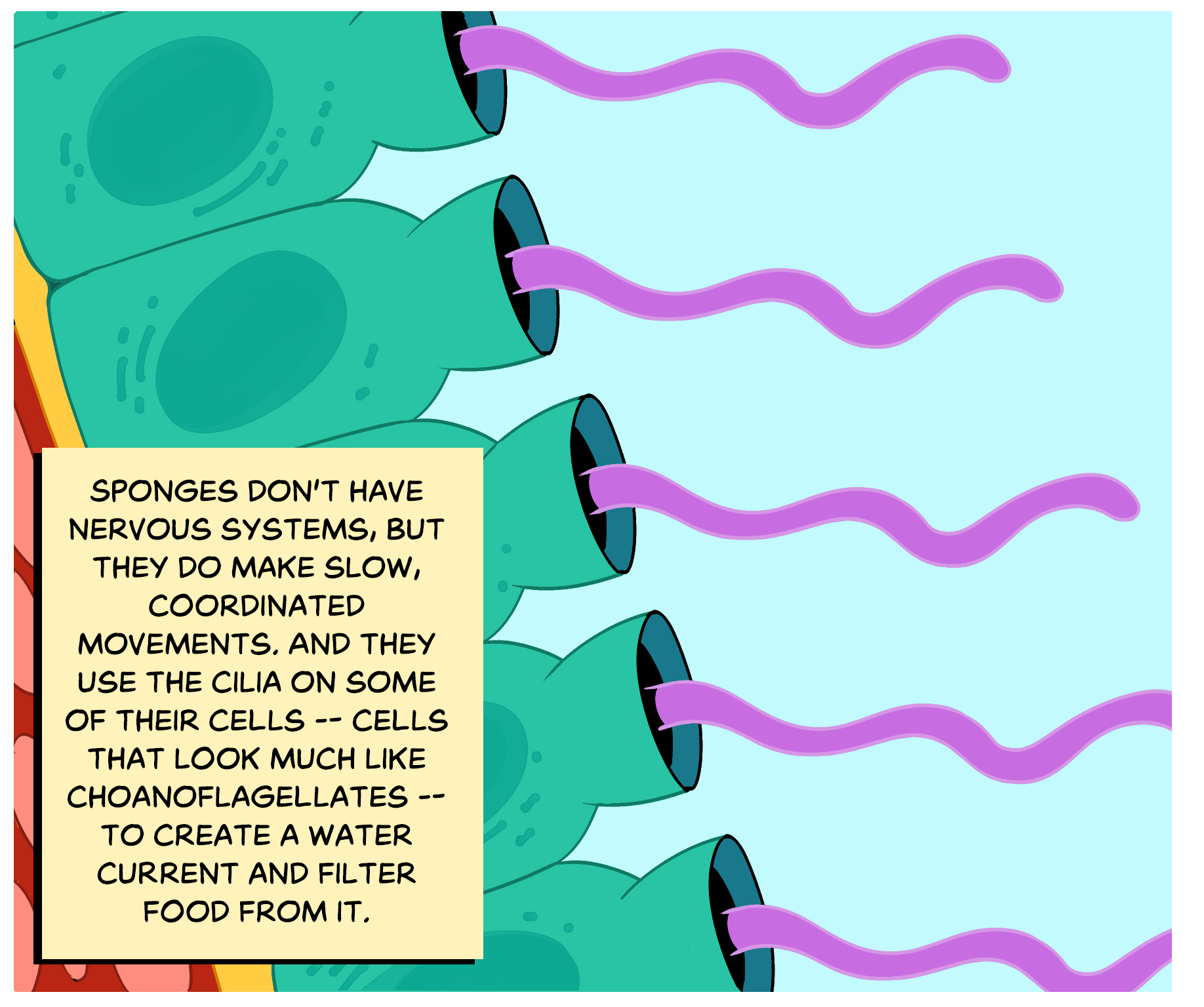
Text: Sponges don’t have nervous systems, but they do make slow, coordinated movements. And they use the cilia on some of their cells — cells that look much like choanoflagellates — to create a water current and filter food from it. Illustration: In a close up of the sponge interior, rows of cells that look like the choanoflagellate from before comb the water for food.
Text: Perhaps some sponge-like creature in the deep past decoupled contraction and communication — evolving separate cells for each task.
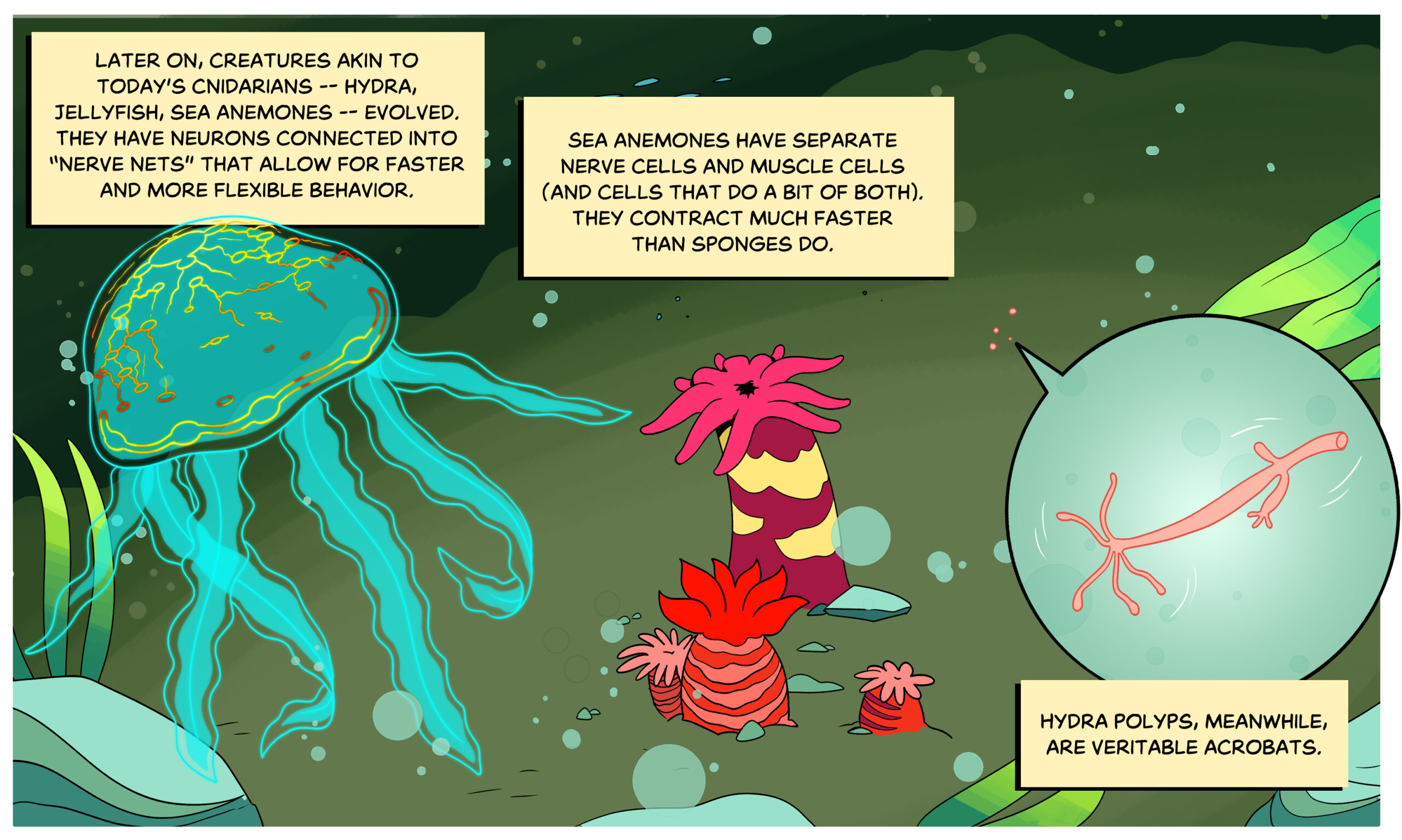
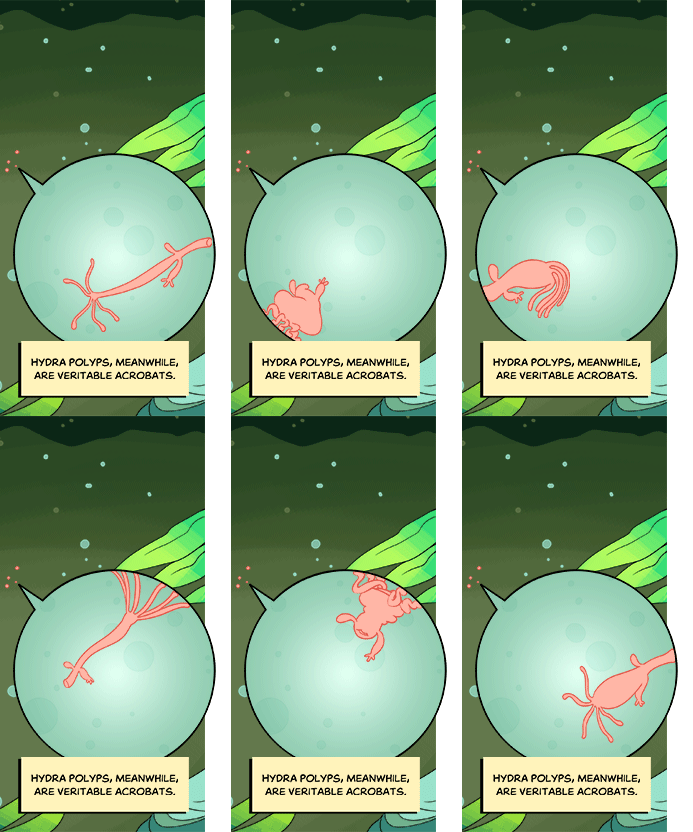
Text: Later on, creatures akin to today’s cnidarians — hydra, jellyfish, sea anemones — evolved. They have neurons connected into “nerve nets” that allow for faster and more flexible behavior. Sea anemones have separate nerve cells and muscle cells (and cells that do a bit of both). They contract much faster than sponges do. Hydra polyps, meanwhile, are veritable acrobats. Illustration: A jellyfish with long flat tendrils floats along the ocean floor. On its body is a glowing network of nerves. Nearby, several red and pink anemones wave their tendrils in the water. : In another microscopic inset, a hydra polyp, which looks like a pink noodle with some long tendrils on one end wiggles and turns.
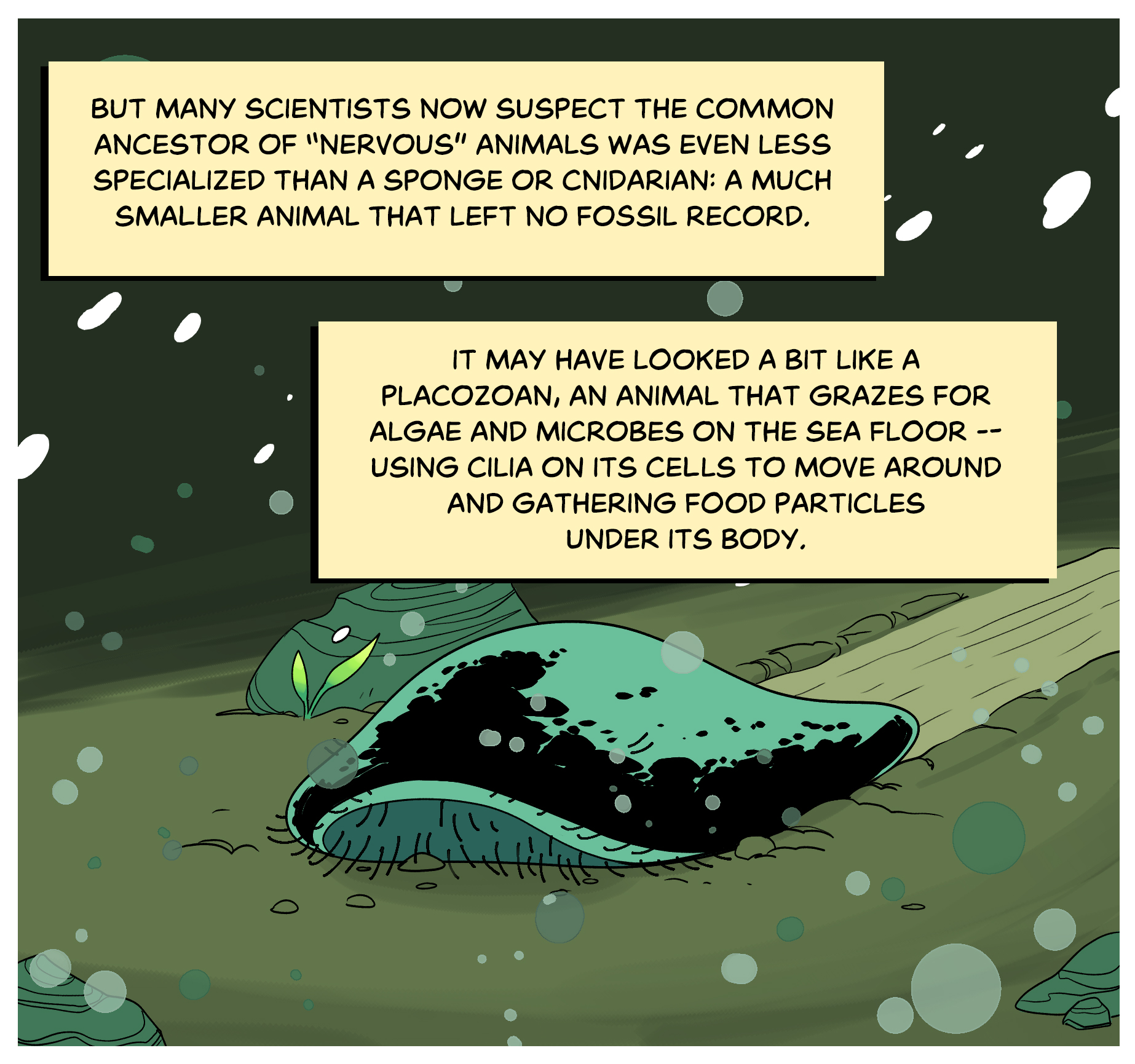
Text: But many scientists now suspect the common ancestor of “nervous” animals was even less specialized than a sponge or cnidarian: a much smaller animal that left no fossil record. It may have looked a bit like a placozoan, an animal that grazes for algae and microbes on the sea floor — using cilia on its cells to move around and gathering food particles under its body. Illustration: A flat featureless mass digs a groove in the soft sea floor as it moves, part of its cilia covered underside can be seen.
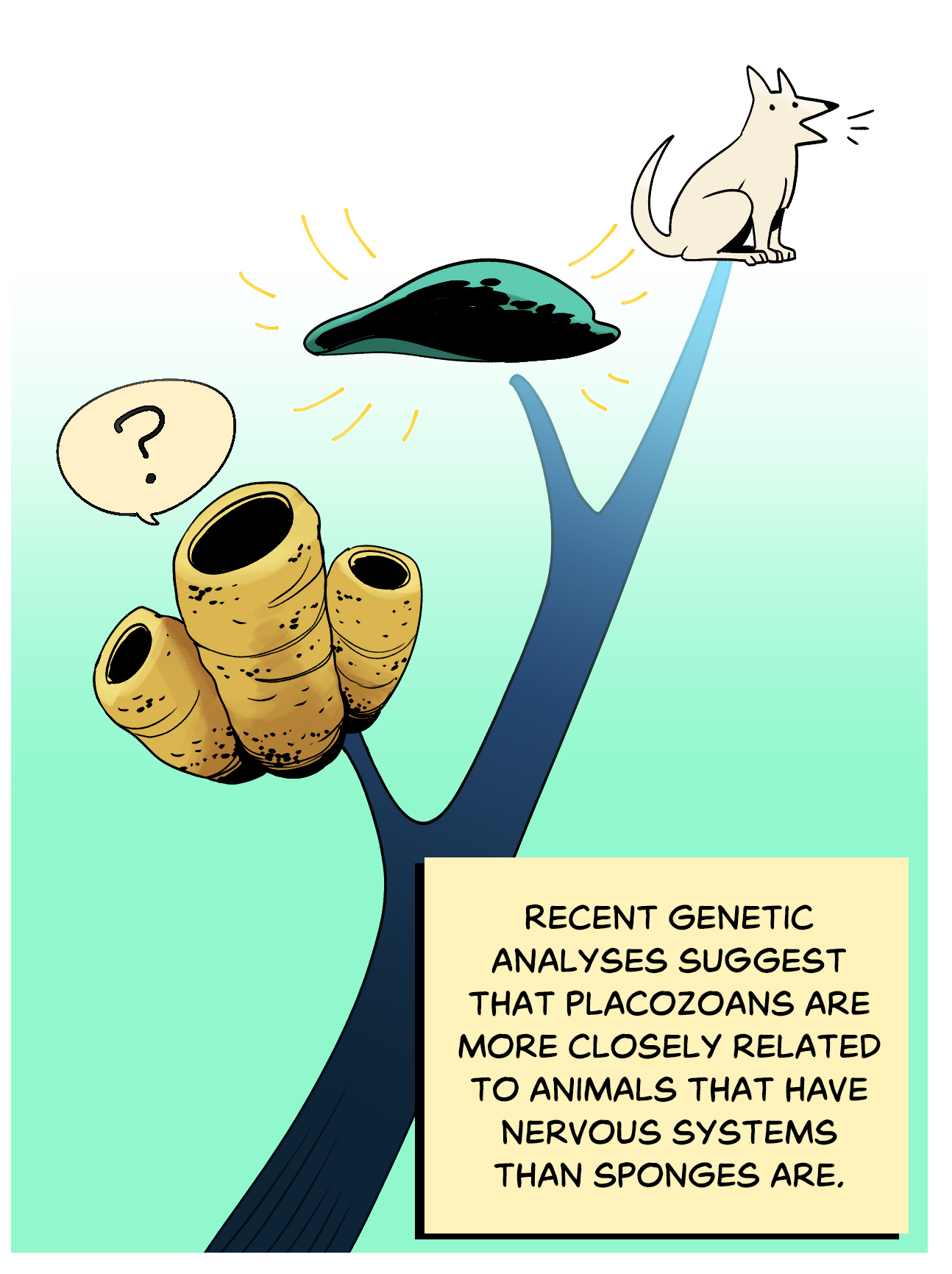
Text: Recent genetic analyses suggest that placozoans are more closely related to animals that have nervous systems than sponges are. Illustration: Another view of that evolutionary branch, but this time that featureless blob sits above a questioning sponge on the tree.
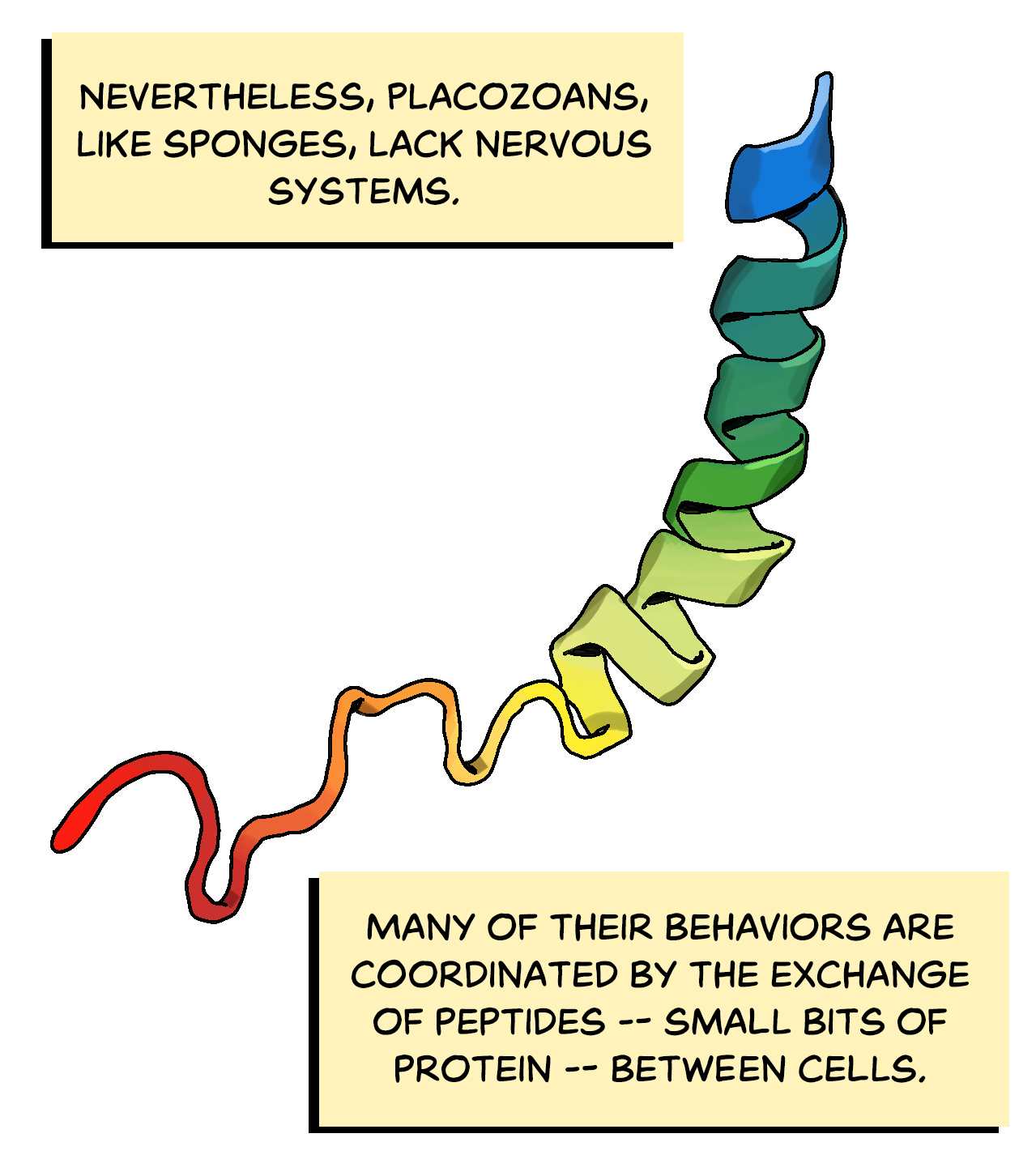
Text: Nevertheless, Placozoans, like sponges, lack nervous systems. Many of their behaviors are coordinated by the exchange of peptides — small bits of protein — between cells. Illustration: A colorful 3D model of a peptide, which looks like a flat ribbon in a tight spiral that tapers off into a windy noodle.
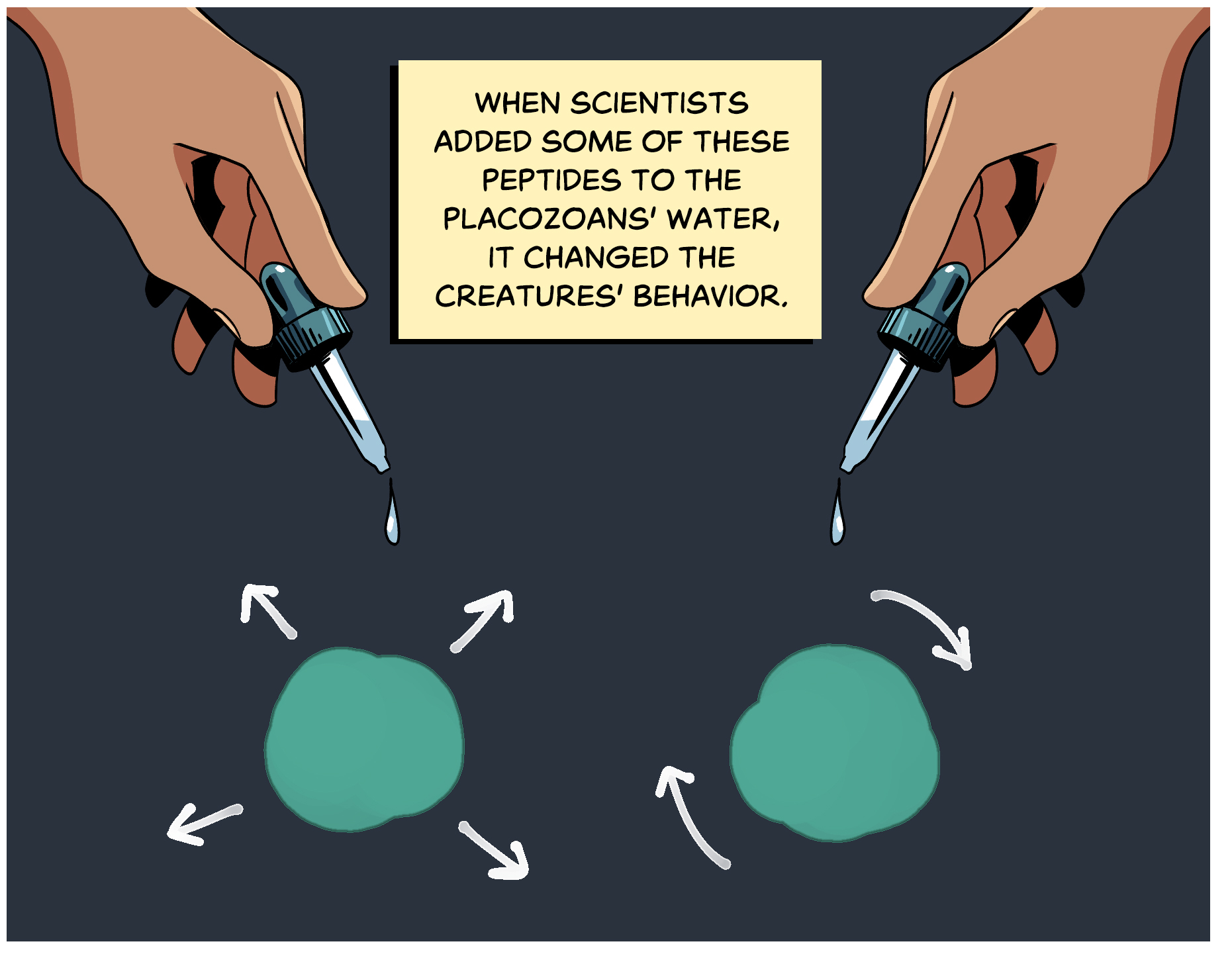
Text: When scientists added some of these peptides to the placozoans’ water, it changed the creatures’ behavior. Illustration: Two hands drop liquid onto two round green placozoans, which expand or spin in response.
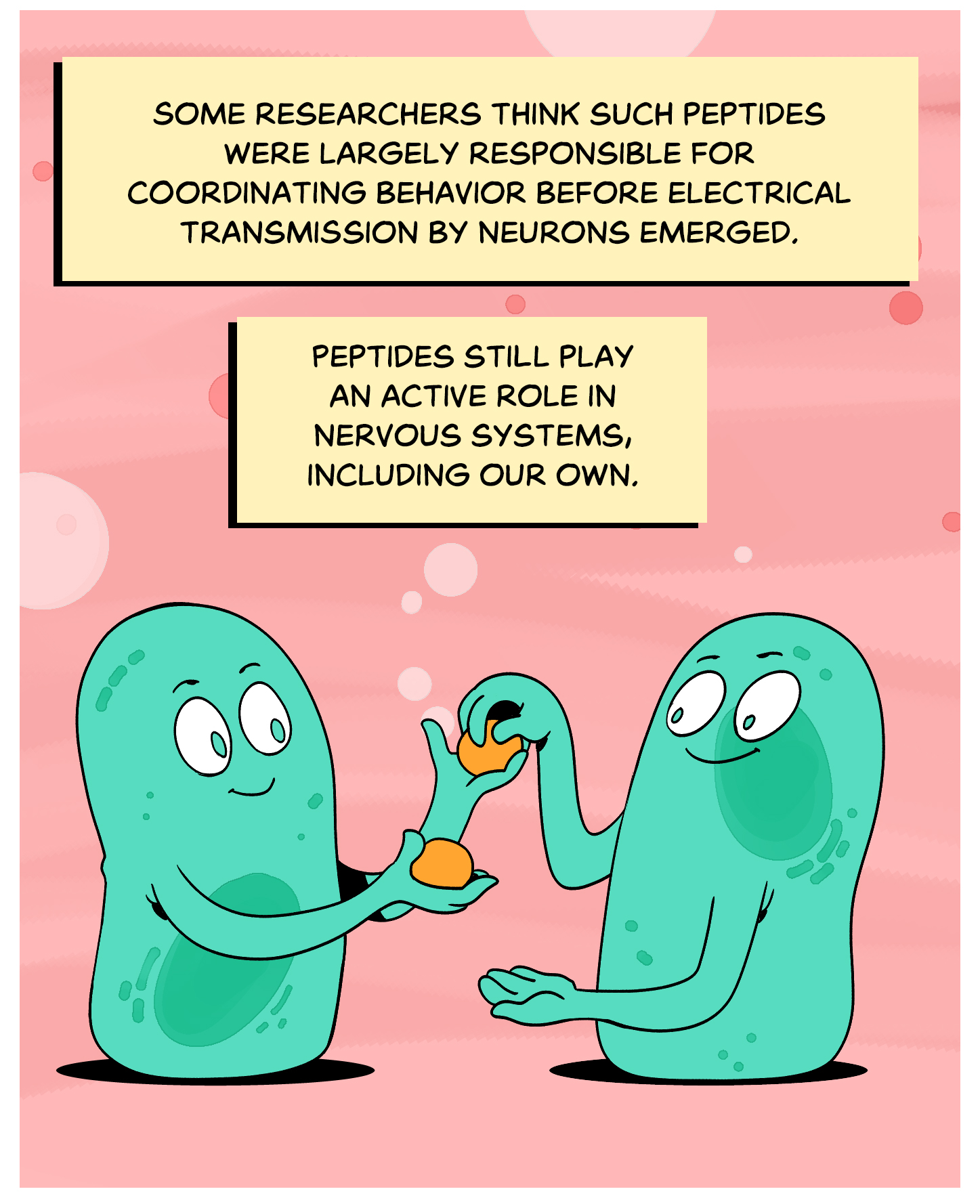
Text: Some researchers think such peptides were largely responsible for coordinating behavior before electrical transmission by neurons emerged. Peptides still play an active role in nervous systems, including our own. Illustration: Two green cells leisurely pass orange balls back and forth to each other.
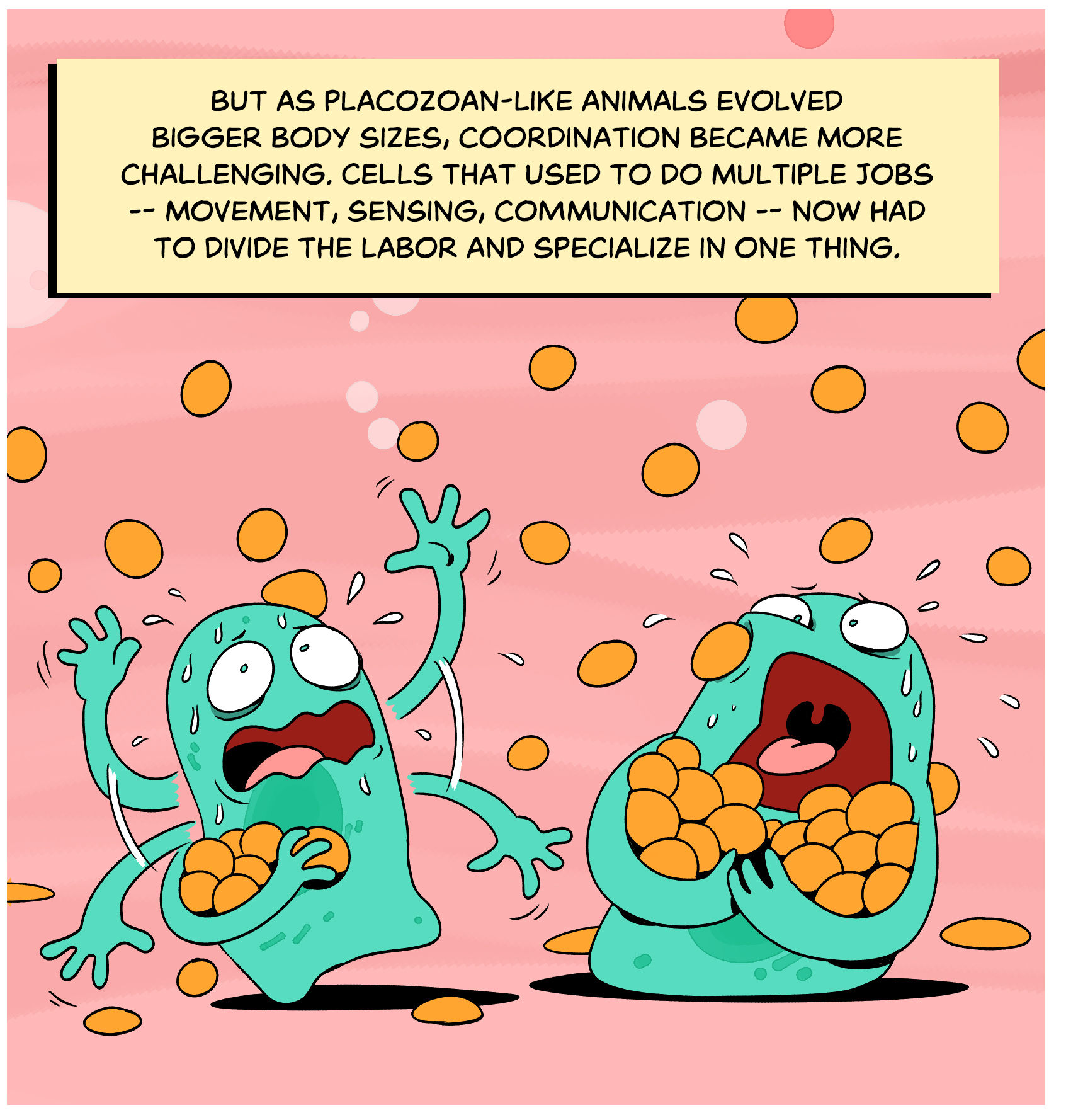
Text: But as placozoan-like animals evolved bigger body sizes, coordination became more challenging. Cells that used to do multiple jobs — movement, sensing, communication — now had to divide the labor and specialize in one thing. Illustration: The same cells, but in total panic with armfuls of orange balls as they struggle to keep up.
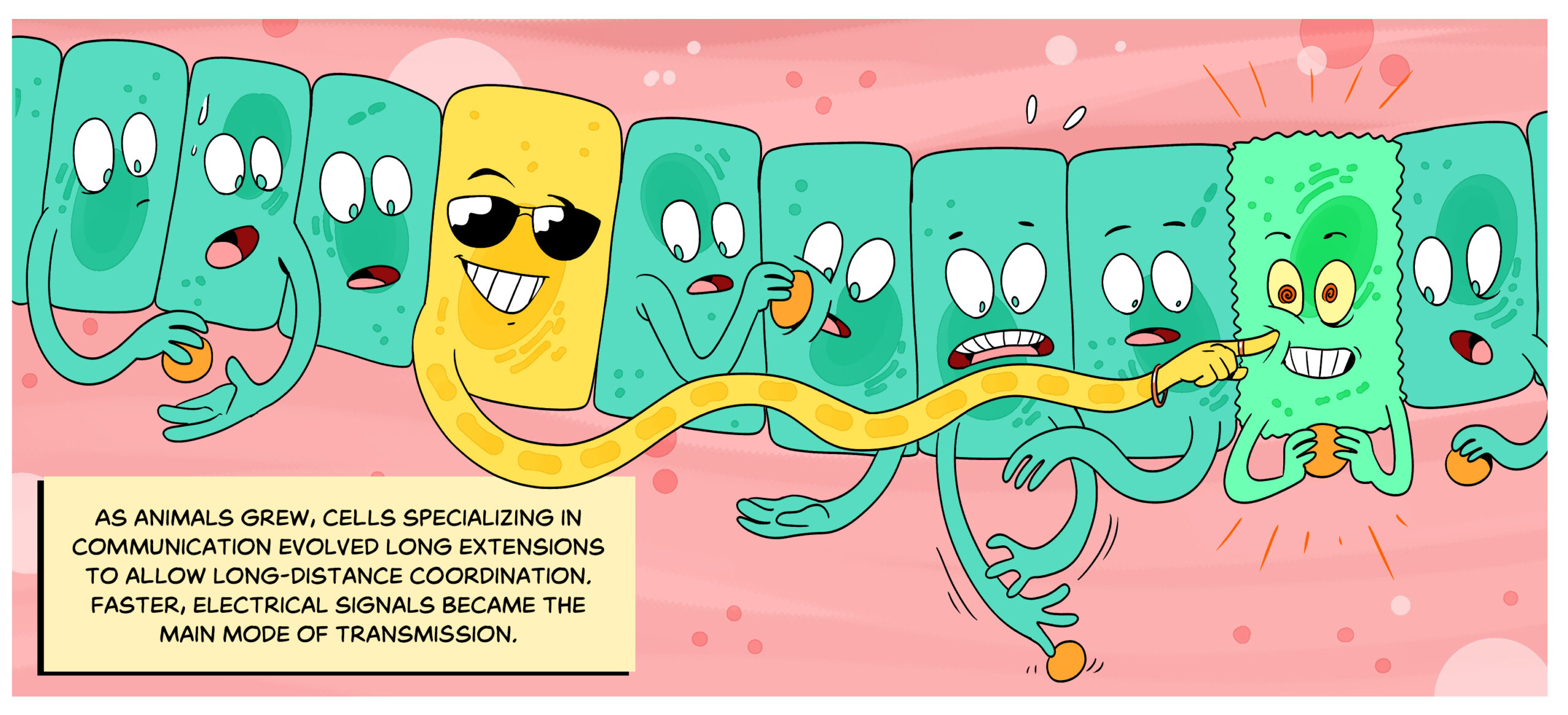
Text: As animals grew, cells specializing in communication evolved long extensions to allow long-distance coordination. Faster, electrical signals became the main mode of transmission. Illustration: A row of green cells side by side in a line passing an orange ball from one to the next. One of the cells — that smug yellow sunglass wearing one —reaches a long arm down the line instead. The arm stretches until it pokes another cells in the cheek, energizing it. The others look on in surprise.
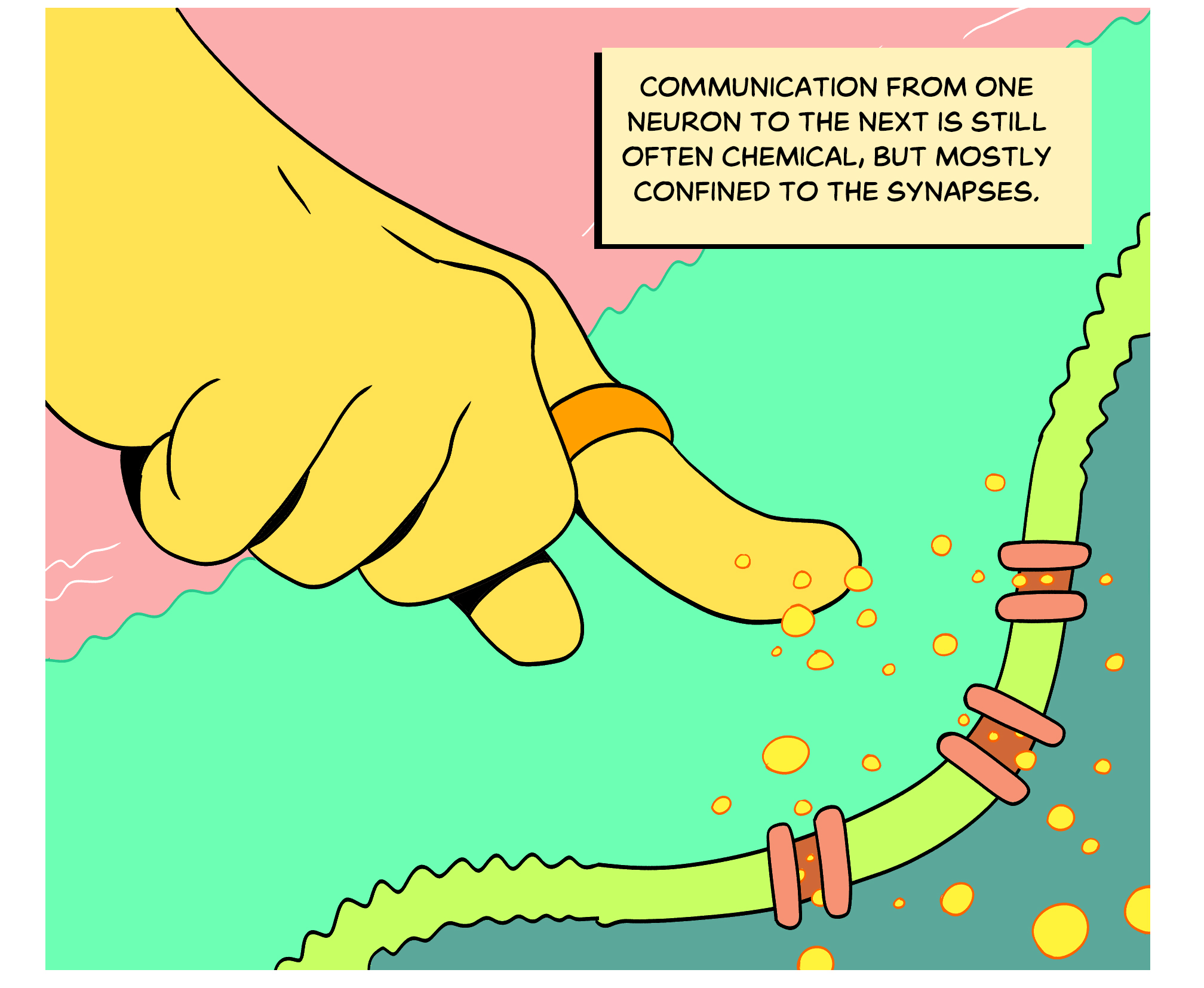
Text: Communication from one neuron to the next is still often chemical, but mostly confined to the synapses. Illustration: A close up of the yellow cell’s finger not quite touching the cell membrane, but sending chemical signals into openings in the cell.
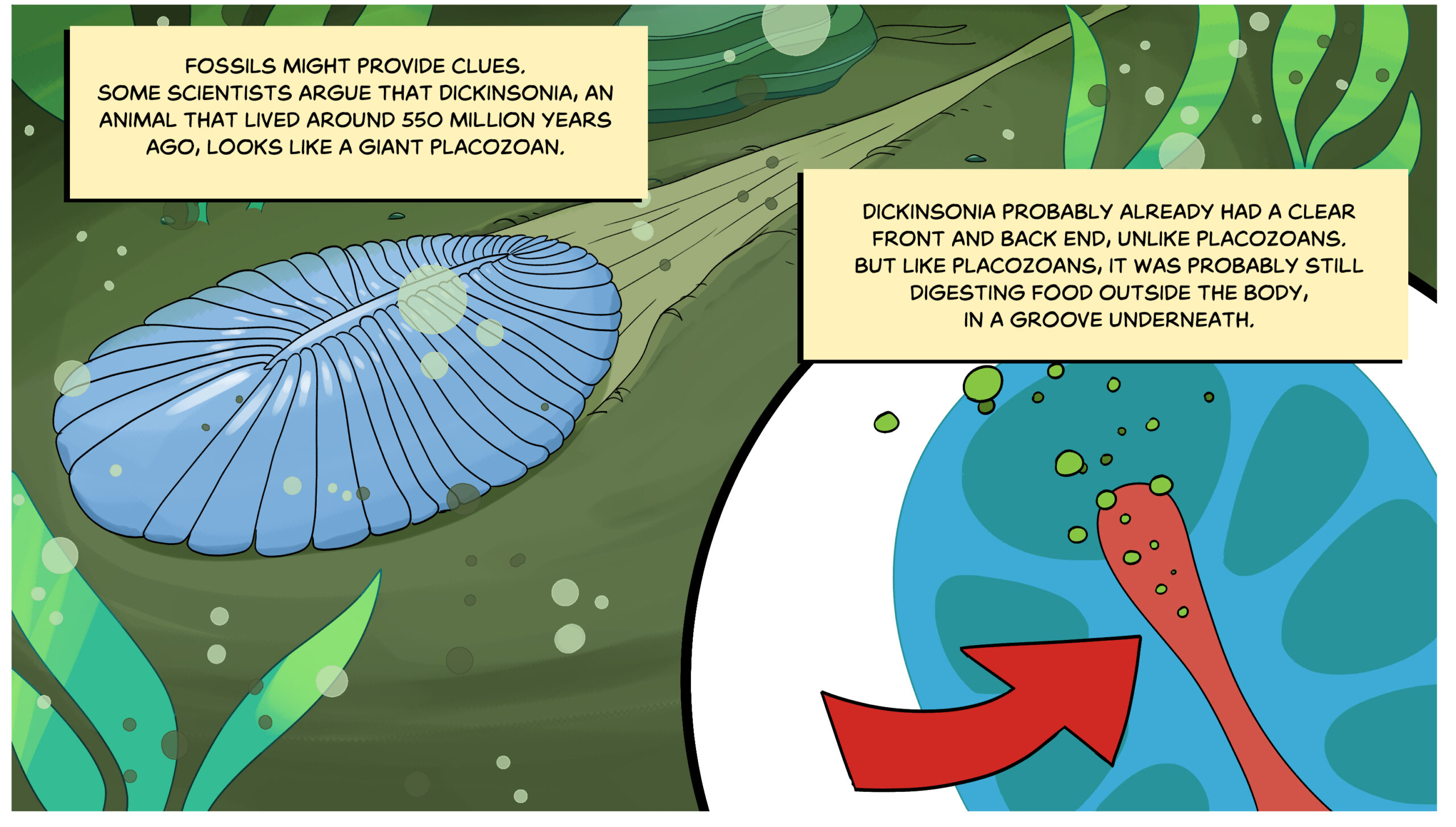
Text: Fossils might provide clues. Some scientists argue that Dickinsonia, an animal that lived around 550 million years ago, looks like a giant placozoan. Dickinsonia probably already had a clear front and back end, unlike placozoans. But like placozoans, it was probably still digesting food outside the body, in a groove underneath. Illustration: Moving along the sea floor similar to the placozoan, this organism has radiating segments originating from a central seam on its back. The underside of the organism, showing a long opening on the bottom that takes in food particles.
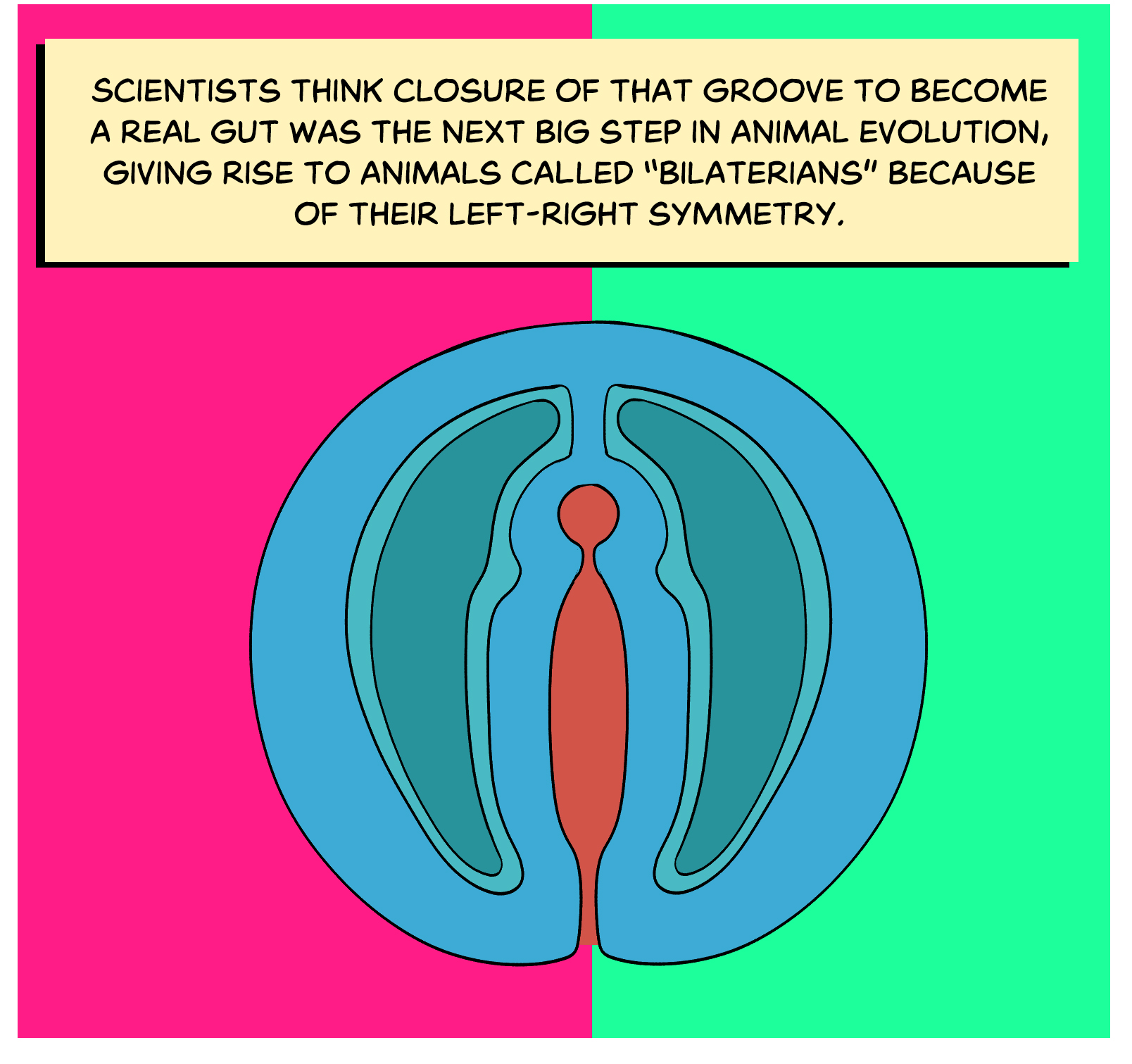
Text: Scientists think closure of that groove to become a real gut was the next big step in animal evolution, giving rise to animals called “bilaterians” because of their left-right symmetry. Illustration: Another view showing the symmetrical form of the organism and how the groove begins to resemble a simple digestive tract with a round opening for a “mouth” and an outlet at the end of the animal.
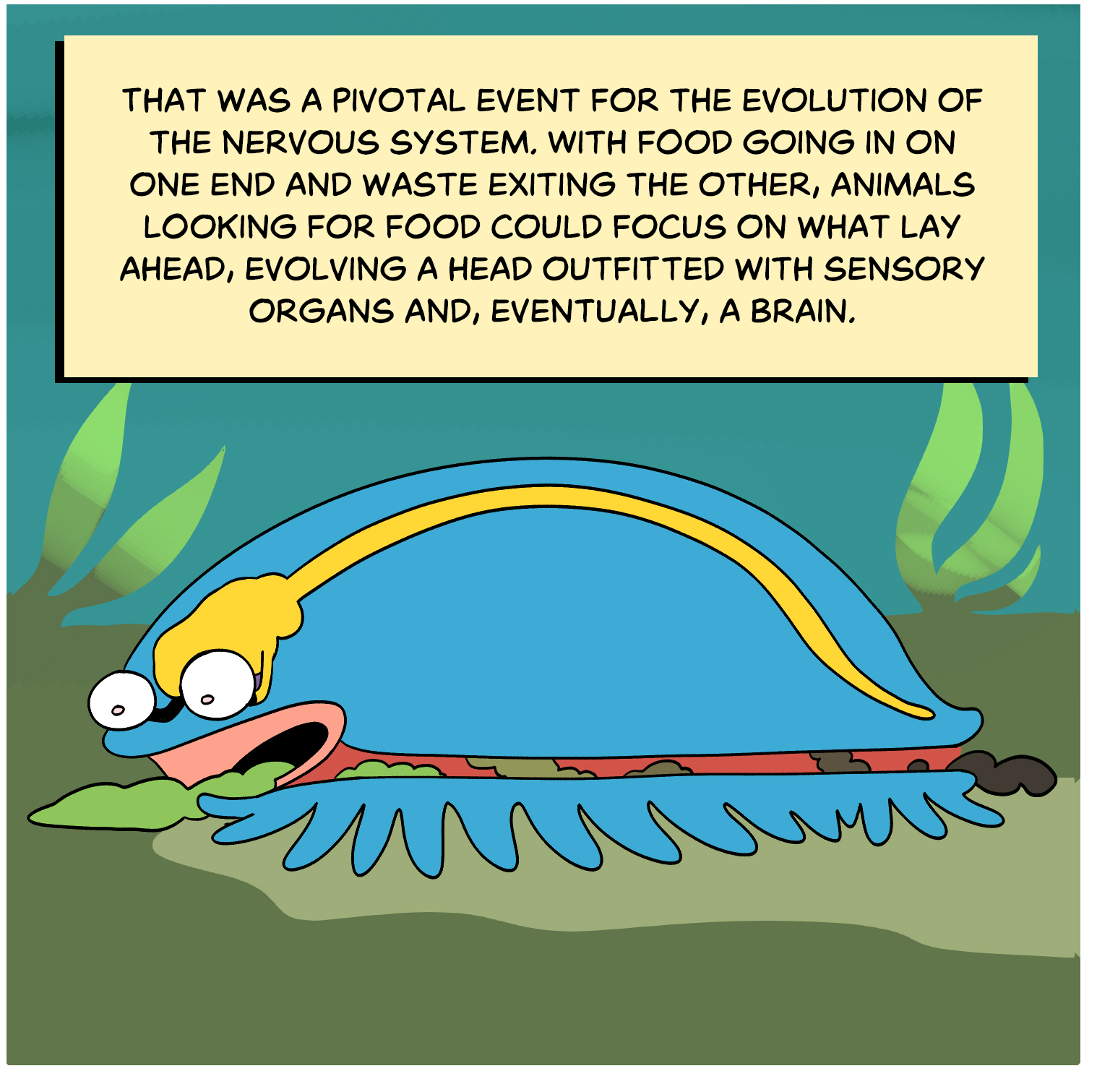
Text: That was a pivotal event for the evolution of the nervous system. With food going in on one end and waste exiting the other, animals looking for food could focus on what lay ahead, evolving a head outfitted with sensory organs and, eventually, a brain. Illustration: The creature seen in cross section, slurping up the sea floor. Its eyes, brain, nerve cord, and gut can be seen.
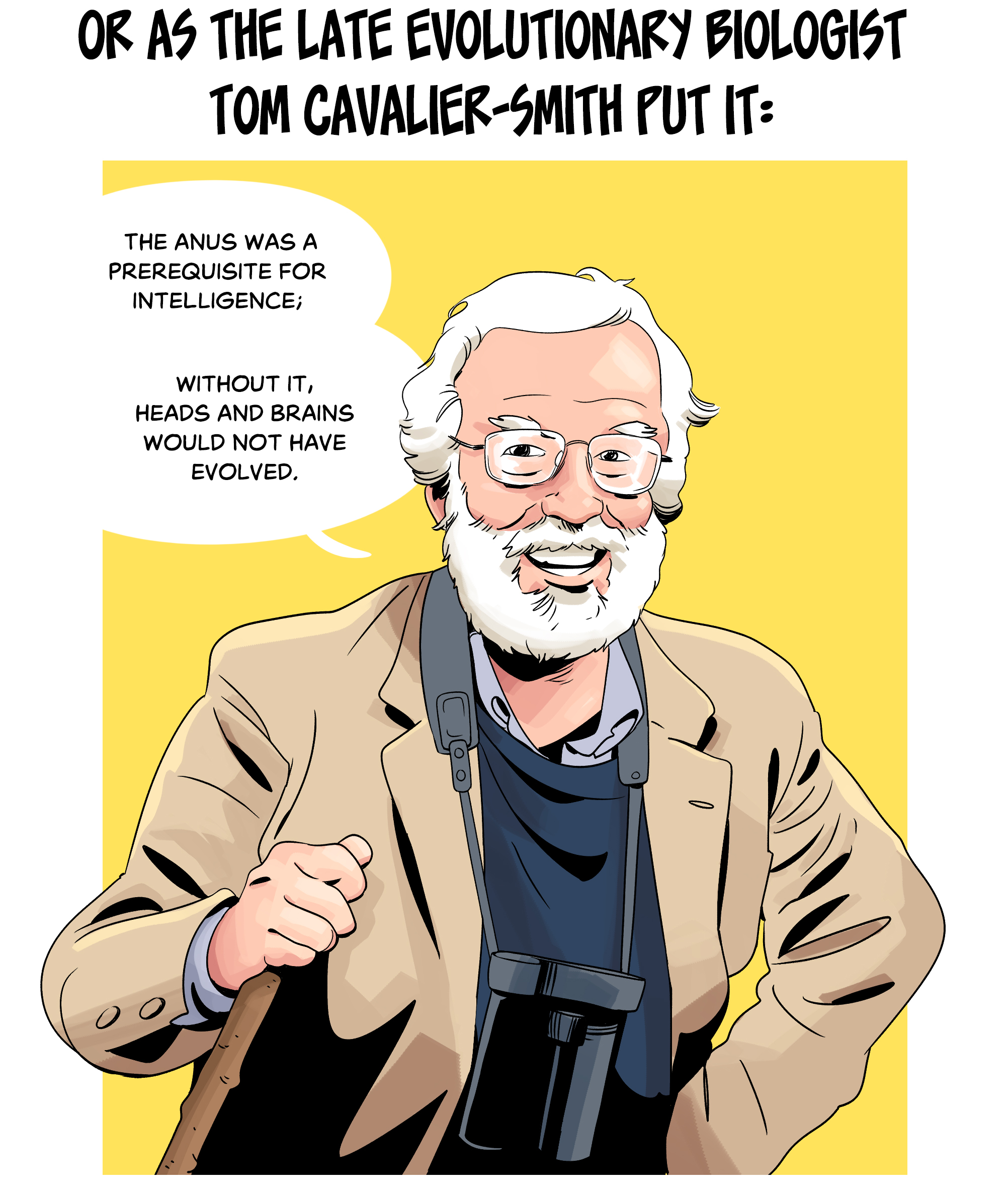
Text: Or as the late evolutionary biologist Tom Cavalier-Smith put it: “The anus was a prerequisite for intelligence; without it, heads and brains would not have evolved.” Illustration: Cavlier-Smith, a joyous old white man with a bushy white beard and glasses, leans on a walking stick. Around his neck hang a pair of binoculars.
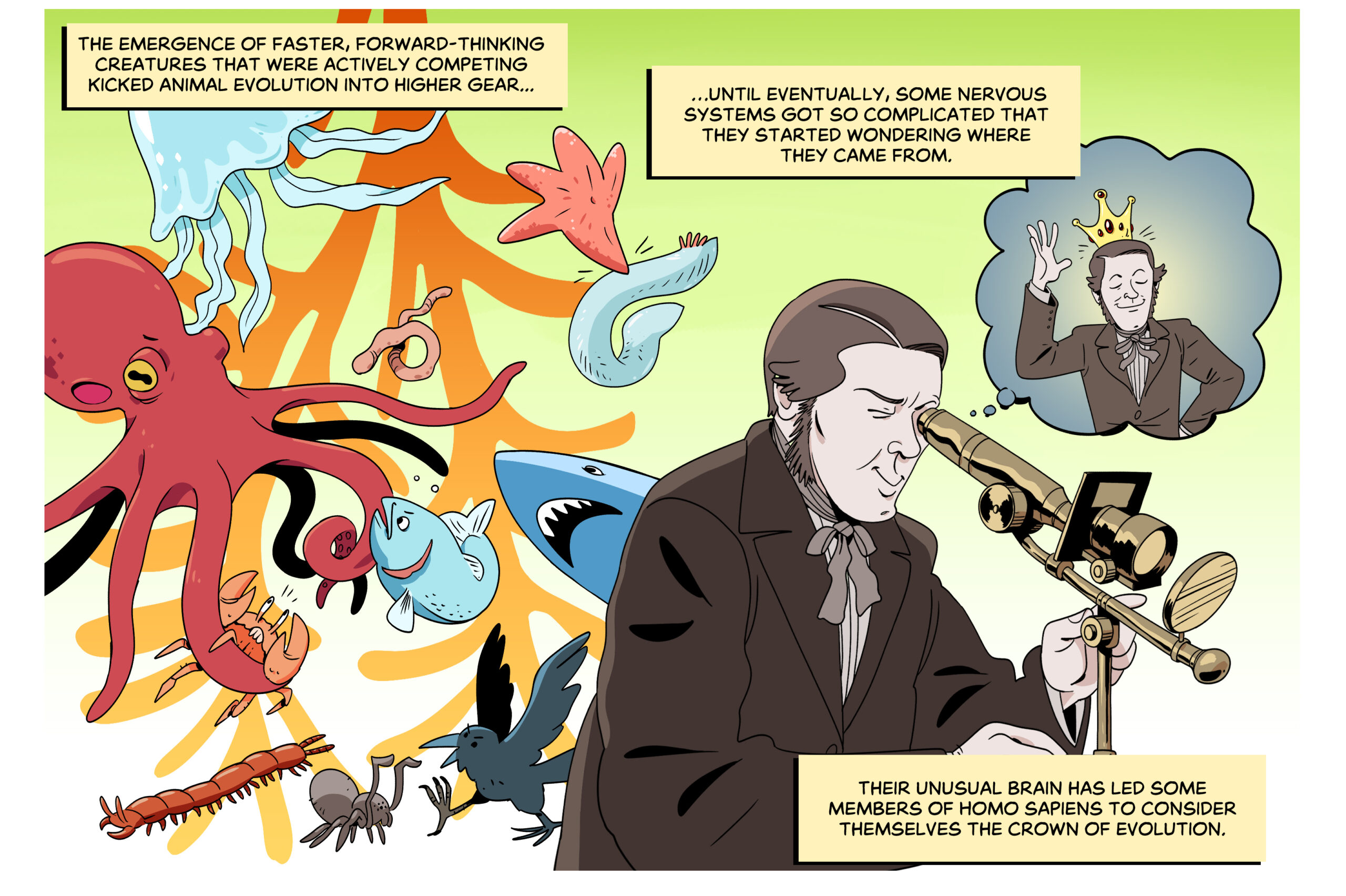
Text: The emergence of faster, forward-thinking creatures that were actively competing kicked animal evolution into higher gear until eventually, some nervous systems got so complicated that they started wondering where they came from. Their unusual brain has led some members of Homo sapiens to consider themselves the crown of evolution. Illustration: An evolutionary tree spreads across the panel. On it various animals from jellies, to octopi, to starfish, sharks, and birds all fight among each other. A sepia toned Victorian man looks through a primitive microscope and imagines himself with crown on his head.
But today, many biologists stress that humans and other primates are just a branch on the tree of life.
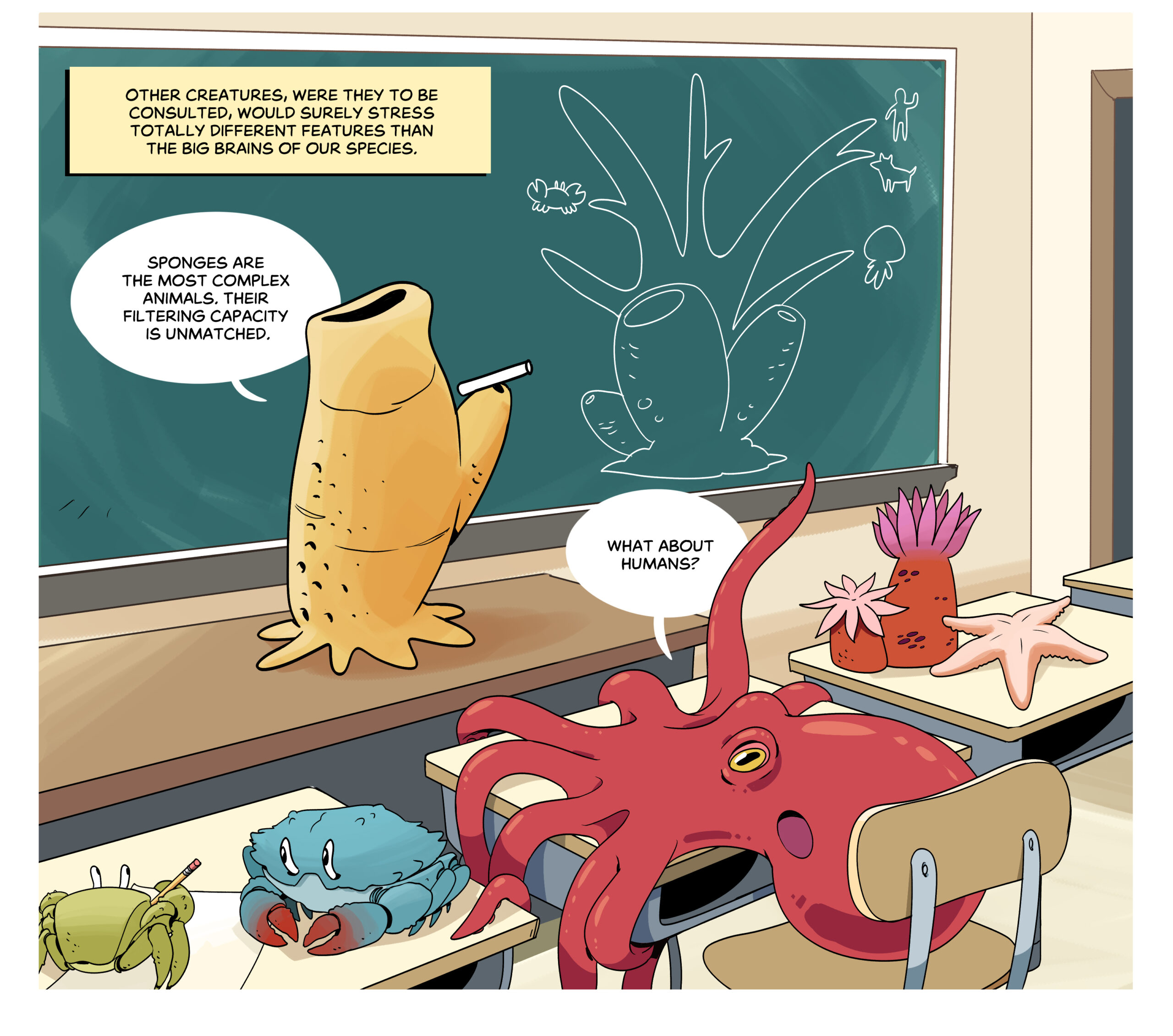
Text: Other creatures, were they to be consulted, would surely stress totally different features than the big brains of our species. Illustration: At the front of a classroom, a sea sponge stands on a desk with a piece of chalk. It has drawn an evolutionary tree with itself at the start in a prominent position, saying “Sponges are the most complex animals. Their filtering capacity is unmatched.” The students comprise of different sea life seen throughout the comic. An octopus raises its tentacle, asking, “What about humans?”
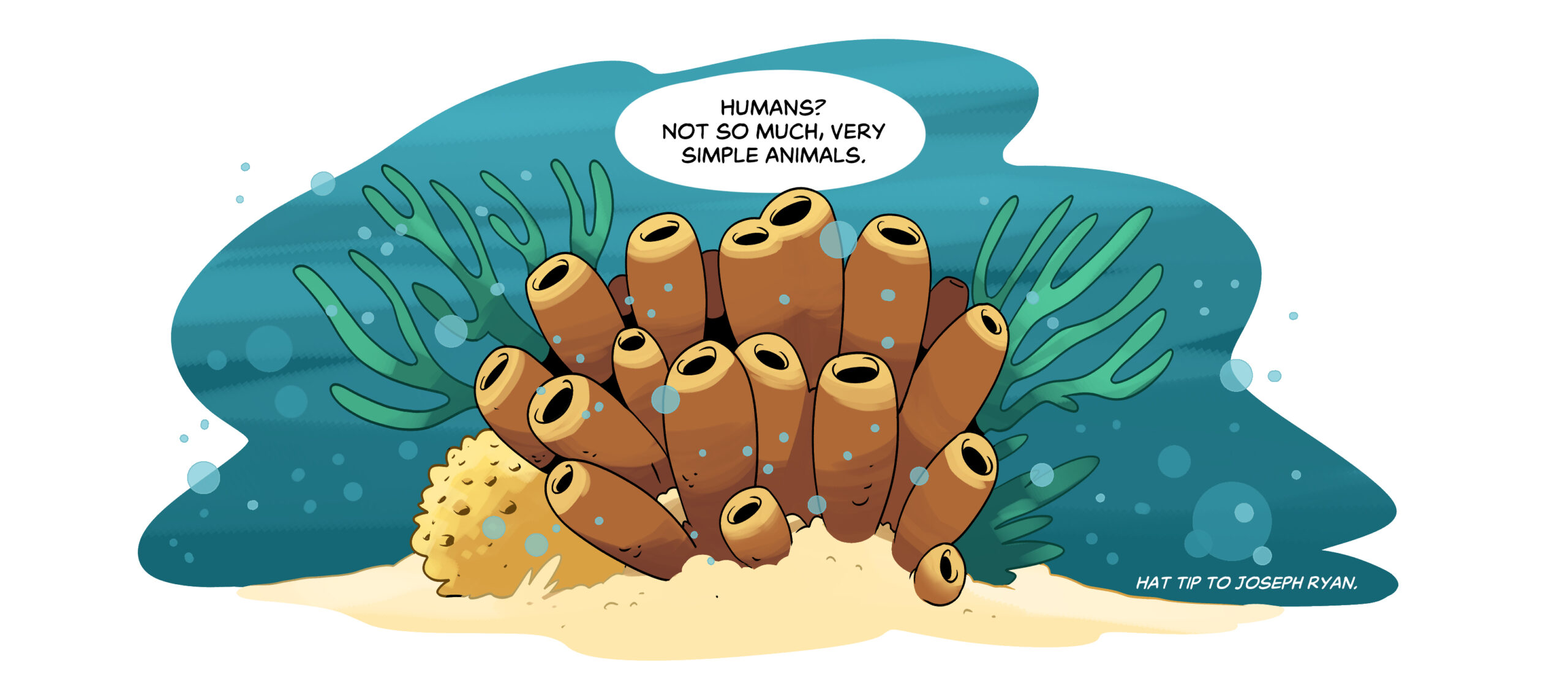
Text: “Humans? Not so much, very simple animals.” Illustration: A scene of a group of yellow sponges, surrounded by colorful coral and warm golden sand. Subtitle: Hat tip to Joseph Ryan.
An animated gif of a hydra polyp bouncing around like a spring on the inside of a microscope viewfinder.

Description

  • Knowable Magazine

  • Getting Nervous

  • 2023

When, why and how did neurons first evolve? Scientists are piecing together the ancient story.

Additional Credits

  • Writer: Tim Vernimmen
  • Editor: Rosie Mestel